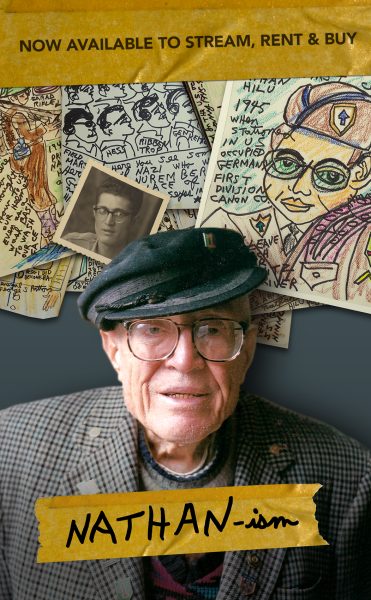

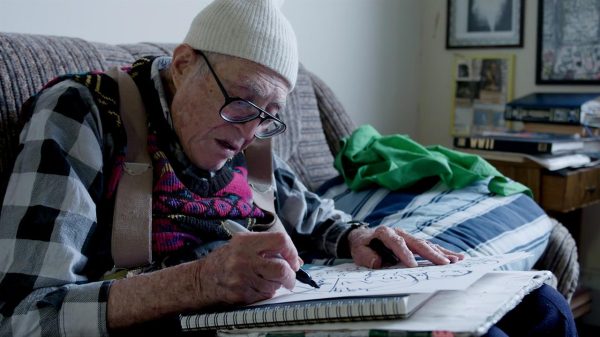
For decades, Nathan Hilu filled sketchbooks with frantic drawings from memory.
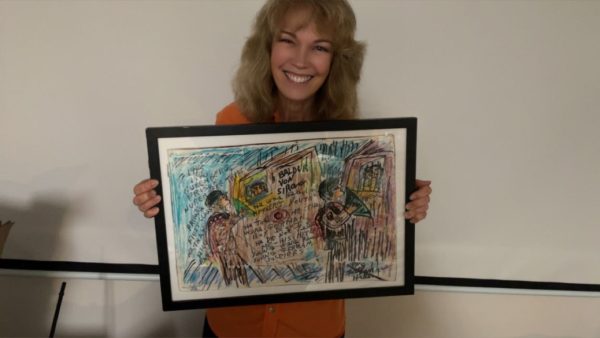
His pages were crowded with handwritten notes, swirls of color, courtroom scenes, military uniforms and repeated images connected to his time as a young Jewish American soldier after World War II. Faces reappeared from page to page. So did courtroom benches, guard towers and Nazi uniforms. Names and phrases spilled into the margins as if he were trying to preserve every detail before it vanished.
Hilu called himself a witness.
To filmmaker Elan Golod, he became something harder to define.
Golod first encountered Hilu through his artwork and the intensely personal world surrounding it. Through his drawings and annotations, Hilu spent decades trying to preserve memories from his time as a Jewish American soldier in postwar Europe.
The deeper Golod went into Nathan’s world, the more emotionally complicated the story became.
That journey eventually became “Nathan-ism,” a documentary that begins as a portrait of an eccentric Jewish artist and slowly evolves into something more fragile and human: a meditation on memory and identity.
Unexpectedly, part of that story would lead to St. Louis.
Enter Lori Berdak Miller
At a certain point during filming, the documentary expanded beyond Nathan’s artwork and recollections.
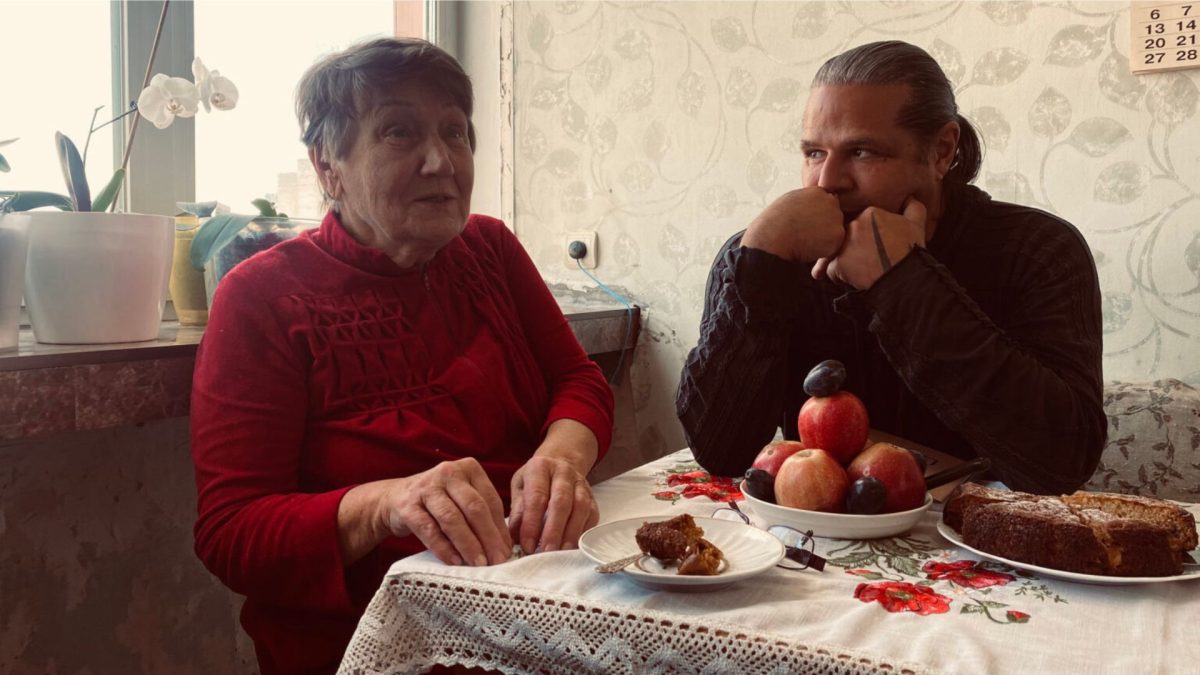
That search led Golod to Lori Berdak Miller, a St. Louis archival researcher who specializes in surviving World War II military records.
“At first, I thought I was just helping provide historical context,” Berdak Miller said.
At the time, she didn’t realize how prominently she would appear in the completed documentary.
Searching the archives
Berdak Miller already understood one major obstacle facing researchers: the devastating 1973 fire at the National Personnel Records Center near St. Louis, which destroyed millions of military personnel files.
But fragments still survive.
“Well, there’s always the microfilm,” Berdak Miller said. “As long as you have somebody’s unit, you can trace them in those units and see where they were.”
Before cameras rolled inside the National Archives facility in north St. Louis County, Berdak Miller had already begun tracing portions of Nathan’s military timeline through surviving “morning reports” and unit records.
“It was exciting,” she said. “When you finally find their name, it’s like, ‘Oh my God, there it is.’”
Memory and identity
What makes “Nathan-ism” unusual is that it never fully settles into a traditional biography or historical documentary.
Instead, the film becomes increasingly interested in the relationship between art, memory and personal identity.
“I became more interested in why these memories mattered so much to him,” Golod said.
That emotional shift surprised Berdak Miller when she finally watched the completed documentary at the St. Louis International Film Festival.
“I hadn’t seen it before that,” she said. “I guess I was kind of like, ‘I guess I’m in this documentary somewhere.’”
Without revealing the film’s emotional turns, “Nathan-ism” gradually moves into deeper questions surrounding storytelling, aging and the ways people preserve personal history.
For Berdak Miller, part of the film’s lasting impact comes from imagining what Jewish American soldiers experienced in the years immediately following the Holocaust.
“It had to have been hard for those Jewish soldiers to be there,” she said. “I just can’t picture what it would have been like.”
A lingering impact
Though Berdak Miller originally joined the project as a researcher, Golod said her presence eventually became an important part of the film’s emotional texture.
Years later, Berdak Miller still thinks about Nathan and his determination to preserve his memories through drawings, annotations and repetition.
“I think people need to continually know that these things happened,” she said.
“Nathan-ism” is currently available to rent or stream on Amazon Prime Video, Tubi and other digital platforms.