
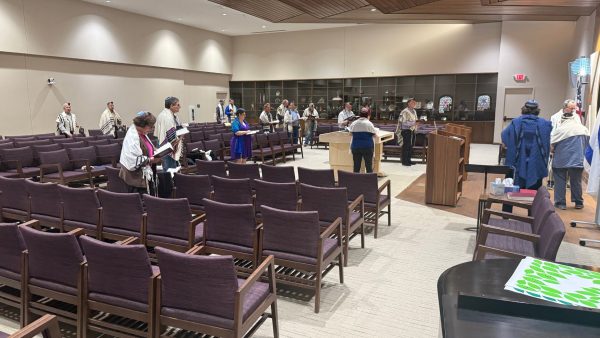
At 7 a.m. on May 7, about 25 people gathered inside Congregation B’nai Amoona’s Guller Chapel for weekday minyan, some wrapped in tallitot and tefillin.
Some came to say Kaddish for loved ones. Others came because Thursday mornings are simply their day to be present. A few would stay afterward for bagels, coffee and conversation before heading to work, doctors appointments or retirement routines.
And increasingly, many of them arrived because of a ping from a WhatsApp group.
Last year, the Creve Coeur congregation launched “Minyan @ B’nai Amoona,” a simple group chat designed to help ensure the synagogue could consistently gather the 10 adults required for traditional Jewish prayer.
ADVERTISEMENT

The idea sounds almost absurdly modern when placed next to one of Judaism’s oldest communal obligations.
But at B’nai Amoona, congregants say it may have helped preserve one of the region’s few remaining egalitarian congregations still holding twice-daily minyanim every day.
“In less than three months, 75 congregants enrolled,” said Sue Rich, one of the organizers behind the effort. “And now about 90% of our minyanim are successfully reaching 10 people.”
Modernizing the call
Instead of calling people one by one, congregants can now send a message to the group asking for help filling a minyan or covering a missed service. Another member can respond and become the ninth or 10th person needed for prayer.
“It’s not Facebook,” Rich said with a laugh. “It’s strictly for assistance.”
For Rabbi Jared Skoff, the WhatsApp group succeeded because it strengthened a culture that already existed inside B’nai Amoona.
“We just needed to mobilize it,” Skoff said of the congregation’s longtime minyan culture.
At B’nai Amoona, congregants often commit themselves to a specific service each week — Monday mornings, Thursday evenings, Sunday mornings — sometimes for decades at a time. The congregation’s grassroots “Minyanaires Club” predates smartphones by generations.
Rabbi Jeffrey Abraham said he had never encountered anything quite like it at previous congregations.
“At B’nai Amoona, people not only choose a day, they say, ‘I’m going to be a Monday morning Minyanaire,’” Abraham said. “And they commit to coming every single week on that day.”
Some congregants have done exactly that for more than 25 years.
The 10th person
But after COVID, the system began to fray. Some longtime participants developed health problems. Others traveled more often. Evening attendance became less predictable.
“There were a couple days a week that we were struggling,” Abraham said.
That’s when synagogue leaders realized the solution might not require reinventing the minyan itself — just modernizing communication around it.
Rick Mazur, who has helped lead minyanim since 1997, said the WhatsApp system also changed something else: the emotional pressure of asking for help.
“When you call someone, and they can’t do it, you made them feel bad,” Mazur said. “If you put it on WhatsApp, it’s totally anonymous. They don’t have to acknowledge they couldn’t do it. We only give them neutral or great. We don’t give them embarrassment.”
For Mazur, the experience has always been about more than attendance numbers.
“It’s a balance of living and dead and memories and simchas and things that are going to be,” he said.
That balance became visible throughout the Thursday morning service.
Some congregants came specifically for yahrzeits. Others attended because this particular weekday gathering had quietly become part of the rhythm of their lives.
“The 10th person is the most important,” said Beverly Chervitz, who regularly leads Thursday morning services. Without that final participant, she explained, the Torah cannot be removed from the Ark and certain prayers cannot be recited.
Somebody still has to show up
Afterward, conversations continued over bagels and coffee while worshippers discussed grandchildren, travel schedules and upcoming services.
The WhatsApp group now helps hold all of it together. It also has enabled individuals who would like to say Kaddish for a family member, but who are unaffiliated with a congregation with a regular minyan to contribute to the success of one that does.
The Congregation welcomes all potential participants. It has staff to help those who would like assistance downloading the WhatsApp app or joining the “Minyan @ B’nai Amoona” group chat.
“Judaism has a phenomenal technology for mourning and loss,” said Dr. David Kantor, a longtime participant in the minyan. “The community is going to take care of the people.”
Ironically, at B’nai Amoona, part of that “technology” now also includes smartphones.
But after spending a Thursday morning inside the chapel, it became clear the app itself is not really the story.
The story is that every notification still depends on somebody deciding to show up.
| RELATED: I lifted the Torah with a bad back—and unexpectedly learned about life balance
ADVERTISEMENT