
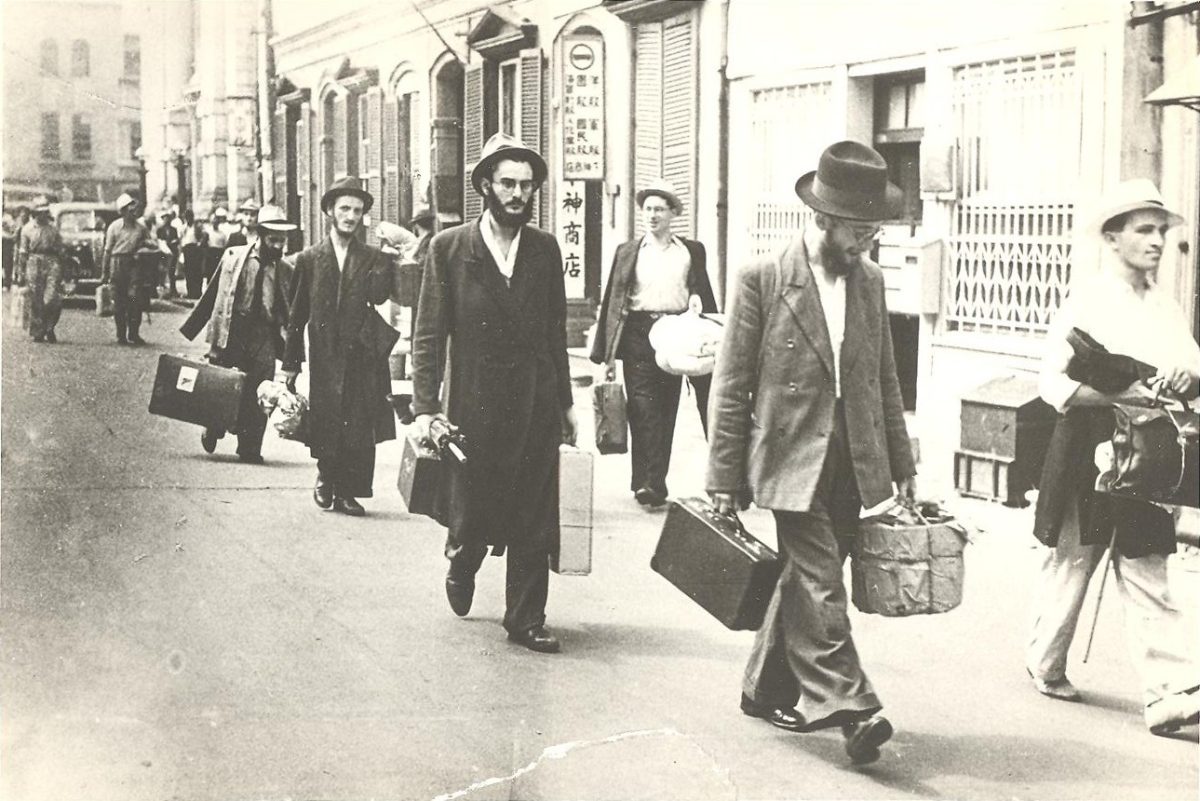
In a black-and-white photograph taken in Kobe, Japan, in August 1940, a group of young Jewish students — refugees carrying everything they owned — walks down a street with suitcases.
Near the center of the image, one of them holds an umbrella.
That man, Rabbi Yosef Landa says, was his father.
The photo first appeared in the Osaka Mainichi newspaper and has since circulated in books and exhibitions about the wartime rescue efforts of Japanese diplomat Chiune Sugihara. The image also appears in the documentary “Sugihara: Conspiracy of Kindness,” which recently screened as a preview to the St. Louis Jewish Film Festival.
For many historians, the image represents one of the most remarkable refugee escapes of World War II.
For Landa, it represents something more personal.
“If my father hadn’t received that visa,” he said, “our family wouldn’t exist.”
A desperate search for escape
Landa’s father, Avraham Tzvi Landa, was among the Jewish refugees fleeing war-torn Poland in 1940
“He was about 20 years old,” Landa said. “Everyone was desperate to get out. Half of Poland was occupied by the Soviets and the other half by the Nazis. Neither of those were good places for Jews.”
At one point during those tense months, Avraham feared he might not receive the documents needed to escape.
A list of students from the Chabad yeshiva had already been submitted to officials working to secure visas from the United States. But Avraham’s name was not on it. He had joined the yeshiva later and worried he might be left behind while his classmates escaped.
So he wrote to Rabbi Yosef Yitzchak Schneersohn, the sixth Lubavitcher Rebbe, who at the time was in New York and actively working to help his students find a way out of Europe.
“He wrote to the Rebbe, you know, ‘What can I do?’” Landa recalled.
The Rebbe’s response was both reassurance and encouragement.
“The Rebbe calms him down and basically says, ‘Don’t worry about the visas,’” Landa said. “He tells him they will do whatever they can to make it happen.”
In the same letter, the Rebbe also offered a blessing that Avraham would live “long, good and illuminating days and years within the tent of Torah.”
Landa said the family still has the original letter.

The visas that opened a path out
At the same time, hundreds of Jewish refugees were lining up outside the Japanese consulate in Kaunas, Lithuania, hoping for a path out of Europe.
The man inside that consulate was Chiune Sugihara. Sugihara, who served as Japan’s consul in Kaunas, asked Tokyo several times for permission to issue transit visas to Jewish refugees and was repeatedly refused.
He issued them anyway.

The documents allowed refugees to travel across the Soviet Union by rail to Vladivostok and then by ship to Japan.
Many of those refugees were young yeshiva students.
According to historians, Sugihara worked nearly around the clock writing visas by hand. Even after he was ordered to leave Lithuania, he reportedly continued signing them at the train station, passing documents through a window as his train pulled away.
Historians estimate Sugihara’s visas ultimately saved tens of thousands of lives as refugees rebuilt families and communities around the world.
A contrast in wartime choices
While Sugihara was quietly opening a path out of Europe, other officials were closing doors.
One of them was Breckinridge Long, a St. Louis-born diplomat who served as assistant secretary of state and played a central role in restricting refugee visas during the war.
Historians have long criticized Long for policies that slowed Jewish immigration to the United States even as news of Nazi persecution spread.

From Lithuania to Japan
For the students who escaped, the journey was only the beginning.
After traveling across Russia on the Trans-Siberian Railway, many arrived in Kobe before being relocated to Japanese-occupied Shanghai, where they spent the war years studying and rebuilding their lives.
Landa said his father rarely spoke about those experiences when his children were young.
“I didn’t really understand the story until my early teens,” he said. “My parents didn’t want to traumatize us with what they had gone through.”
The family’s losses were immense. Most of his father’s relatives were murdered in the Holocaust. His mother survived Auschwitz and Bergen-Belsen.
“They came to America with nothing,” he said. “But we had a loving home. They were not broken people.”
A quiet life in America
After the war ended, Avraham arrived in San Francisco in 1946 before settling in Brooklyn.
There, he spent many years teaching second grade.
“He was an extremely patient man,” Landa recalled. “Perfect for second graders.”
Students who passed through his classroom likely had no idea that their quiet teacher had once crossed a continent and an ocean as a refugee.
From rescue to community
For Landa, the story of Sugihara’s visas is not only about survival. It is also about the moral choices individuals make.
“We teach the horrors of the Holocaust,” he said. “But we should also teach about the goodness — the people who stood up and did the right thing.”
Decades later, that chain of survival would reach St. Louis.
Rabbi Yosef Landa eventually moved here to lead Chabad of Greater St. Louis, helping expand Jewish life across the region. The community he serves today — its synagogues, schools and families — traces part of its story back to those desperate days in 1940 when refugees lined up outside a Japanese consulate seeking a path out of Europe.
When Landa looks at the photograph of his father walking through Kobe with an umbrella and a suitcase, he doesn’t just see history.
He sees the moment his family’s future began.