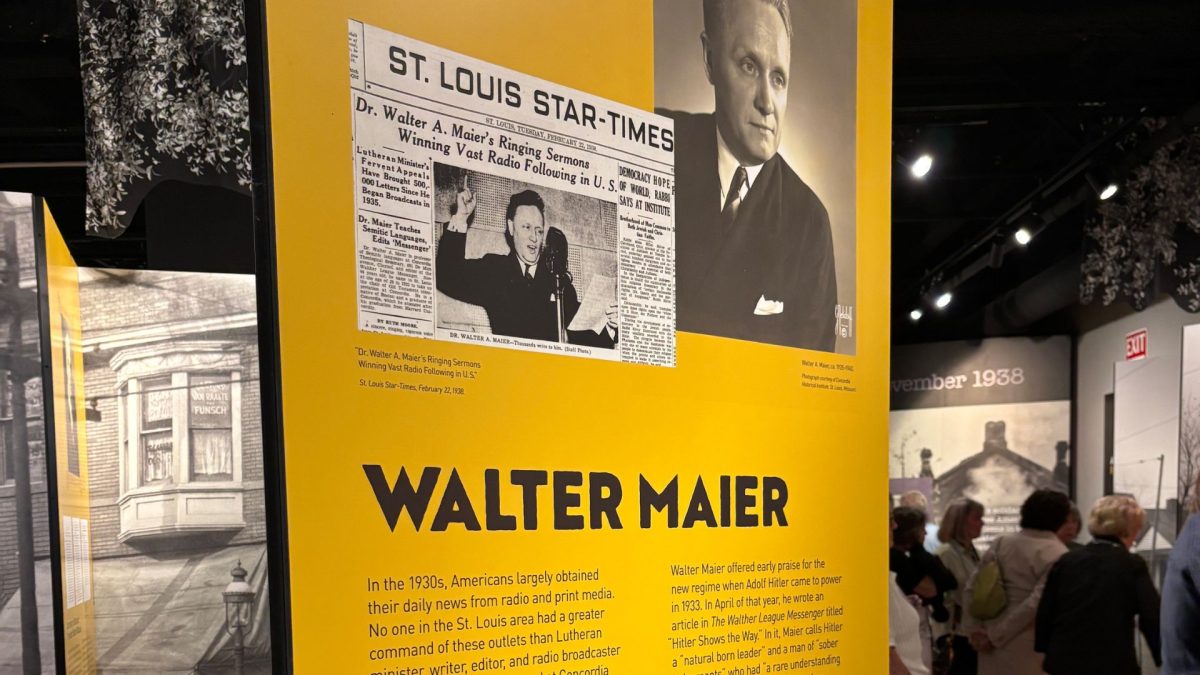


This story starts with a lecture at the St. Louis Kaplan Feldman Holocaust Museum.
Two weeks ago, Kent Hirschfelder was in the audience as David Marwell discussed his book, “Mengele: Unmasking the Angel of Death,” and his experience investigating Nazi war criminals for the U.S. Department of Justice. At one point, Marwell mentioned that Josef Mengele had attended medical school at the University of Munich in 1930.
Hirschfelder’s head snapped up.
“Well, the hair, what little I have, stood up on my head,” he said. “Because that’s where my father also was. Same school. Same year.”
Hirschfelder, a longtime volunteer tour guide and speaker at the museum, was quick to act. When he got home that night, he began digging.
His father, Dr. Max Hirschfelder, was born in 1910 and studied medicine in Munich in the early 1930s. He would later flee Nazi Germany, continue his training in Chicago and practice ophthalmology for more than 50 years in Centralia, Ill.
But that night, Hirschfelder was focused on one detail: 1930.
He checked birth year’s first — 1911 for Mengele, 1910 for his father.
“My next task was to email several friends of mine in Munich,” Hirschfelder said, including a retired physician and an archivist who has helped him access university and city records in the past.
Within 24 hours, the 1930 University of Munich medical school roster was in his inbox.

There, on the page, were two names.
Max M. Hirschfelder.

And Joseph M. Mengele.

A document from 1930
“I had no previous knowledge about this,” Hirschfelder said. “No reason to have made any inquiry.”
The document does not indicate whether the two men knew each other, shared classes or had any personal interaction. Hirschfelder doubts they did.
“I think the Jewish students stayed pretty much apart from the gentiles,” he said. “My guess is that they were not pledge brothers at ZBT.”
In 1930, neither name carried the weight history would later assign. Mengele would continue his studies, join the Nazi Party and later serve at Auschwitz, where he conducted lethal medical experiments.
Dr. Max Hirschfelder’s path moved in a different direction.
From Munich to Illinois
By 1935, Max Hirschfelder had been stripped of his German citizenship, a fact documented in contemporary newspaper notices that the family still has. In 1936, he emigrated to the United States where he continued his medical training in Chicago and eventually settled in Centralia, where he practiced for decades.

His mother remained in Germany until 1941. The family has little information about how she survived during those years or who helped arrange her escape.
“There are Jewish doctors who for various reasons didn’t leave,” Hirschfelder said. “They ended up in the death camps. Dad had family already in the U.S., so he had the necessary sponsorship that allowed him to get a visa.”
What we remember
Seeing the two names on the same roster does not change how Hirschfelder views his father.
“His choices were limited,” he said. “This really doesn’t change how I see his story.”
Still, the document was hard to forget.
“I doubt they knew each other,” he said. “But seeing Dad’s name and Mengele’s in the same document was indeed chilling.”
For Hirschfelder, who has been researching his family history since the early 1990s and frequently speaks at the museum, the moment underscored something else — a personal regret.

“Dad really didn’t speak much about medical school or what was happening in Munich and Germany during the late 1920s and early ’30s,” he said. “One of my regrets is that I never ‘interviewed’ him, or had my kids do it, to get more specific information.”
Now, when he speaks to students, he urges them to ask questions while they still can.
“Learn about your family history,” he said. “Family photo albums, medals from Vietnam, a family Bible with names of relatives, maybe the local historical society has information about a family member or a business they were involved in.”
Carrying on
At the end of his museum presentations, Hirschfelder shows a final slide with a question:
What happens when we forget to remember?
In 1930, two young medical students appeared on the same University of Munich roster, a reminder that history does not announce itself in real time. History had yet to reveal which path each would take.