
I’ll be honest. When I first read the announcement for the St. Louis Kaplan Feldman Holocaust Museum’s next exhibition, one focused on the incarceration of Japanese Americans during World War II, I paused.
Japanese American incarceration? At the Holocaust Museum?
What the exhibition shows
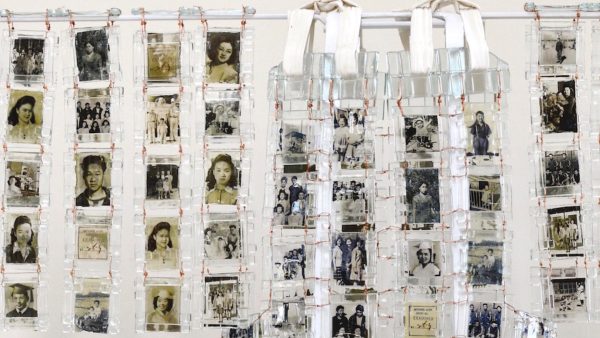
Opening Jan. 17, “Resilience – A Sansei Sense of Legacy” brings together contemporary works by eight third generation Japanese American artists, using sculpture, photography and mixed media to explore how the incarceration of Japanese Americans during World War II continues to echo through families decades later.
That story begins in 1942. After the bombing of Pearl Harbor, President Franklin D. Roosevelt signed Executive Order 9066, which ordered the forced removal of more than 120,000 people of Japanese descent from the West Coast. Many were American citizens. Families were incarcerated in remote camps as far east as Arkansas, losing their civil rights, their homes and their livelihoods along the way.
ADVERTISEMENT

“They lost their civil rights and their livelihoods,” said Myron Freedman, executive director of the Museum. “The ‘Resilience’ exhibit pays homage to those who endured those years, while also shining a light on the dangers of public policy being influenced by wartime hysteria and prejudice.”
Context before the art
Like many readers, I knew the outline of this history but not much beyond it. The museum is assuming visitors may feel the same way. That’s why the exhibition includes contextual panels explaining what transpired in the 1940s before visitors encounter the artwork itself.
“This exhibition is a powerful reminder of how easily fear can override justice and how quickly a democracy can abandon its own principles when people are dehumanized as the ‘other,’” Freedman said. “This story is not just about the past. It is a warning that remains urgently relevant.”
Gaman and endurance
Running throughout the exhibition is a concept many visitors may be encountering for the first time: Gaman.
Freedman describes Gaman as a shared ethos of endurance and quiet dignity deeply rooted in Japanese culture. During incarceration, it became a way to survive injustice without outward resistance.
That idea appears repeatedly in the artwork. One installation features a hanging sculpture made from 10,000 numbered ID tags, representing prisoners held in a single camp. Another uses three tattered, burned kimonos to symbolize how Japanese cultural identity itself was damaged through incarceration.
“Artworks in this show illustrate how Gaman was necessary for the incarcerated in powerful ways,” Freedman said.
Why this museum
What also stood out to me is who is telling this story. The exhibition centers on Sansei artists, third generation Japanese Americans whose parents or grandparents lived through the camps.
For those who were incarcerated, Freedman said, talking openly about those years was often not an option. Many carried internalized shame and focused on rebuilding their lives rather than revisiting trauma.
“Today’s generation of Japanese Americans are able to denounce the incarceration and reclaim pride in our heritage in a way that was not possible before,” he said.
That generational distance allows artists to reflect, question and contextualize what their families endured without erasing the pain. Their work explores trauma, but also silence, memory and what gets passed down when stories go untold.
So why does this exhibition belong at a Holocaust Museum?
For Freedman, the answer comes back to the institution’s mission.
“The Holocaust Museum exists to ensure that the mandate of ‘never forget’ is not confined to a single history, but understood as a universal moral responsibility,” he said. “This exhibition reveals how dehumanization, whether in Nazi Europe or the United States, leads to devastating injustice.”
Seen that way, “Resilience” is not a departure from the museum’s work. It is an extension of it. A reminder that fear does not stay contained to one moment or one community.
And that initial pause? That’s where the conversation begins.
Know before you go
What: “Resilience – A Sansei Sense of Legacy,”
When: Jan. 17 to April 4
Opening day: Saturday, Jan. 17, with cultural demonstrations including ikebana, origami and a traditional Japanese tea ceremony
Where: St. Louis Kaplan Feldman Holocaust Museum, 36 Millstone Campus Drive
Tickets: Admission to the exhibition is free, but tickets are available through the museum’s website.
| RELATED: Mensch’s Through History: Chiune Sugihara, the Japanese Oskar Schindler