
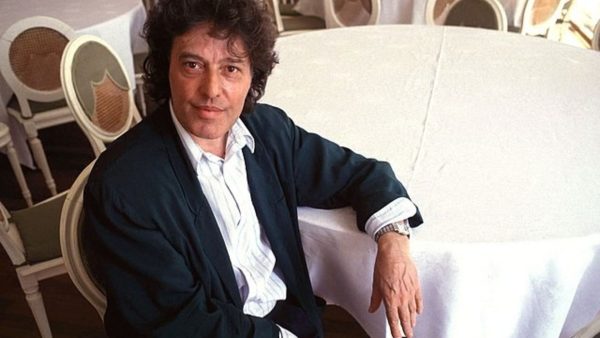
In Sir Tom Stoppard’s “Leopoldstadt,” a character muses: “A Jew can be a great composer. He can be the toast of the town. But he can’t not be a Jew.”
The play, which bears witness to the lives of an Austrian Jewish family before, during and after the Holocaust, examines the tension between the family’s Jewish and Austrian identities over the course of several decades.
For most of Stoppard’s life, he considered his own identity that of an Englishman and playwright. His Jewish heritage was tucked away, only to be rediscovered late in life, leading to a multidecade odyssey of self-discovery resulting in the creation of “Leopoldstadt.”
“Leopoldstadt” was Stoppard’s final work, but it was not his most famous. His stage and screen career spanned multiple decades. The playwright’s masterpiece, “Rosencrantz and Guildenstern are Dead,” an absurdist spin-off of Hamlet, premiered in 1966 and won four Tony Awards. It was adapted into a 1990 film, written and directed by Stoppard, starring Gary Oldman, Tim Roth and Richard Dreyfuss.
However, Stoppard is perhaps best known by contemporary audiences for writing the screenplay for “Shakespeare in Love,” for which he won an Oscar.
Waiting in the wings of Stoppard’s successful career were doubts and questions about his origins. He was under 2 years old when the family fled Czechoslovakia in 1939 for Singapore on a journey that eventually led him to England. It wasn’t until middle age that Stoppard discovered the extent of his family’s experience in the Holocaust.
ADVERTISEMENT

His journey of self-discovery began in the 1970s when Stoppard asked his mother to begin writing down her memoirs. Years earlier, Stoppard had on occasion asked his mother about the family’s Jewish heritage. She was vague, short in her responses.
Bobby Stoppard’s resistance to her son’s earlier questions was perhaps due less to disinterest than to trauma. As Stoppard would find out over the course of several decades, most of his mother’s family was murdered during the Holocaust. In her memoirs, she remarked on her decision to “draw a blind over my past life” once arriving in England, deciding never to discuss the family’s life in Czechoslovakia with Tom or his brother Peter, probably in an attempt to shield herself from the pain of loss.
Through his mother’s memoirs, Stoppard began to discover the full extent of his family’s Jewish heritage and the devastation wrought on his extended family by the Nazis and their collaborators.
His journey reached an apex during a conversation with a cousin, Sarka, in 1993. He recalls the following conversation after Sarka drew him a family tree.
“What happened to Wilma?”
“She died in Auschwitz.”
“Berta?”
“Auschwitz.”
“Anny?”
“She died in a different camp. I don’t know where.”
“Ota?”
“He survived.”
This conversation was included, almost word for word, in “Leopoldstadt.”
In total, Tom Stoppard lost all four of his grandparents, three aunts and multiple extended family members. He wrote:
“My grandparents all died at the hands of the Germans. My father’s parents, Julius and Hildegard Straussler, were part of a ‘transport’ of Moravian Jews taken to Terezin, in Bohemia in northern Czechoslovakia, where they arrived on Dec. 2, 1941. On Jan. 9, 1942, they were among 112 prisoners transported ‘to the East,’ to Riga in Latvia. This is the recorded date of their deaths because it is the last fact known about them. Rudolf and Regina Beck, my mother’s parents, were also transported to Terezin, and died there, in July and April 1944.”
How Stoppard’s family escaped Czechoslovakia in the shadow of the Nazi occupation, a journey that took them from Singapore to India and, finally, to England, is the subject of the upcoming program “Hidden History, Lasting Art,” a partnership between the St. Louis Kaplan Feldman Holocaust Museum and the St. Louis Shakespeare Festival on March 16.
The Shakespeare Festival is producing Stoppard’s “Rosencrantz and Guildenstern are Dead” in association with Albion Theatre from March 26 to April 11 at the Kranzberg Arts Center Black Box Theater.
In the play, Guildenstern muses, “We cross our bridges when we come to them and burn them behind us, with nothing to show for our progress except a memory of the smell of smoke, and a presumption that once our eyes watered.”
In the end, Stoppard did not burn the bridge behind him. Instead, he spent the final decades of his life building one back toward a past he had never been allowed to know — piece by piece, memory by memory, until the distance between who he was and where he came from could finally be crossed.