
With “Prayer for the French Republic,” New Jewish Theatre is again giving St. Louis audiences their first chance to see an important new work of Jewish interest. The play and the production are both excellent.
Joshua Harmon’s play asks a fundamental question at a time of rising antisemitism: where can Jews be safe? The script’s great strength is conveying the urgency of its topic by showing how it puts vividly drawn characters in conflict. They are members of the same family facing the same dangers.
The play interweaves stories that take place at two different times in Paris. The contemporary timeline begins in 2016 in the apartment of Marcelle Salomon Benhamou and her family. She is welcoming a distant American cousin named Molly, a college student who is beginning a year abroad in France.
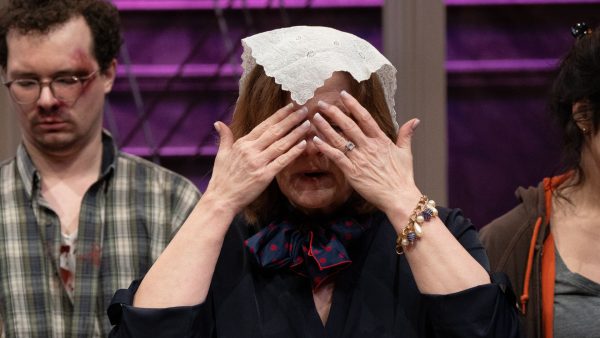
The tranquil scene is suddenly interrupted when Marcelle’s husband, Charles, and their 26-year-old son, Daniel, burst into the room. Daniel is wearing a kippah and has dried blood on his face and shirt. Three men followed him on his way to the metro, harassed him for being Jewish and then beat him up.
Daniel downplays the attack, but his parents are beside themselves. They have reasons in both the present and the past to be worried. The 2015 shootings in Paris at the Charlie Hebdo newspaper and a kosher supermarket are recent memories. Marcelle’s family was even less safe in Paris seven decades earlier.
ADVERTISEMENT

The historical timeline begins in 1944. Marcelle’s great grandparents, Adolfe and Irma Salomon, are still living in their Paris apartment. They were reluctant to leave France when it was still possible because their wealth was tied up in the family’s piano business. Two of their adult children and three grandchildren were arrested during the war. Adolfe and Irma can only imagine what happened to them.
The NTJ cast is excellent. Jenni Ryan captures the conflicts in Marcelle between her rationality and her motherly concern and between her commitment to Jewish tradition and her wariness of public displays of religion. Dave Cooperstein leaves no doubt about how deeply Charles is stricken by the attack on his son.
Bryce A. Miller’s Daniel is filled with a young man’s self-assurance and determination to be independent. The romance between Daniel and Molly is developed with charm by Miller and Lilah Kreis, who is a responsive listener to the arguments swirling around her.
Hailey Medrano is a force of nature as Elodie, Daniel’s older sister, who is said to be bipolar. Medrano is mesmerizing in Elodie’s impassioned monologue. John Wilson is knowing and warmhearted when Marcelle’s brother Patrick is the narrator. Wilson is equally convincing on the attack when Patrick disagrees with his sister’s plan of action. Bob Harvey is inspiring in a brief appearance as the family’s patriarch, Pierre.
In the flashbacks to the 1940s, Irma and Adolph are played with stirring gravity and emotions by Kathleen Sitzer and Bill Stine. Sitzer is making a welcome return to the company she founded in 1997.
As Irma and Adolphe’s son Lucien, Adam Flores finds all the pain in Lucien’s anguished outburst when he is goaded into telling what happened after his arrest. Ben Hammock projects exactly the right emotions for young Pierre, Lucien’s son, who survived in a concentration camp alongside his father.
David Blake’s scenic design places the audience on three sides of a large playing area. On the fourth side is a slightly raised platform for the piano that constantly reminds us of the family business.
Props supervisor Elaina Houston provides well-chosen pieces of furniture that define areas on the open stage for specific scenes. Heather Reynolds’ lighting is an unerring guide for viewers’ eyes.
Director Rebekah Scallet’s masterly use of the space prevents the flashbacks from causing confusion and keeps the action moving at an ideal pace. The play seems much shorter than its three-hour length.
Michele Friedman Siler’s costumes reflect her meticulous research into period styles and her usual sensitivity to character. Mary Robinson original music and sound design are essential contributors to the atmosphere.
“Prayer for the French Republic” at NJT reminds us how fortunate St. Louis is to have a company that takes chances on unfamiliar plays and brings out their best in production.
‘Prayer for the French Republic’
WHEN: Through May 3
WHERE: The New Jewish Theatre’s Wool Studio Theatre in the Jewish Community Center’s Arts & Education Building, 2 Millstone Campus Drive
HOW MUCH: $29–$61
MORE INFO: Visit newjewishtheatre.org or call 314-442-3283