
Elon Gold did not want a podcast. He says this plainly, repeatedly and without nostalgia. He doesn’t listen to them. He doesn’t like how much time they take. He doesn’t love how accessible they’ve made something he still believes should be hard.
Which makes the way he ended up hosting one—twice—somewhat fitting.
Comedy, in his view, is selective. Podcasts are not. And yet, two seasons in, Gold is the host of “Stars of David with Elon Gold,” one of the most successful Jewish podcasts around, and the irony is not lost on him.
The backstory
I first encountered Gold’s podcast in 2024, after receiving a press release from Unpacked, a content partner of the Jewish Light, announcing a new show hosted by one of my favorite Jewish comedians. I wrote a straightforward preview based on the release. Useful. Professional. Entirely forgettable.
Fast forward to early 2026. About a week before my first trip to Israel, I noticed—again via Unpacked—that Gold had quietly dropped Season Two. I clocked it, then, as I’m wont to do, promptly forgot about it.
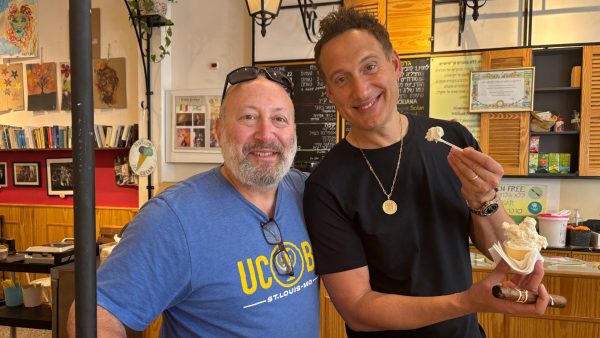
So when I ended up standing in Arte Glideria (an ice cream shop) in Tel Aviv, midway through a walking food tour, and Elon Gold walked in, I did what any self-respecting Jewish journalist would do. I forgot my job and asked if he’d take a picture with me. I also forgot the podcast existed entirely.
I got the picture.
It wasn’t until I got back to St. Louis, reviewed my notes and saw that photo again that the connection snapped into focus. “What an idiot,” I thought to myself. I had him right there. So I reached back out to Unpacked. They set up a call.
The interview
Gold hadn’t been given the backstory of who I was—or that I was the guy from the ice cream shop in Tel Aviv. That became clear almost immediately.
“I’m the guy who was with Benjy the tour guide,” I said. “We took some photos together. You were there with your son at Arte Glideria.”
“Wait,” he said. “We met where?”
The misunderstanding broke whatever formality might have existed. The conversation loosened, wandered and stayed there. What followed felt less like a scheduled interview and more like a long, unexpected detour—one Gold seemed perfectly happy to take.
Now, finally, to Season Two

Gold says Season One of the podcast happened reluctantly. He was persuaded only after assurances that the commitment would be limited. Eight episodes. No lifestyle overhaul. When it performed well—reaching No. 1 in Apple Podcasts’ Judaism category—he agreed to do it again.
“I learned nothing,” he said, deadpan, when asked what carried over from Season One to Season Two.
Then he corrected himself.
“You learn by doing,” he said. “Organically, you get better.”
That growth is most apparent in Season Two’s guest list, which ranges from Tiffany Haddish to Israeli comedian Yochay Sponder, with conversations that move easily between humor, identity and culture.
That sensibility is exactly what Gold says the podcast is trying to capture.
When he first described “Stars of David,” he called it “a mix of laughing, kvetching and celebrating the joy of being Jewish.” Season Two, he says, still lives there—but with sharper edges and more intention.
“It’s Jewish pride without self-hatred,” Gold said. “We’ve had decades of self-deprecating Jewish comedy. Now we need self-loving Jews.”
Gold is openly observant. Hosting the podcast during a moment when Jewish identity feels heavier and more contested has clarified his own voice—not as someone looking to pick fights, but as someone willing to be proudly Jewish without apology.
The show isn’t just for Jews, he insists, though it helps if you are one. Some references get specific. Some jokes will fly past non-Jewish listeners. That’s fine.
“Comedy is about relatability,” Gold said. “You wait for the next joke you do understand.”
The Larry David test
That approach is perhaps best illustrated by one Season Two guest who almost never agrees to conversations like this: Larry David.
Gold knew exactly what he was dealing with.
“Larry just leaves,” Gold said. “If he’s not happy, he gets up and goes.”
So Gold came prepared.
He opened the episode by doing the one thing Larry David immediately understands: annoyance. Gold greeted him with a blunt “Why would you do this?” David shot back, “Because you’re a persistent a++h#le.”
That set the tone.
Gold describes the episode as a balancing act—entertaining David enough to keep him engaged while still pulling off a real interview. His secret weapon was impressions. During a previous Shabbat dinner at Gold’s home, he stuffed challah into his cheeks to do a Marlon Brando impression. David, Gold recalled, was pounding the table laughing.
“He stayed for three hours,” Gold said. “That’s how I knew.”
Gold says he could do an entire story on that episode alone. But that would spoil the fun. The Larry David episode drops in early March, and it’s worth hearing for yourself.
When listeners finish an episode, Gold hopes they feel good—about themselves, about being Jewish and about laughing. Comedy, like any relationship, should benefit both sides.
“I feel good making you laugh,” he said. “You feel good laughing. We both go home happy.”
For someone who never wanted a podcast, it’s a surprisingly good reason to keep making one.