
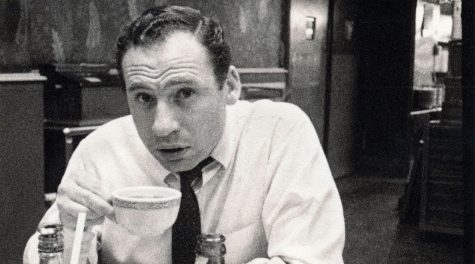
Mel Brooks didn’t just make Jewish jokes. He turned Jewish survival into comedy.
That’s the sentence I kept coming back to while preparing for my May 28 talk at the Mirowitz Center called “Why Jewish humor is so darn funny.” This month’s focus was on Mel Brooks, who is approaching his 100th birthday.
Often, I receive emails from readers who can’t attend these “laughfests” and want to know what was covered. I have no idea how to send my deck of slides, or if they would make sense, so today I’m attempting to put my presentation into story form.
Understanding Mel Brooks
At first, I thought I was putting together a fun nostalgia presentation. Some movie clips. Some stories. A little dash of “The 2000-Year-Old Man.” A sprinkle of “Blazing Saddles.” Maybe a pinch of old Jewish Light archive surprises along the way.
ADVERTISEMENT

Instead, I accidentally found myself trying to explain something much bigger. Why certain rhythms sound Jewish before you even process the words? Why can panic feel funny? Why interruption, handled just right, can be hilarious? And why generations of Jews learned to turn “High Anxiety” (pun intended) into timing, argument into performance and fear into laughter.
And why Mel Brooks is at the heart of all the mishigas.
The rhythm behind Mel Brooks
A lot of people know Mel Brooks through punchlines.
“I’m a stand-up philosopher.”
“Walk this way.”
“Fifteen… Oy. Ten commandments.”
But the deeper I got into his work, the more obvious it became that Brooks wasn’t just telling Jewish jokes. He was building Jewish sensibilities directly into the rhythm of American comedy.
Not religious Judaism.
Cultural Judaism.
Brooklyn Judaism. Everybody-talking-at-once Judaism. Interrupting-you-before-you-finish-your-sentence Judaism.
Honestly, it feels less like “comedy writing” and more like listening to certain Jewish families try to pick a restaurant.
That rhythm runs through Brooks’ movies. Doors slam. Voices overlap. Everybody escalating immediately.
But underneath all the chaos is precision.
Panic with timing.
Panic with musicality. (You can feel it while watching “Springtime for Hitler.”)
It’s panic with structure.
Learning Jewish rhythm at the movies
The strange thing is that I recognized that rhythm long before I understood where it came from.
When I was 8 years old, my father took me to see “Silent Movie” at the old Des Peres 4 Cine. Somewhere during the movie, his beeper went off. He was an OB-GYN. A patient was in labor. He leaned over and told me he’d be right back.
Then he disappeared.
This was apparently acceptable parenting in the 1970s.
So, I stayed there alone watching “Silent Movie” over and over for hours while Mel Brooks, Marty Feldman and Dom DeLuise crashed through scenes like the Three Stooges having nervous breakdowns inside a jazz orchestra.
At the time, I thought I was just laughing.
Years later, I realized I was learning rhythm.
Explaining Mel Brooks
That’s part of what makes Brooks difficult to fully explain to people who didn’t grow up around Jewish cadence.
Even when his movies weren’t technically “about Jews,” they often sounded Jewish.
You hear it in the interruptions.
The bargaining.
The constant sense that civilization itself may collapse because somebody ordered the wrong soup.
The “2000-Year-Old Man” routine with Carl Reiner may be the purest example. The jokes matter less than the cadence. Brooks turns conversation itself into comedy. Tiny pauses become punchlines. Complaints become music.
It feels familiar because, for many Jews, it is familiar.
Not performance.
Recognition.
When comedy becomes survival
One of the major themes we explored during the lecture was the idea that Jewish humor originally developed less as entertainment and more as adaptation.
For centuries, Jews survived by reading danger quickly, deflecting tension, negotiating social discomfort and using humor to reclaim power before somebody else could weaponize humiliation first.
That instinct became cultural rhythm.
Which may explain why Brooks’ comedy often feels both ridiculous and strangely defensive at the same time.
Especially when Nazis enter the picture.
No major American filmmaker mocked fascism quite like Brooks. Maybe Charlie Chaplin, but we digress.
“The Producers” transformed Hitler into absurdity. “History of the World Part I” turned the Spanish Inquisition into a Broadway production number. Repeatedly, Brooks used ridicule to shrink authoritarianism into something pathetic.
His argument was simple: if you make tyrants look ridiculous, you rob them of mythology.
Why Jews still argue about Mel Brooks
Not everybody agreed with him, especially the Spanish Inquisition scene.
In the new HBO documentary “Mel Brooks: The 99-Year-Old Man!,” director Judd Apatow briefly highlights a 1981 column by Jewish Light Editor-in-Chief Emeritus Robert A. Cohn reacting to “History of the World Part I.”
But Cohn praised parts of the movie, especially Brooks’ famous Moses joke:
“The Lord Jehovah has given unto you these fifteen…”
Crash.
“Oy. Ten. Ten commandments.”
But he also struggled with whether certain historical trauma should become spectacle.
That tension still exists. Because Jewish humor has always lived close to grief.
Relevant at 99
And maybe that’s ultimately why Brooks still matters. Not because every joke aged perfectly. (They have not.) Not because every movie worked. Not because younger audiences necessarily recognize every reference.
He matters because he understood something emotionally true about Jewish life:
That panic and resilience sometimes arrive in the exact same voice.
The rhythms still sound familiar.
The nervous laughter still feels current.
And beneath all the chaos, Mel Brooks may have been documenting something Jews understood long before America did:
Sometimes comedy isn’t escapism. Sometimes it’s survival.