

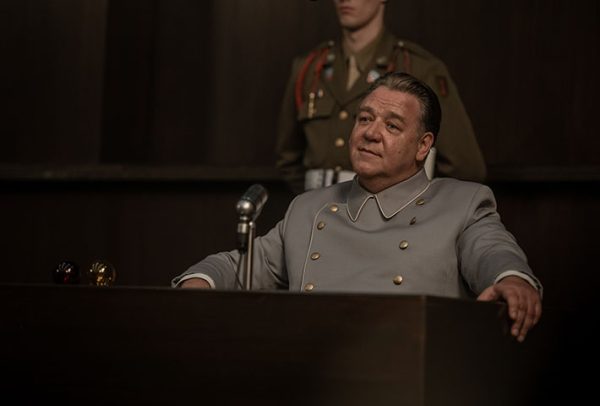
Russell Crowe and Rami Malek deliver outstanding performances in the gripping historical drama “Nuremberg,” which chronicles the creation of the post–World War II tribunals that brought the surviving leaders of Nazi Germany to justice. These groundbreaking trials marked the first time in history that leaders of a nation that took the world to war were prosecuted for crimes against humanity and crimes against the peace of the world. The proceedings revealed to the world the full scope of Nazi evil and atrocities and held the remaining architects of the Shoah to account for their actions.
| RELATED: St. Louis law library honors Nuremberg prosecutor who put Nazis on trial
“Nuremberg” presents the events that led to the creation of the international tribunal, an effort led by U.S. Supreme Court Justice Robert H. Jackson (the excellent Michael Shannon). However, the film particularly focuses on the Nazis’ second-in-command, Reichsmarschall Hermann Goering (Crowe), and his relationship with American Army psychiatrist, Dr. Douglas Kelley (Rami Malek), assigned to evaluate the Nazi prisoners for fitness to stand trial.
The drama’s other track focuses on Justice Jackson, who resisted pressure from Congress and others calling for the summary executions of the remaining Nazi leaders. Instead, he pushed for international war-crime trials, despite the lack of any precedent for them. Jackson hoped to demonstrate the supremacy of the rule of law over Nazi lawlessness, and to show to the world evidence of the Nazis’ war crimes and the Shoah.
The film opens on the last day of WWII, in May 1945, with Crowe’s Hermannn Goering in a fancy touring car, driving up to some American soldiers on a crowded dirt road. He announces his surrender, then asks them to get his luggage, in a perfect tip-off of his towering ego. Although Malek’s Dr. Kelley is brought in to assess all the Nazi prisoners for fitness to stand trial, he also has personal ambitions to write a book about Goering and is especially focused on trying to “psychologically define evil.” As the days unfold, Kelley slowly develops a complex relationship with his narcissistic yet charming subject.
Based in part on Jack El-Hai’s book, “The Nazi and the Psychiatrist,” and written for the screen by director James Vanderbilt, “Nuremberg” is a powerful, classically made historical drama that is strikingly timely. Vanderbilt centers the film on the complicated relationship between the cunning Nazi leader Goering and determined psychiatrist Kelley, building a cat-and-mouse game that brings a thriller aspect to the film.
ADVERTISEMENT

While the first part plays out much like a psychological and political drama – exploring not only the battle of wits between the Nazi and the psychiatrist but also Jackson’s maneuvering to get the international tribunal he believes is essential to defeating Nazi evil and keep it from re-emerging. The film culminates in a riveting courtroom scene, where Goering takes the stand, and evidence of Nazi crimes are laid bare before the court, and the whole world.
Both Crowe and Malek give Oscar-worthy performances, arguably among the best of their careers, and lead a sterling ensemble cast. Shannon is, as always, remarkable as the Supreme Court justice. Richard K. Grant plays the British prosecutor Sir David Maxwell-Fyfe in this international effort, and Leo Woodall is Sgt. Howie Triest, the German-speaking American soldier translator for Kelley, someone with his own heartbreaking backstory. Colin Hanks plays Dr. Gustave Gilbert, another psychologist brought later to reassess Kelley’s work, and John Slattery is Col. Burton Andrus, who runs the Nuremberg prison where Nazis are held. His main job is to keep them alive so they can be executed after they are tried.
Unlike previous films about the Nuremberg trials, this gripping drama reaches the courtroom later, but when it does, it offers some of the film’s most powerful, emotional and timely moments. Crowe’s portrayal of Goering on the stand is especially compelling, as he details how the Nazis seized power, their goals and their rationalizations—echoing Hannah Arendt’s concept of the “banality of evil.”
Audiences should be aware that the courtroom portion includes archival footage of concentration and death camps taken during liberation. While some may recognize the images, they remain visceral and difficult to watch. Though harrowing, the footage is essential to convey the full horror of the Nazi regime.
“Nuremberg” will be called an Oscar-bait drama by some, and it is, but it is Oscar-bait with a higher purpose, to revisit a time when the world held evil to account, and as a reminder, once again, what we all should remember: never again.
“Nuremberg” opens Friday, Nov. 7, at AMC Creve Coeur, Marcus Des Peres, Marcus Ronnies, Chase Park Plaza Cinemas, and Alamo Drafthouse City Foundry.