
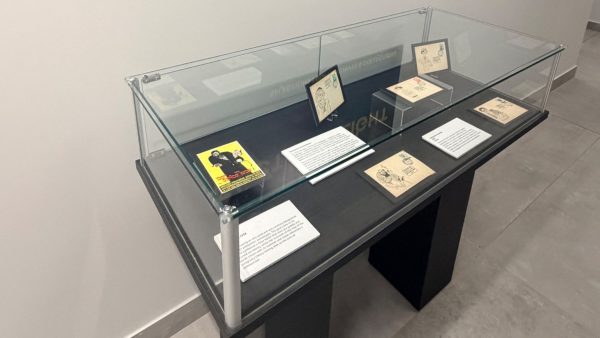
Inside a small glass case at the St. Louis Kaplan Feldman Holocaust Museum are several postcard-sized drawings once connected to one of Nazi Germany’s most infamous antisemitic exhibitions.
The images are crude, exaggerated and deeply unsettling. But what makes them historically dangerous is something else entirely:
They were likely designed as advertising.
These were not underground materials passed secretly between extremists. They were public-facing propaganda meant to make antisemitism feel familiar, modern and ordinary.
ADVERTISEMENT

Now featured as part of the museum’s latest “Artifact Spotlight,” the hand-illustrated caricatures trace back to “Der Ewige Jude” (“The Eternal Jew”), a massive Nazi propaganda exhibition first launched in Munich in 1937 under the direction of Joseph Goebbels and other top Nazi officials.
The exhibition later traveled to Vienna, Berlin and other cities, drawing more than 400,000 visitors while spreading racist stereotypes designed to portray Jews as dangerous and subhuman.
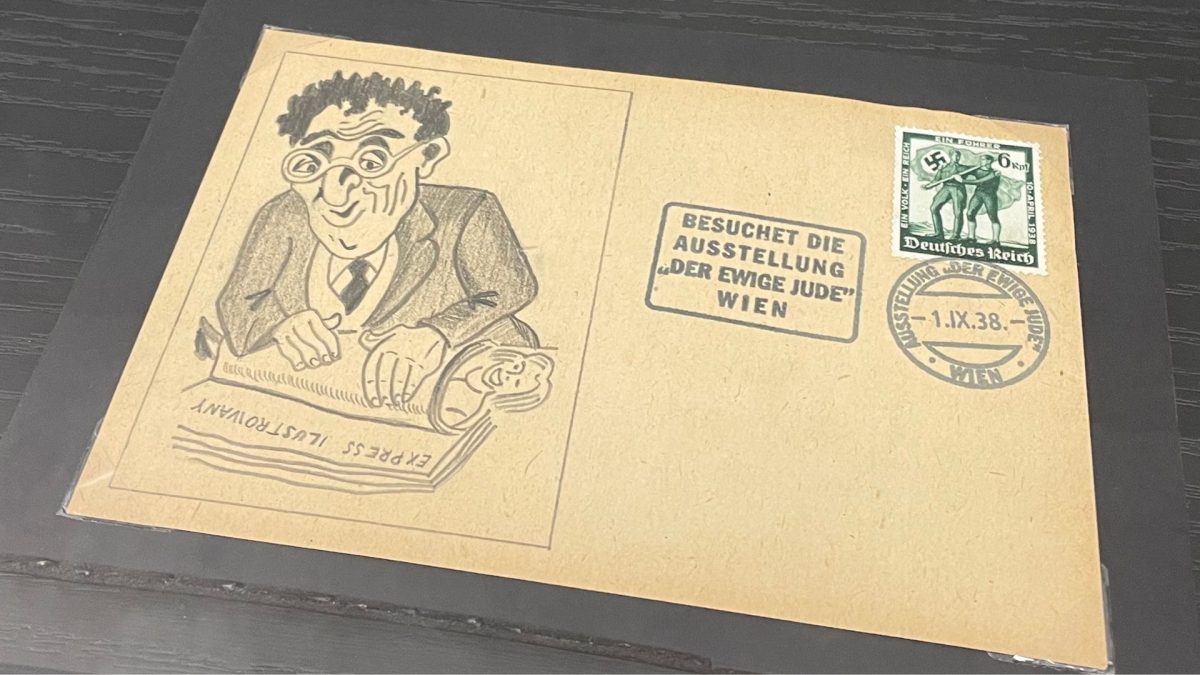
Some appeared on postcards. Others may have been intended as promotional materials tied to the exhibition’s 1938 run in Vienna, according to Amy Moorman, director of archives and collections at the museum.
“As far as we can determine, these drawings were intended for advertising purposes,” Moorman said. “They do each have the same stamp as the printed postcard which promotes the exhibit’s run in Vienna.”
When propaganda looks ordinary
The exhibition itself presented antisemitism as education.
Visitors encountered charts, caricatures, photographs and pseudo-scientific displays designed to make hatred appear rational, modern and ordinary.
Historians have noted that antisemitic sentiment and violence often increased in cities where the exhibition traveled.
One surviving envelope from the period even included a postal advertisement encouraging recipients to visit the Vienna exhibition, showing how deeply the propaganda had embedded itself into ordinary public life.
That’s part of what makes the St. Louis artifacts so unsettling now.
Small objects, enormous consequences
The drawings currently on display arrived in St. Louis after being purchased in Poland and anonymously donated to the museum.
Little information about their original ownership has survived.
Part of the power comes from the scale itself.
The drawings are small enough to fit inside a modest archival display case.
Yet the ideas behind them helped normalize antisemitism for hundreds of thousands of people across Nazi-controlled Europe.
“We are always looking for ways to bring attention to the history and pervasiveness of antisemitism,” Moorman said, “and these artifacts provide a particularly strong example.”
| RELATED: A book drawn after Auschwitz liberation now has a St. Louis story to tell
ADVERTISEMENT