
Retirement conversations tend to follow a familiar script: downsizing, travel plans, volunteer work, maybe a little consulting and, inevitably, someone discovering pickleball or bird watching with the intensity of an Olympic sport.
But beneath the logistics and jokes sits a harder question: Once work no longer defines your days, what does?
Richard Lincoff seems to have found an answer.
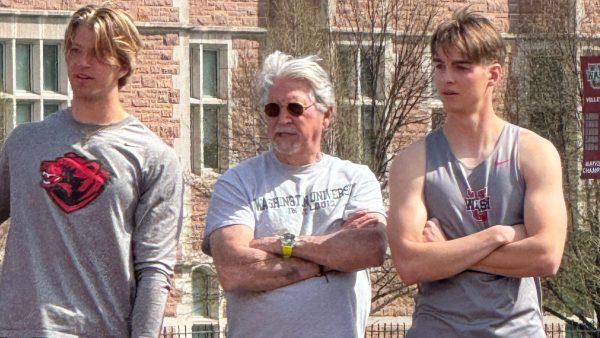
At 81, he coaches track athletes at Washington University and is on tap to do the same at this summer’s Maccabiah Games in Israel; he volunteers in the community, including at the Missouri Eastern Correctional Center in Pacific; he takes college classes; and he still competes in track events.
His schedule sounds less like winding down and more like staying fully wound.
ADVERTISEMENT

Or, as his daughter Kate Lewis, 40, puts it: “He didn’t retire. He rewired.”

That version of Lincoff — fully engaged, constantly learning, deeply present in other people’s lives — didn’t emerge overnight.
Before retiring at 69, he had already built a career defined by reinvention, global reach and a knack for landing on his feet.
For two decades, he ran a Los Angeles consulting firm advising companies including Merck, Philips and Apple on global product launches. The Whittier earthquake in 1987, when he and his family sheltered under an archway wondering whether LA was the place for them, prompted a reassessment that soon became real: A Merck client recruited him to St. Louis.
That move led to senior roles at Ernst & Young and then Cognizant, where he worked until retirement.
But retirement for Lincoff was never going to be an ending.
“He talks a lot about being purposeful,” Lewis said. “That really resonated with him deeply and very quickly.”
Without a clear plan, Lincoff began exploring interests that had little to do with boardrooms or business strategy. He enrolled in classes at Washington University and eventually earned a master’s degree in liberal arts, driven by a feeling that earlier education had been more about credentials than curiosity. He became a docent at the St. Louis Art Museum, where for four years he guided visitors through exhibits, focusing as much on context and meaning as on the artwork itself.
Then came another turning point.
After attending a Prison Performing Arts program with friends and his wife, Lincoff found himself unexpectedly moved by the experience.
“My parents were blown away,” Lewis said. “It really deeply touched my dad. That was like a light bulb for him, that he could do things that were deep and so meaningful.”
He soon began volunteering at the men’s prison in Pacific, initially supervising recreation and sports activities before eventually teaching courses ranging from anger management to marketing. More than a decade later, he is still there.
Jesse Amsden, the institutional reentry coordinator at the prison, said Lincoff’s classes have become some of the most sought-after.
“He has a much higher rate of keeping his students,” Amsden said. “In fact, his students tend to promote his classes to other inmates. He’s able to get the inmates to focus and participate, which in this scenario can often be difficult. He just engages with them. He’s a very positive person.”
Lewis said: “Doing meaningful things became a driver and a purpose for my dad.”
But retirement, Lincoff learned, is not a tidy third act. Even lives built around purpose can be shaken off course.
In July 2017, everything stopped.
That’s when his wife of 39 years, Judy Zisk Lincoff, died at age 61 from T-cell lymphoma after a sudden five-week illness. Lincoff was 72 and only beginning to imagine what this next chapter of life would look like with her beside him.
“My dad’s world as he knew it ended,” Lewis said. “He lost his compass.”
For six months, the routines and commitments that had begun to shape his retirement fell away. The prison volunteering stopped. The momentum disappeared. Grief, suddenly and completely, took over.
But gradually, Lincoff began rebuilding.
“It was one step and then the next,” he said.
He returned to volunteering at the prison. And he found another outlet that combined competition, mentorship and connection: track and field.
A longtime Masters track athlete who competes throughout the world, Lincoff started helping with throwing events (javelin, hammer, discus and shotput) at Ladue High. Over time, he deepened a friendship with fellow Masters competitor Gordon Reiter, 80, a retired Parkway School District teacher who coaches at Washington University.
The two had met years earlier through Masters track and field competitions and bonded over their shared love of track.
“We ended up at the same place at the same time, just doing what we like to do,” Reiter said.
Reiter eventually recruited Lincoff to join the WashU coaching staff.
“He didn’t bite at the first offer,” Reiter said with a laugh. “So I kept asking him and eventually he came to a practice. That was about four years ago. And he’s been coming ever since.”
Reiter said that what stands out most about Lincoff is the depth of his commitment.
“When he does something, he’s all in,” Reiter said. “It’s all about the people he’s working with and not so much about him.”
At WashU, Lincoff coaches the throwers. The track team has won two NCAA championships during his tenure, and the coaching staff has been recognized nationally.
For athletes like Kally Mack, a recent graduate who trained with Lincoff for four years, his age quickly became beside the point.
“For the longest time, we all thought he was like 60,” Mack said, laughing. “Then we figured out he was 80 and we were like, ‘Holy cow.’ ”
Mack described Lincoff as both a mentor and daily presence during her college years, especially through injuries and setbacks.
“You can tell he’s there because he truly loves it,” she said. “He’s very kind, very inspiring and very much there for you as an athlete. He’s been a huge part of my time here at WashU.”
She remembers meets where the two would play “guess the mark,” trying to predict throwing distances, or practice sessions during which Lincoff would challenge athletes to “hit the dollar” with a javelin throw.
“He gives that big smile,” Mack said. “He just makes the experience better.”
Now at 81, Lincoff is preparing to coach Team USA throwers at the Maccabiah Games in Israel in July.
“Doors open,” he said simply. “For me … yes, I’m interested.”
More than a decade after stepping away from his formal career, Lincoff’s life is not defined by what he left behind, but by what he continues to build. Along with his coaching, volunteering and classes, family remains at the center of it all. He spends summers in Denver with his daughter Kate, her husband and their two children; his other daughter, Amanda Platz, 42, lives in St. Louis with her wife and their three children.
Lincoff is also in a committed relationship and still makes time to travel whenever he can — fitting it all into a life that, even now, continues to expand rather than narrow.
“I feel most proud of my dad as I watch him grow as a person at 81,” Lewis said. “He’s a better version of himself today than he was 15 years ago.”
His philosophy is both simple and relentless.
“Fill each unforgiving minute with 60 seconds worth of distance run,” he said, paraphrasing Rudyard Kipling. Then he translates: “Do things. Don’t not do things.”
And maybe that’s what stayed with me most after meeting Richard Lincoff. Retirement, at least the way many of us imagine it, is about slowing down. His version is about staying curious, useful, connected and amenable to whatever door might open next.
For those of us inching toward that chapter ourselves, that may be the most hopeful lesson of all: that life after work does not have to get smaller, and neither do we. If anything, there is still room to grow, still more to explore, still more to become.
ADVERTISEMENT