
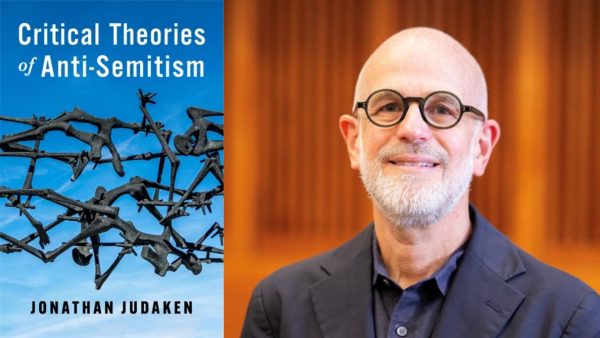
It’s not every day a St. Louis scholar makes national headlines in the world of history. But this week, Washington University’s Jonathan Judaken joined the ranks of the American Historical Association’s top honorees, receiving the “Dorothy Rosenberg Prize” for his book “Critical Theories of Anti-Semitism.” The award, one of the AHA’s most prestigious, recognizes the most distinguished English-language work on the history of the Jewish diaspora published in the past year.
A lifetime spent asking hard questions
Judaken, the Gloria M. Goldstein Professor of Jewish History and Thought and chair of WashU’s Department of Jewish, Islamic and Middle Eastern Studies, has built a career examining how racism, antisemitism and identity intersect. His book, published by Columbia University Press, explores the philosophical and historical roots of antisemitism, tracing how prejudice against Jews connects with other forms of racism and exclusion.
Born in apartheid South Africa, Judaken’s global experiences in Israel, Paris, Memphis and now St. Louis have shaped a lifelong pursuit to understand how hate operates across societies. “A deeper understanding of antisemitism requires us to understand its entangled history,” he said in a 2024 interview with the Jewish Light.
In that same conversation, he added that understanding antisemitism means seeing it as part of something bigger: “You can’t understand antisemitism without understanding how it connects to anti-Black racism, Islamophobia and xenophobia.”
ADVERTISEMENT

A national award with local meaning
The “Dorothy Rosenberg Prize” honors depth of research, methodological innovation, conceptual originality and literary excellence. This year’s AHA honorees were selected from nearly 1,300 entries, reflecting the best new work in the historical discipline. Judaken’s selection highlights his contribution to reframing how antisemitism is understood, both within academia and in public discourse.
He will officially receive the award at the AHA’s annual meeting in Chicago in January.
St. Louis on the scholarly map
For St. Louis’s academic and Jewish communities, the award carries special meaning. Judaken’s work deepens understanding of antisemitism’s enduring presence and its relationship to other social injustices. His public talks, including one last week at Central Reform Congregation, have drawn large audiences eager to engage with his ideas about the modern relevance of Jewish history and identity.
The recognition by the American Historical Association reinforces the idea that scholarship emerging from St. Louis can help lead national and global conversations about antisemitism, justice and coexistence.