
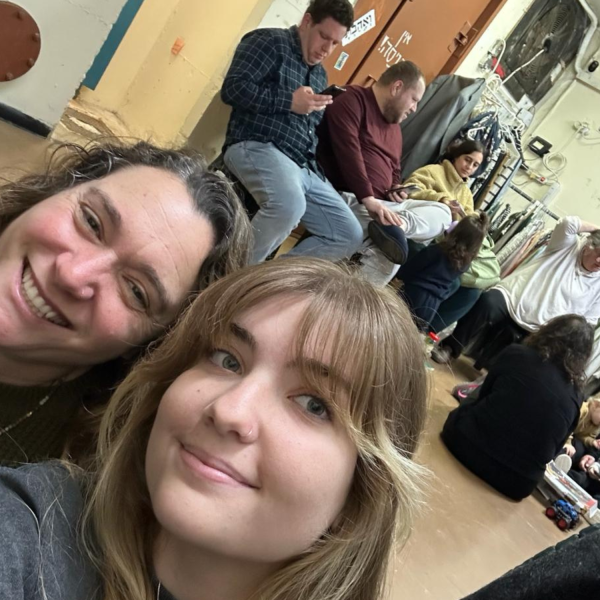
Rebekah Simmons, 19, chose to spend a year in Israel knowing that even during a “ceasefire,” daily life can still include sirens and shelters.
She says she feels steady.
“My daily life feels very different now compared to when I first arrived to Israel,” she said. “I’m not scared or very worried, I feel calm. I know what to do when a siren goes off, I know where to go and I know I’m safe and surrounded by caring people.”
Learning the rhythm of alerts
Simmons is spending the year in Israel as a “reverse shinshin,” living in the Megiddo region as part of a partnership program connected to the Jewish Federation of St. Louis. She is currently studying at Ulpan in Ein HaShofet and living with a host family on Kibbutz Ramot Menashe.
When alerts come, residents receive phone notifications from Israel’s Home Front Command warning of incoming missile fire. In some cases, there are several minutes of notice before the siren begins. Once it sounds, people have about 90 seconds to reach a protected space.
“Everyone quickly makes their way there and we all gather together inside,” Simmons said. “Most homes have a built-in shelter, but if you’re outside, there are underground shelters available where anyone can take cover.”
ADVERTISEMENT

‘Another siren, here we go again’
But for Simmons, the more striking part is not the system. It is how ordinary it feels.
“I think what would surprise my friends the most back in St. Louis is how normal this is for people here in Israel,” she said. “This isn’t new to them, it’s just part of life. It’s almost like, ‘Sigh, another siren, here we go again.’ Israel is literally at war and it’s crazy to think I’m living through history.”
She and her friends check in constantly.
“My friends and I are always in touch, texting things like, ‘In the shelter?’ and making sure everyone is accounted for.”
A host family’s instinct
Rebecca Spiewak, a longtime participant in the St. Louis–Israel Partnership through the Jewish Federation of St. Louis, is helping host Simmons during her year abroad. The Federation’s partnership connects St. Louis with communities in Israel’s Megiddo region.
When the first alert came, Spiewak said her instinct was simple.
“When we first received the alert that we needed to be ready to enter a safe room, I immediately went to pick up Bekah and drive her to our home,” Spiewak said. “Making sure she was with us felt important.”
Later that night, Spiewak asked a hard question.
“I asked her if she wanted to go back to St. Louis. I asked her if she wanted to talk with her mom about it,” she said. “She told me that she didn’t even ever consider that option and was surprised when I brought it up. She is doing great and is a real light to have here at this time.”
Instinct takes over
Simmons said what her friends back home may not understand is how quickly instinct replaces fear.
“My friends have no idea what it feels like to hear a siren and immediately have to get inside a shelter, or to not know when the next attack might come, how much time you have to shower or even go to the bathroom and waking up in the middle of the night to get to a shelter,” she said. “It becomes such an instinct that even hearing any sound similar to a siren, even in a video on your phone, can make your heart race. Everyone is on edge.”
When asked if she was okay, she answered plainly.
“Yes! 100%. No need to worry!”
For now, she said, life continues — classes, friendships and learning Hebrew — even as history unfolds around her.
If stories like Rebekah’s remind you why connection between St. Louis and Israel matters — especially through the next generation — consider honoring her or someone in your life with a tribute to the St. Louis Jewish Light. Your support allows us to continue telling the stories of young people who step forward with courage and heart.
To make a tribute, click here.
If you would like to mail a check instead of paying online, please mail to:
St. Louis Jewish Light
P.O. Box 32127
St. Louis, Mo. 63132-2127
The St. Louis Jewish Light is a 501(c)(3) nonprofit organization.