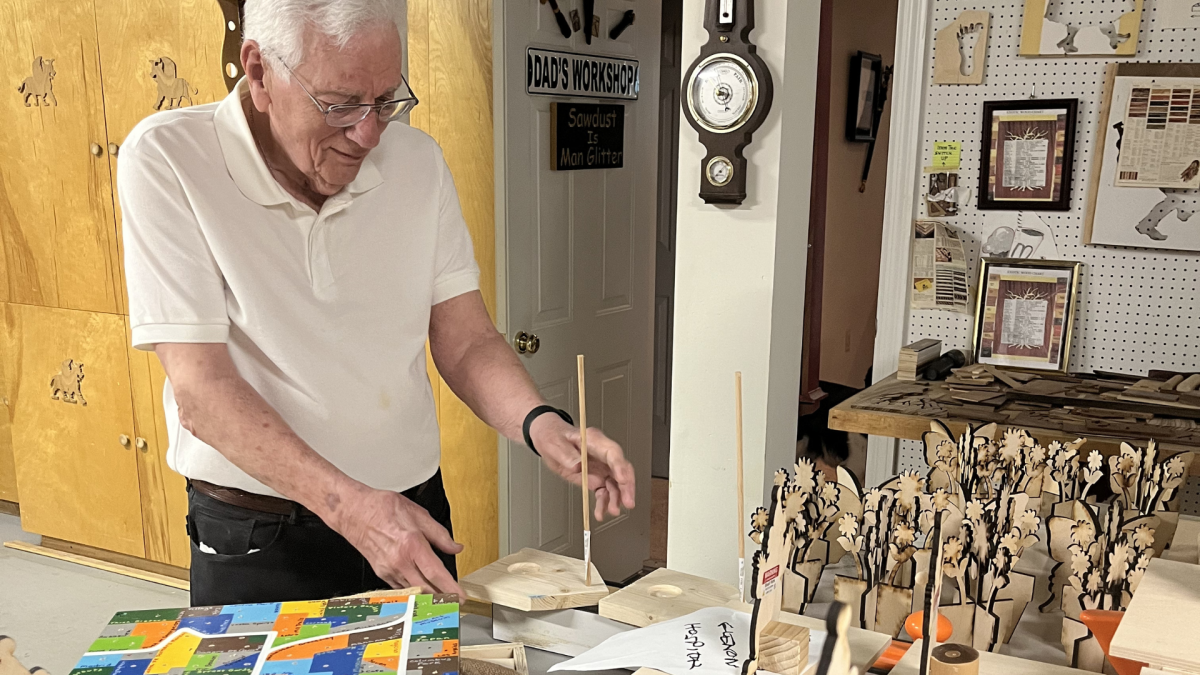

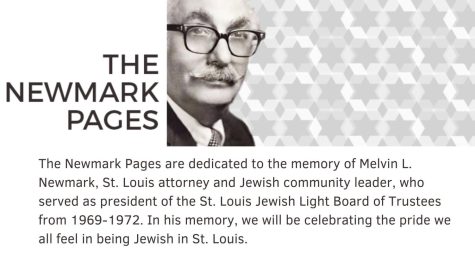
One night in the early 1960s, Melvin Newmark walked into the backyard of the Crystal Palace and was surprised by his own 50th birthday party.
“That’s how much our family life was tied up in that place,” his son Tom said.
That detail says everything.
For a brief stretch beginning in 1958, when the Crystal Palace opened at 3516 Olive Street, Gaslight Square became the “Greenwich Village of the Midwest.” Within a few years, the club moved west to 4240 Olive and became what one obituary later called the nerve center of the district.
On weekend nights, people spilled onto Olive Street. Couples drifted between the Crystal Palace, the Golden Eagle and Port St. Louis. Jazz floated through open doors. Even without a ticket, you could stand on the sidewalk and feel that something was happening.

Behind the scenes, Jewish entrepreneurs and professionals helped build it — including a corporate attorney named Melvin Newmark, who, almost accidentally, became a co-owner of its most iconic venue.
Recently, I spoke with Melvin’s sons, Michael and Tom Newmark, about their family’s part in that story — and about a St. Louis that, for a moment, felt bigger than itself.
Saturdays at the Palace
“I have myriad memories of it,” Tom said, recalling the Saturdays he tagged along with his father to meetings at the Crystal Palace.
“Dad would meet the other owners — Fred and Jay Landesman, Alvin Novick — and I’d tag along. I had the real pleasure of going behind the bar and serving myself and my grade school buddies soda. Only soda,” he laughed. “But I remember that bar being quite ornate.”
Ornate is a word both brothers use. Chandeliers. Stained glass. The glimmer of stage lights — bohemian glamour in a city better known for steak and beer.
“It wasn’t burlesque,” Michael said. “It was ornate — a beautiful theater.”
The Crystal Palace began as a theater-bar hybrid, staging avant-garde works like Beckett’s Endgame.
“I’d bring my college friends down,” Michael said. “We were seeing something you didn’t usually get in St. Louis — art that felt risky.”
From Beckett to the Smothers Brothers
The Palace soon evolved into a nightclub, attracting comedians and musicians on the national circuit.
“They’d been at the Hungry I in San Francisco or Second City in Chicago,” Michael said, “and they’d come through St. Louis to play the Palace. The Smothers Brothers, Barbra Streisand, Mort Sahl, Lenny Bruce — all of them.”
Tom was too young for the late shows but still brushed up against the scene.
“The Smothers Brothers came to our house one Sunday morning for brunch,” he said. “That was normal for us.”
Michael laughed. “I saw them all — Streisand, Lenny Bruce, Nichols and May — but I didn’t sit there thinking these are going to be great people. I just thought they were funny. It was only later I realized I’d witnessed history.”
“In lieu of legal fees”
Their father’s involvement was part passion, part happenstance.
“Dad was the lawyer for the Gaslight Square Association and the Crystal Palace,” Tom said. “He was given an ownership interest in lieu of legal fees — that’s how things worked in those days.”
“There were six owners total,” Michael added. “Each with different percentages. Dad’s interest came from the legal work he did. He was a corporate lawyer, not an entertainment lawyer, but he cared about this.”
What he gained wasn’t wealth.
“When the Crystal Palace folded, there was zero dollars left,” Michael said. “It was never about the money. It was cultural.”
The Jewish footprint
Gaslight Square’s rise owed much to Jewish entrepreneurship. The Palace’s main owners — Jay and Fred Landesman, Alvin Novick and Melvin Newmark — were Jewish. So were the Dewoskins of Port St. Louis and Jack Carl, whose deli 2¢ Plain became a gathering spot for performers and locals.
“There were a lot of Jewish-owned establishments,” Michael said. “But we weren’t aware of it in a conscious way.”
“You’ve got to realize,” Tom added, “for me, everybody in St. Louis was Jewish. I grew up in a grade school that was 99 percent Jewish. It wasn’t anything notable.”
Still, the Jewish presence shaped the tone of the district — ambitious, funny, willing to take a risk. It was avant-garde, but still unmistakably St. Louis.
Lenny Bruce and the edge
Lenny Bruce’s visit became family legend.
“I remember Dad talking about staying up all night with Lenny Bruce,” Tom said. “They were talking about who’s a Jew. I think the line was, ‘Everyone born in New York City is a Jew; no one born in Fargo, North Dakota, is a Jew.’ I can’t swear to it — maybe I read it later — but that’s what stuck.”
Michael laughed. “I remember the show. I didn’t enjoy it. I thought he was offensive — but that was law school me talking.”
That balance defined Gaslight Square. St. Louis could handle edgy. Just not too edgy.
The Nervous Set: Before Broadway
When I asked the brothers about “The Nervous Set,” they both lit up.
Before it reached Broadway, the Beat-inspired musical was workshopped at the Crystal Palace. The show centered on poets, jazz musicians and restless young Americans trying to figure out who they were.
Jay Landesman co-wrote it with Theodore Flicker. Fran Landesman wrote lyrics, including the enduring jazz standard “Spring Can Really Hang You Up the Most.” Tommy Wolf composed the music.
“It was very well received in St. Louis,” Michael said. “They brushed it up and took it to Broadway.”
The run was short. But the fact that it began on Olive Street mattered.
For a moment, Gaslight Square wasn’t just a stop on the circuit.
It was a laboratory.
The rise and the fall
The decline came quickly.
“It went from avant-garde to honky-tonk,” Michael said. “Some of it was crime. Some of it was the area becoming rundown.”
“The weekends were packed,” Tom said, “but weekdays were tough. St. Louis didn’t have the convention base to keep it going.”
By the mid-1960s, the Palace closed.
“I got some chandeliers out of the deal,” Michael said, laughing. “They came from the Landesman antique store. But they remind me of that time.”
The legacy
Barbra Streisand mentions the Crystal Palace in her memoir. The Landesmans’ son, Rocco, went on to become a major Broadway producer and later chaired the National Endowment for the Arts.
For the Newmarks, the legacy is simpler.
“It wasn’t a side thing,” Michael said. “We don’t have anything like it today. Gaslight Square was it.”
For a few brief years, a handful of Jewish risk-takers turned Olive Street into the center of something. Not nostalgia. Not myth. Something real.
And then it was gone.