
One of my favorite programs on television is found on PBS, and it is called “Finding Your Roots.” An overview of the series reads as follows:
Educator Henry Louis Gates Jr. has hosted several PBS series that examine U.S. history. In “Finding Your Roots,” the Harvard professor continues his quest to “get into the DNA of American culture.” In each episode, celebrities view ancestral histories, sometimes learn of connections to famous/infamous people, discover secrets, and share the emotional experience with viewers.
Analyzing genetic code, DNA diagnosticians trace bloodlines and occasionally debunk long-held beliefs.
The knowledge that his guests gain as a result of the research empowers them and affirms their identities, providing a fuller understanding who they are. The show has inspired many to take a deep dive into their own genealogies through the many sources available on the Internet.
Knowing one’s story is not only important for individuals but for groups. A study done many years ago demonstrated that successful businesses taught their stories to their employees. Origin stories bind the group together and create common goals and values. They are also produce “buy-in.”
Parshat Bo contains the origin story par excellence of the Jewish people. It opens with the last three and most terrible of the Ten Plagues, locusts, utter darkness, and the death of all of the first born of Egypt. During the tenth plague, Pharaoh relents and finally orders Moses to take the Israelites, men, women, children, and livestock, and leave Egypt, finally convinced that his power has been exceeded by Moses’ God. This mass exodus is the birth story of the Jewish people.
ADVERTISEMENT

Exodus chapters 12 and 13 describe and explain rituals through which the Jewish people continue to find their roots. These chapters describe what has come to be called the Pesach, or Passover, holy days. We learn of the process of choosing, slaughtering, preparing, and consuming the Pesach, the Paschal lamb, and how the animal’s blood was painted onto the lintels and doorposts of the Israelite homes, distinguishing them from those of the Egyptians. This was done so that God would “pasach,” or “pass over,” their homes when bringing on the tenth plague.
The people were to prepare only unleaded bread for consumption over the week, as, according to the text, there was no time for the dough to rise before they were encouraged to leave Egypt. Since circumcision distinguished the Israelites from everyone else, only those who bore this distinction were allowed to participate in the meal, and the lambs was to be shared by all members of a household, with smaller households sharing one.
Furthermore, this was not an occasion for putting on one’s finest clothes. Rather each person was to dress as if s/he had to leave at a moment’s notice, for on that first Passover, that was the case. And since the first born of the Israelites were spared the fate of Egypt’s first born, they were to be redeemed.
The Passover ritual was to be observed throughout the generations, so that future generations might know their origin story through this experiential learning. The Passover seder is among the most popular rituals in Judaism, because of the experiential learning provided, wherein all of the five senses participate in reliving the origin story. Jews are familiar with our origins as a family who wandered into Egypt and subsequently enslaved until freed from that slavery to become a nation that would find its home in Canaan, later called Israel. Through the development of the seder over different periods of history, participants experience the dynamic between freedom and slavery, drinking wine, reclining, enjoying some small plates, then a meal fit for royalty, all the while telling the story, but also tasting it, smelling, seeing it, experiencing it. It is the model of what Jewish education can be.
Through this annual review of our roots, we reaffirm our ties to one another, to the generations prior to and following ours, to the Jewish people and to God. The Haggadah is similar to the book which is compiled for each of the guests on “Finding Your Roots.” Through this Passover experience, we learn who we are and what we value.
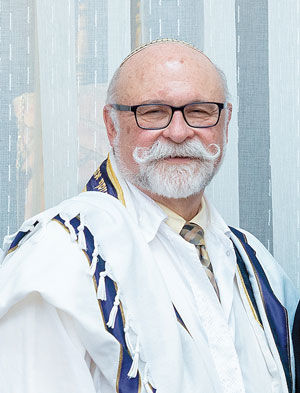
Rabbi Josef Davidson is retired and a member of Congregation B’nai Amoona. He is a member of the the St. Louis Rabbinical and Cantorial Association, which coordinates the d’var Torah for the Jewish Light.