
Founded in 2012, Arch Grants set out with a clear mission: to boost innovation and attract entrepreneurs to St. Louis. Each year, the organization hosts a competition in which winning startups receive a $75,000 grant and access to a network of resources designed to help them grow.
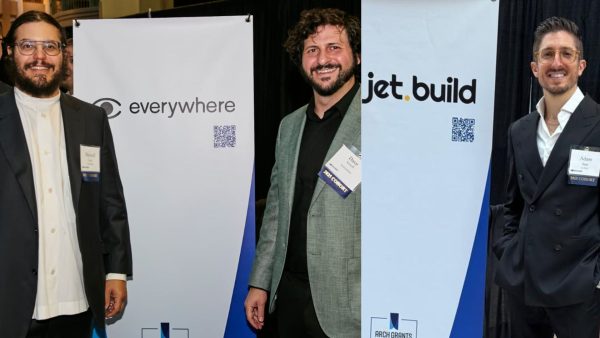
This year, 375 startups applied, and 19 were selected as winners. Among them, at least two were created by Jewish entrepreneurs: Jet.Build and Everywhere, founded by Adam Stark and Max Citron, respectively.
Jet.Build, which Stark and business partner Joseph Shua-Haim formed in 2021, is an online platform designed to help companies building retail or commercial spaces efficiently manage documents, workflows and communications.
“Jet.Build creates a single source of truth for all of these companies to collaborate and operate in their respective roles with industry standard functions,” Stark said.
Everywhere is a material science company and Citron’s brainchild. In 2017, he launched Everywhere Apparel, which makes maximally sustainable textiles. This year, he started Everywhere Materials a company focused on reusing and recycling waste.
ADVERTISEMENT

“I like to look for maximum impact at the lowest costs,” Citron said. “What are the most sustainable technologies on Earth where we can turn shit into gold. That’s what Everywhere does.”
Each company will use its Arch Grant win to deepen relationships with potential clients in St. Louis, give back to the local community and further its business goals.
From service to startups
Stark, 35, was born in California and moved to New Jersey when he was in middle school. There he attended a Jewish high school and played sports against his future business partner, who was attending a rival school. After graduating, he and Shua-Haim independently joined the Israel Defense Forces and served as paratroopers in different divisions.
After service and college, Stark moved to New York City, where he started working for builders developing properties in the Northeast. He quickly realized that he was losing time having to keep track of multiple projects at once and that there was no tool to efficiently consolidate all the information he needed. That challenge inspired the creation of Jet.Build.
“Since starting the company, we’ve evolved the platform to cover industry standards in its holistic form,” Stark said. “We’re not redefining anything. Rather, we’re simplifying how teams operate.”
Shua-Haim explained how the platform has changed to meet the needs of customers, resulting in a suite of “practical” tools rather than ones with theoretical and potentially ineffective uses.
“We’ve worked closely with clients to build features out specifically for them,” he said. “It’s tailored for our clients, which has been our key to success.”
Stark outlined the different ways a developer can use software to manage a project. He described Jet.Build as a more efficient alternative to outdated legacy systems, which are often more costly and less effective.
While in New York, Stark met Danielle Serota on a blind date. Eventually the couple moved back to her hometown of St. Louis. Like Stark, Serota served in the IDF. They bonded over shared experiences and the difficulty of going from military to civilian life.
“Going from having that much responsibility and a strong sense of purpose to suddenly being on an American college campus was really challenging,” she said.
In addition to Jet.Build in 2024, Stark started a podcast called the “Veterans Who Build Show.” Each episode highlights the stories of veterans, exploring how the skills they gained during their service have translated into success in civilian life.
“There are fundamental skills everyone has embedded into them in service,” Stark said. “Working with teams and managing something with a deadline, equipment and a budget are all dynamics that translate well to working on job sites and doing manual labor.”
To date, there are about 45 episodes, and the podcast has nearly 300,000 views on YouTube.
Stark “felt like a little kid” when he found out he won an Arch Grant, calling the honor “incredibly meaningful.” Jet.Build, which is working with NFL teams, U.S. airlines and major developers, hopes the grant will help them attract more local clients, build a team in St. Louis and give back to the Arch Grants program.
Science meets sustainable innovation
Citron, 39, who moved to St. Louis at the beginning of the pandemic, wanted to connect with other Arch Grant founders if he won. He hopes those connections will help launch Everywhere Materials, which uses cutting-edge research and technology to develop sustainable solutions.
Nick Benavides, a co-founder of Everywhere, met Citron at Stanford University when they were 18. He said Citron approaches his highly scientific work with an “artistic intuition” and compared him to a chef.
“If you’re a good cook, you know if something needs a little more salt or acid to improve flavor,” he said. “He can do that with polymers.”
Benavides recalled one instance when Citron wrote a patent for a yarn blend on the spot and another when he invented his own chemical solution because the products on the market were not sufficient.
When Citron was 31, his mom passed away from cancer. Afterward, he learned how microplastics and other toxins impacted her health. While walking the Ohenro, a pilgrimage to 88 temples in Japan, and saying the Mourner’s Kaddish and Heart Sutra for his mom at each one, he had a vision for starting Everywhere.
Chief Operating Officer Dave Kanoff, who joined the company after hearing Citron speak at Washington University, said that Everywhere’s overarching goal is to organize all material objects to help people make informed choices when selecting materials.
“Think of it as the nutrition facts for an object,” he said. “We’re trying to make the world more sustainable for things that people probably utilize every single day but just take for granted.”
Everywhere also develops custowm sustainability solutions. For example, they recently collaborated with Rivian, an electric-car company, and turned its headliner waste into ottomans in Rivian showrooms across the country.
During his 20s, Citron lived in the woods of Maine, where he learned to build houses with no nails and make his own paint. He draws inspiration from the complex ways nature organizes itself, believing that by mimicking these natural processes, Everywhere can discover solutions to even more challenges.
Citron also sees a clear connection between tikkun olam and Everywhere’s work.
“Jewish mystical and ethical thought continues to be the motivation for the company,” he said. “If we can create industry that mirrors natural creation, that’s how we can live in ecological balance with the planet and practice Hillel’s golden rule of righteousness.”
Benavides said there is a “spiritual dimension” in every aspect of Everywhere Materials.
All three were excited to win an Arch Grant. Kanoff described it as a “seal of approval” from the St. Louis business community.
He highlighted how St. Louis has a burgeoning entrepreneurial community and abundant resources making it an excellent place to launch a business.
“You have great university talent, you have a ton of Fortune 500 companies,” he said. “You have a ton of resources available to you through places like Arch Grants to try to bring it all together.”