
Chronic insomnia and sleep disorders affect millions of Americans. While stress, anxiety and lifestyle habits may cause poor sleep, one of the most common medical conditions is sleep apnea. It is also one of the easiest to treat.
Sleep apnea affects 25% of adult men and 10% of adult women. It is most common among all adults over age 60, according to the National Sleep Foundation. Symptoms often include loud snoring, gasping for air during sleep, headaches in the morning and waking with a dry mouth. The cause is simply not getting enough air while breathing during sleep, according to Dr. Stephen Cohen.
“Sleep apnea is narrowing or closure in the back of the airway such that your oxygen goes down and your body gets a shot of adrenaline to open up your airway, which is good, but then it causes you to wake up for three to eight seconds and then go back to sleep,” said Cohen, a board certified physician at BJC Health who specializes in sleep medicine. “You’re not consciously waking up, but it’s causing you to not stay in deep sleep and to constantly be in light sleep.”
Cohen, who is a member of Kol Rinah, said his patients with sleep apnea tend to fall into several standard categories.
“One is when their partner is telling them, ‘You’ve got to get this done because it’s interfering with my sleep,” he said. “Then there are people who are just so tired that they’ve gotten to a point where it’s messing up their work and their family life. They just can’t do the things they want to do anymore. And then there are the unfortunate people that really aren’t tired, don’t have a bed partner, and come to me after they’ve had a heart attack, a stroke, or AFib (atrial fibrillation, an irregular heart rhythm), and then we find severe sleep apnea.”
ADVERTISEMENT

Untreated sleep apnea can put significant strain on a person’s heart and can trigger respiratory failure in some cases. Cohen has a special empathy for sleep apnea patients since he has the condition himself.
“Most people have this for years to decades and just don’t know it,” he said. “We all take sleep for granted until we don’t sleep anymore.”
The first step toward diagnosing sleep apnea is a sleep study. A patient is monitored while sleeping with sensors to gauge brain waves, eye movements, muscle activity, heart rate and breathing patterns.
If sleep apnea is confirmed, several treatment options are available, including surgery, but the most effective is a CPAP (continuous positive airway pressure) machine. It uses mild air pressure to keep the breathing airway open during sleep. The CPAP machine was invented in 1980. Early models were noisy, bulky and weighed nearly 30 pounds.
“It took a while for it to catch on,” Cohen said. “A patient showed me his old CPAP, and it was a giant thing with a separate large humidifier with a hot plate attached. It was non-portable. I don’t know if I would have used one back then.”
CPAP machines have progressed significantly over the past 45 years. New models are compact and virtually silent. Most have a Wi-Fi setting and transmit sleep data back to a physician, who can adjust the airflow remotely to assure the patient experiences uninterrupted sleep. A smartphone app is available with most CPAP machines, which tracks your overall sleep including the number of times per hour your breathing stops.
“I’ll have patients not breathe for 45 seconds,” Cohen said. “My longest is two minutes and 47 seconds. There have only been three patients that have stopped breathing longer than a minute and 20 seconds. It’s not that common, but it does definitely happen.”
Chronic interruption of breathing during sleep can cause additional health problems. The CPAP machine forces breathing to continue by keeping the airway open, he said.
“It’s essentially like blowing up a balloon,” he said. “The pressure blows your airway up so it can’t close.”
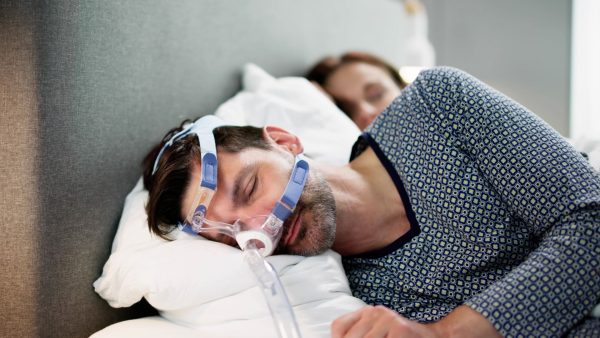
For many sleep apnea patients, the challenge is getting accustomed to wearing a face mask while sleeping. Masks are lightweight and come in a variety of designs, so a sleep specialist can help match the best option for comfort. Still, many people diagnosed with sleep apnea stop using the CPAP machine after trying it for a week or two. Some studies show as many as one-third of CPAP users quit. Cohen is aware of those trends, but he finds his patients have a much higher acceptance rate.
“Unfortunately, there are a lot of doctors who make their money doing the sleep study and then selling the CPAP, and then they don’t follow up as closely,” he said. “So, people will start having issues. I try to see my patients back quickly, troubleshooting issues, and really try to instill into my patients that if you’re not able to use this thing through the night, that’s OK.
“Just try putting it on every night, getting used to that, and not trying to stress out all night using it and trying to sleep with it. If you wake up and it’s bothering you, just take it off and we’ll try again tomorrow. And that cuts a lot of the stress of using it and the frustration that people get.”
Cohen said feedback is very positive from his patients who stick with the CPAP machine.
“Their partners are happy, I’m sure, because of the snoring,” he said. “It’s simple but complicated because essentially, I am telling you to sleep differently than you’ve slept for the last X number of years. It really takes getting into a routine and the habit of using it. But I would say the majority of my patients within two to three months will be sleeping better, feeling better and definitely happy with what we did.”