When the Jewish Light reported that Torah Prep School of St. Louis had purchased a building on Olive Boulevard for its expanding boys’ division, the story seemed complete.
But, within hours, my inbox started filling up.
Readers who had walked those halls in the 1960s and ’70s wrote to say the building had a much deeper Jewish past — as a Jewish Community Center branch, a hub of youth programs and a place where a generation of St. Louis Jews first found community.
Together, their memories revealed something the original story only hinted at: this wasn’t just a school expansion — it was the latest chapter in a building that has quietly served Jewish life for more than 60 years.
Some readers simply wanted to add missing history. Others shared personal memories that helped fill in the gaps.
The first email came from Josh Kranzberg, who wrote after reading the original story that the building’s Jewish history stretched back much further than its years as the Rabbinical College. He noted it originally opened in 1961 as the Charles H. Yalem Building, a Jewish Community Centers Association facility that operated into the 1970s. He also pointed out the property borders Ohave Sholom Cemetery, where Holocaust survivor Rudolf Oppenheim is buried.
“I know because I used to go to AZA meetings and events there in the ’60s,” wrote Eric S. Richman, recalling the building’s years as the University City branch of the JCCA.
Joyce Olshan remembered it as part of a turning point in where Jewish St. Louis gathered.
“I remember it as the first version of a western ‘Y,’” Olshan wrote. “The main Jewish center in my day was on Union in the city. The Jewish community was on its early western migration.”
Merryl Winstein recalled childhood visits with her family, including exercise classes her mother attended and summer art programs she and her sister joined there.
“It was an exciting, clean, new-smelling building,” she wrote, remembering classes and activities from the early years as Jewish institutions expanded west.
Other readers helped fill in the historical record.
Larry Fry, who dug deeper into the building’s history after the story ran, helped piece together a fuller timeline, including its opening as the Yalem Building in 1961 and its role during a period when Jewish institutions were following families west from the city.
Taken together, their recollections helped clarify the building’s long Jewish timeline.
A building tied to Jewish migration
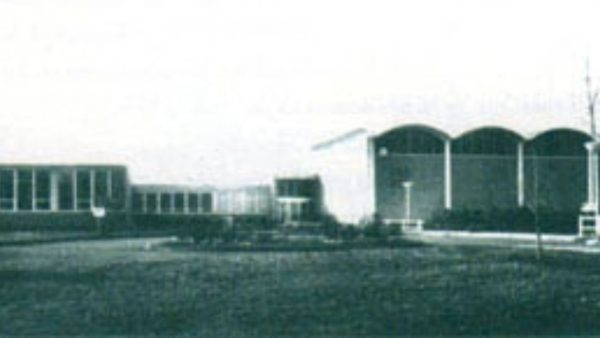
The facility opened in 1961 as the Yalem Building, named for St. Louis businessman and philanthropist Charles H. Yalem, whose financial support helped make the project possible.
At the time, the Jewish Community Centers Association was expanding west to serve families leaving older city neighborhoods. The Olive and Hanley location became an early hub in that transition before activities later consolidated farther west at the Millstone Campus near Creve Coeur.
The building became known as a place for youth programs, senior activities and community gatherings during a period when the geographic center of Jewish St. Louis was shifting.
Yalem was known for supporting Jewish institutions he believed would strengthen Jewish life in St. Louis. Decades later, the building is still doing that work.
From community center to Jewish learning
After its years as a JCCA facility, the building became home to the St. Louis Rabbinical College in 1966, after community center operations moved west to the new Carlyn H. Wohl Building on the Millstone Campus.
That chapter added another layer of Jewish educational use to the property’s history.
That connection also carries meaning for Torah Prep. Rabbi Tzvi Freedman, who founded the school. He once studied at the Rabbinical College when it occupied the site.
Today, Torah Prep plans to renovate the roughly 23,000-square-foot structure to support continued growth in its boys’ division.
School leaders say the move reflects both practical needs and the continued expansion of Orthodox Jewish education in St. Louis.
When readers become historians
If not for the emails, much of that history might have remained scattered across archives and personal memories.
Instead, readers helped connect youth programs of the 1960s, rabbinical training of later decades and now the expansion of a Jewish day school.
This is how stories about Jewish St. Louis are supposed to work.
A story goes out. The community answers back. The story gets better.
In this case, what began as a real estate story became something else: a reminder that buildings can hold more than classrooms or offices. They can hold decades of community life.
Some buildings simply change hands. Others keep finding their way back to the same purpose.
At 7400 Olive Blvd., Jewish history didn’t just happen once. It keeps rolling on.