
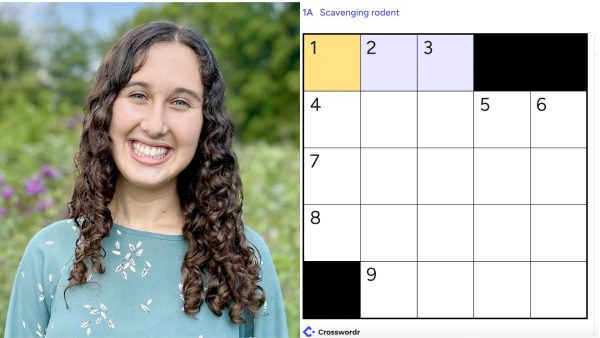
“Character sketch,” “golden doodle” and “contact trace,” are all theme answers to the Monday, Jan. 6, 2025, New York Times crossword created by Washington University student Rena Cohen. Each is a clever play on the final revealer clue, “draw conclusions.”
Cohen, a Rodriguez scholar, is a sophomore at WashU majoring in psychology with minors in Spanish and applied linguistics. That Jan. 6 puzzle is one of six she has had published in the Times. Her puzzles have also appeared in Spyscape and the Los Angeles Times. Her next puzzle is scheduled for Apple News later this month.
Cohen, 19, who is Jewish, doesn’t see much overlap between crosswords and Judaism. But in her view, solving a crossword can be like studying a tricky passage of text.
“The same way you could look at a Torah portion and interpret it in a different way, you’re looking at different patterns in English and trying to find double meanings and interpret them or see new patterns that other people haven’t seen before,” she said.
Her introduction to crosswords came as a child sitting with her dad, Judah, trying to figure out certain clues. Now they are a core part of her life.
Cohen is from Bloomington, Ind., where she grew up playing Boggle, Scrabble and whatever other word games she could find. Crosswords quickly became her favorite. Before she could solve a 15-by-15 grid, she started creating puzzles with her dad and mailing them to the New York Times.
One of Cohen’s first puzzles included variations of “Why did the chicken cross the road?” jokes; another was based on books by Judy Blume.
She is a self-described perfectionist who still uses her family as test solvers, sometimes sending eight variations of the same crossword with slight changes to see which clues they prefer the most.
Her dad, a former professor at Indiana University and now provost of the Hebrew Union College, says the tendency to leave no stone unturned and check for every single tiny detail has helped her develop as a cruciverbalist — a skilled crossword puzzle solver.
Across and down destiny
When she was 9, Cohen saw Will Shortz, an IU alumnus and longtime crossword editor at the New York Times, speak on campus. After the talk, she started submitting handwritten notes to Shortz along with her puzzles.
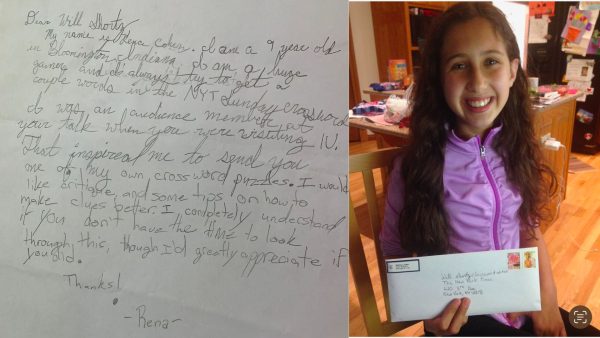
“I was an audience member at your talk when you were visiting IU,” one note read. “That inspired me to send you one of my own crossword puzzles. I would like a critique and some tips on how to make clues better.”
Three years later, Cohen met Shortz at another IU event. At this point, she was determined to become the youngest person to have a puzzle published in the Times — a mark set by fellow Bloomington native Daniel Larsen in 2016 when he was just 13 years old.
Cohen did not beat the record and took a break from crosswords until 2021. At first, she started solving and then began constructing again. Over time, she better understood “the language of crossword puzzles” and crossword culture.
In fall 2023, she was selected to be part of the New York Times Diverse Crossword Constructor Fellowship, where she worked alongside an editor, pitching ideas and getting constant feedback. Her skills rapidly improved. The puzzle she made during the fellowship ended up being the first of the group’s published by the Times on Oct. 3, 2024.
“It felt very surreal, because it was one of those deja vu moments I’ve envisioned so many times, and it finally happened,” she said.
After the fellowship, Cohen applied for a mentor through the Crossword Puzzle Collaboration Directory, a Facebook group that aims to support crossword constructors from diverse backgrounds. She was paired with Kate Chin Park, the associate puzzles and games editor at The New Yorker, who said Cohen quickly overcame the usual struggles a newer cruciverbalist faces.
“She has a wide range of themes that she comes up with,” Park said. “It might be some sort of pun-based wordplay, letter transformation or something visual in the grid. It’s not like she had a handful of ideas and got boxed into doing the same thing. She’s genuinely inventive.”
Cohen said she used to focus on including specific words in puzzles, but changed her perspective after adopting Park’s adage: “Your grid is only as good as its worst word.”
Gridding her own path
Historically, crosswords were written by older white men. Grassroots movements have led to the New York Times and other news outlets publishing more puzzles by people from underrepresented backgrounds. Including a diverse group in the test-solving process is crucial because it helps prevent the chances of accidentally publishing a slur. For example, in 2019, the Times published a puzzle that included “Beaner,” a slur against Mexicans. Incorporating clues that reflect a variety of experiences also makes puzzles more engaging for a broader audience.
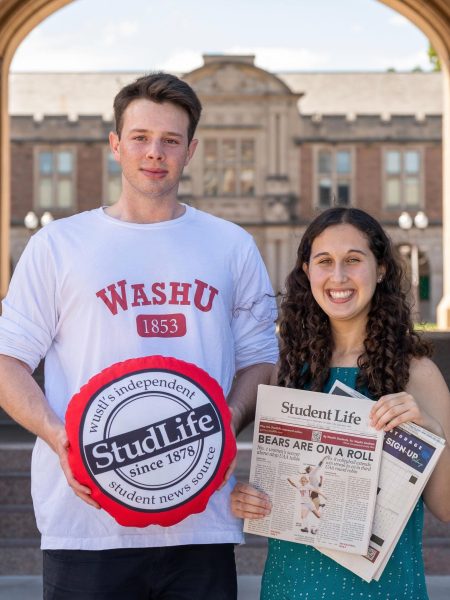
“You want the language in the puzzles and themes to appeal to a more diverse audience,” Cohen said. “It’s in everybody’s best interest.”
In the fall of 2024, she started at Washington University and joined the student newspaper, Student Life. She hoped to start a daily minipuzzle tailored toward WashU students.
“A lot of people my age are intimidated by crosswords, and I don’t like that,” Cohen said. “I want people to think they’re accessible.”
At the newspaper, she met Alex Nickel, a senior at the time, who had been the one-man crossword section for the past three years. He always wanted to do more than publish once a week. It wasn’t until meeting Cohen that doing so felt like a real possibility.
“Immediately she had so many ideas,” Nickel said. “I’ve never seen someone so quickly hit the ground running on the thing that they love.”
They decided that by Halloween 2024, they would start publishing daily minicrosswords, or minis, online. They worked with other members of the newspaper staff to build a games page on the website and quickly ramped up the number of puzzles they were producing.
To date, more than 17,000 people have solved the daily minis. After Nickel graduated, Cohen took over running the section.
Teaching through wordplay
Last winter, Cohen recruited Vinisha Tripathi, a fellow WashU sophomore, who in her words was “horrible” at the New York Times mini crosswords.
Inspired by Cohen, Tripathi worked up the confidence and eventually began creating her own minis. Her first one took five hours to complete. After she submitted it, Cohen sent back detailed notes.
“She sent back advice for every single clue and word. I don’t think I’ve ever received feedback like that from my professors,” Tripathi said. “She was so in touch with everything.”
Tripathi now regularly contributes minis to the Student Life games section. She hopes to submit a 15-by-15 grid to the New York Times by the end of this year.
Cohen encourages fellow WashU puzzlers to build grids around topics they enjoy. Tripathi often includes references to Disney movies in her puzzles, while another student, aiming for a Rosh Hashanah–theme puzzle, worked with Cohen to include answers such as “babka” and “kugel.”
Although Cohen no longer relies on her dad’s help to construct puzzles as she did in childhood, he still enjoys being part of the process. He solves all of her puzzles, often sparking long, candid discussions about which clues will work and which won’t.
Over the summer, they collaborated on a generation gap puzzle, blending words from Judah Cohen’s childhood — familiar mostly to those in their 40s or older — with slang commonly used by people 25 and under.
“It was a really rewarding experience,” Judah Cohen said.
Even as the semester ramps up and finals approach, Rena Cohen does not plan on slowing down. She wants to make more puzzles on 21-by-21 grids and be published more frequently in the Times. While she has accomplished so much, the difficulty only seems to fuel her.
“For as many puzzles that get accepted, there still are multiple rejections,” she said.