

In November, I wrote that I was heading to Israel to see firsthand how the Jewish Federation of St. Louis funding makes a difference. In January, I stood inside Galilee Medical Center in Nahariya, listening as its deputy director calmly explained how the hospital prepares for the next war.
A month later, the next war arrived.
This week, as Israel confronts direct escalation with Iran, sirens are once again part of daily life in Nahariya. In a video recorded inside the hospital, Deputy Director Dr. Tsvi Sheleg described what happens when the alarm sounds.
“We have up to 15 seconds,” he said. “Everyone needs to get to sheltered areas like we just did.”
Within hours, the hospital was fully operational underground.
“It took us about four hours to make sure the whole hospital is fully functional in protected facilities,” he said.
In January, that four-hour deployment plan sounded procedural. Now it is real life.
Built for the moment no one can schedule
Galilee Medical Center sits six miles from the Lebanese border and serves more than 650,000 residents across the Western Galilee. It is the closest hospital to any Israeli frontier and functions as a Level 1 trauma center.
During earlier phases of the war in Gaza, the hospital operated underground for 14 months. Missile fragments landed in its parking lot. A drone strike hit within 500 meters.
No patients or staff were killed. That outcome, hospital leaders insisted in January, was not luck. It was preparation.
“We have checklists. Everybody knows exactly what to do,” Sheleg told us during our visit. “We did it already. We will do it again if it is needed.”
The staff knows which departments must move and which must remain in protected spaces. Intensive care units cannot simply be wheeled downstairs. Ventilated patients require teams, monitors, power connections and time. Moving the entire hospital safely can take hours.
They rehearse for that.
Now they are living it again.
What that means for St. Louis
The number that stuck with me in January was four hours.
That’s how long it takes to move a working hospital underground when there are 15 seconds between siren and shelter.
In January, I wrote it in my notebook. This week, they’re living it.
The Federation’s partnership region stretches into Israel’s north. It stops feeling abstract when you’re standing in the hospital’s emergency department, the one our community helped equip with advanced monitoring systems. Then you see those same machines downstairs in the fortified complex — already installed, already wired, already tracking heartbeats.
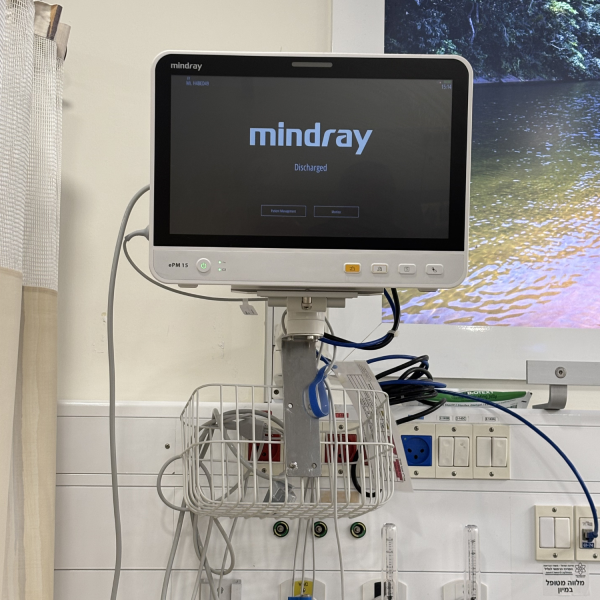
They allow doctors and nurses to monitor vital signs without interruption. When beds are rolled downstairs, the data rolls with them. And when you hear that information, a partnership stops being a nice photo and starts being structural.
Reinforced ceilings. Protected emergency rooms. Equipment waiting below ground before the first patient even arrives.
Four hours isn’t a slogan. It’s what keeps an emergency room functioning when everything outside is not.
What you can’t see from St. Louis
From St. Louis, it’s easy to picture buildings. It’s harder to picture the people inside them.
We don’t hear the sirens. We don’t feel the 15-second countdown. And we don’t see what that kind of routine does to doctors and nurses over time.
“All of us are post-trauma persons,” Sheleg said when I asked about the toll on staff.
Doctors and nurses who treat severe injuries one hour may drive home under rocket fire the next. Some relocated for a while. A few left the region. Most stayed.
“This is our home,” Sheleg said. “There is nowhere we can go.”
The hospital has psychologists and social workers. But at 2 a.m., in a trauma room, it’s often senior physicians who pull someone aside after a brutal case and make sure they’re steady enough to keep going.
Back underground
In the video recorded this week, doors close behind staff as they enter protected areas. The alarm stops, but the work doesn’t.
“Since then, we’ve been doing the same thing as we used to do throughout the whole war,” Sheleg said.
No speeches. No theatrics. Just a doctor, doing his job.
In January, I listened as hospital leaders described how they prepare for the next war. A month later, that preparation is being used again.
This is what I went to see.
And this is what it looks like when it counts.