
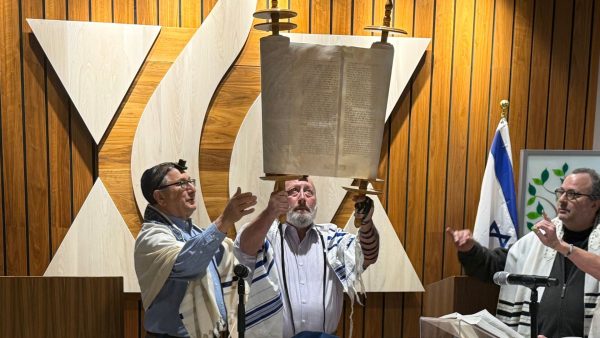
Last week, while working on a story about minyans at Congregation B’nai Amoona, I was invited to perform Hagbah, the ritual lifting of the Torah following the morning reading.
Before this moment, I mostly understood Hagbah academically. A ritual. A responsibility. A meaningful honor inside a Jewish service.
Then suddenly, there I was standing over an open Torah on the bimah thinking:
“My back has been out since my 50,000 steps at Jazz Fest. Should I really be lifting a Torah over my head right now?”
The night before, Rabbi Jared Skoff gave me quick instructions.
“Bend your knees.”
“Use your legs.”
“Lift carefully.”
Simple enough.
The Torah itself was spread open maybe a foot and a half wide. Beautiful. Ancient. Sacred.
But standing over it on the bimah, I realized pretty quickly this was going to be more of a balancing act than a lifting contest.
I grabbed the wooden handles, bent my knees and lifted.
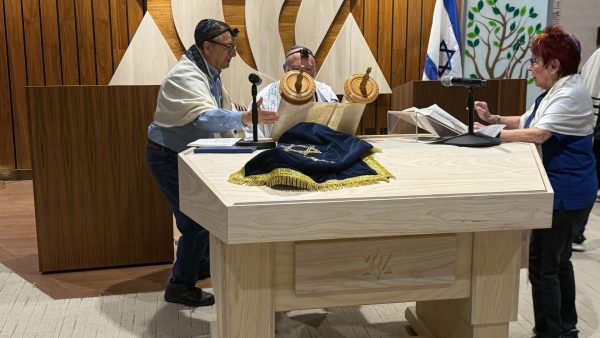
And to be fully honest, while everyone else may have been focused on the holiness of the moment, I was mostly thinking:
“Please don’t let me be the schlep who drops or tears the Torah.”
That was my spiritual state.
Then came the turn.
Part of Hagbah involves slowly turning so the congregation can see the words of the Torah, which sounds very graceful when you describe it afterward. In reality, with an achy back and roughly 25 pounds over your head, it feels a little more like carrying a couch down icy stairs.
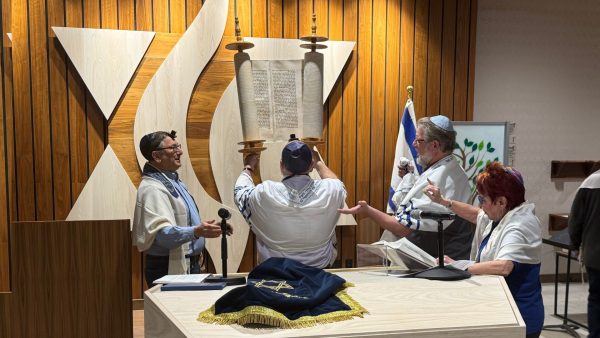
Then, a kind soul approached and gently guided me toward a nearby chair. I sat down still holding the Torah upright while another group moved in to dress it and return it to the ark.
The whole thing probably lasted less than a minute.
But after the Torah was finally taken from my hands and returned to the ark, I stayed sitting there for another moment.
That’s when the thought hit me.
At first, I was only thinking about physical balance.
Then suddenly, without warning, I started thinking about the balance of my actual life.
Not in a deep, thunderbolt-from-the-heavens kind of way. But the feeling was real.
I realized I spend most of my life trying to keep things upright.
My work.
My health.
My back.
My deadlines.
My medications.
My family.
My finances.
My energy.
My ambition.
And maybe hardest of all, trying to maintain the appearance that I have all of this under control.
The truth is, I probably look more balanced than I actually feel.
I love what I do. I really do. But there are days when stopping to stretch, take my pills or simply walk away from the computer for 10 minutes feels strangely stressful because when I’m doing that, I’m not chasing a story, writing a story or worrying about the next story.
The irony, of course, is that refusing to stop is part of what throws everything out of balance in the first place.
And maybe that’s why Hagbah hit me harder than I expected.
Because I was prepared for the weight.
I wasn’t prepared for the balancing act.
What stayed with me most wasn’t even the lifting itself. It was the moment someone stepped in to guide me toward the chair.
Relief instantly replaced anxiety.
Not because a weight was lifted, but because I realized I wasn’t holding it alone anymore.
That may actually be the most Jewish part of the entire experience for me.
From the outside, Hagbah looks like one person lifting the Torah. But in reality, it takes several people to keep everything steady.
One person lifts.
Another guides.
Others step forward to help dress it, support it and eventually return it safely home.
That feels less like ritual to me now and more like life.
I experienced that same feeling earlier this year standing at the Western Wall in Jerusalem. I remember thinking that I had technically belonged to this club my entire life, but for the first time, I finally felt like I was inside the clubhouse.
That feeling returned during Hagbah.
Not because I suddenly became more religious.
Not because I uncovered hidden spiritual depth.
But because for one brief minute, standing there awkwardly trying not to tip sideways under the weight of something sacred, Judaism stopped feeling theoretical.
I could feel it in my legs.