
To say the past 25 years have been full of twists and turns is a gross understatement. The St. Louis Jewish community has experienced moments of challenge, growth and reinvention, and the Jewish Light has been there to chronicle it all.
Before 2026 fully kicks off, let’s look back at a topic-by-topic collection of some of the people, events and trends that helped shape the past quarter century.
Jewish organizations: Mergers/closings
The synagogue and broader Jewish institutional landscape have changed dramatically over the past 25 years, marked by a series of mergers, closures and reorganizations.
In 2006, Orthodox congregations Beth Hamedrosh Hagadol and Sha’arei Chesed merged to form the U City Shul. Five years later, in 2011, the Saul Mirowitz Jewish Community School was begun when Saul Mirowitz Day School-Reform Jewish Academy merged with Solomon Schechter Day School. Meanwhile, Congregation Kol Am voted to dissolve amid financial pressures.
The pace of change continued in 2013, when Shaare Zedek and Brith Sholom Kneseth Israel merged to form Kol Rinah, which eventually swapped buildings with Journey Christian Church and is now based in Clayton.
ADVERTISEMENT

In 2016, the historic St. Louis Reform congregation B’nai El officially merged into Congregation Shaare Emeth. That same year, the Louis and Sarah Block Yeshiva High School closed after 38 years.
In 2019, H.F. Epstein Hebrew Academy announced the sale of its eight-acre campus and a merger with Yeshivat Kadimah High School to form a single school.
Torah Prep moved in 2021 from 8659 Olive Blvd., the site where a Costco now sits, to the former McNair Building, a 44,000-square-foot facility that had been part of the University City School District.
In 2020, Jewish Federation of St. Louis closed the Center for Jewish Learning eight years after merging the Central Agency for Jewish Education (CAJE) into Federation.
Jewish cultural institutions also saw significant losses, including the loss of longtime kosher options like Pratzel’s Bakery (2011), Diamant’s Kosher Meat Market (2011) and Kohn’s (2024). Jewish deli Pumpernickles also closed in 2022.
A new philanthropic force
In the past 25 years, real estate developer Michael Staenberg emerged as the most prominent philanthropist in the St. Louis Jewish community. In 2005, he established the Staenberg Family Foundation, which has provided millions of dollars in support of synagogues and Jewish institutions across the region, including the Jewish Light, which he serves as board president.
Through the scale of his giving and the transformative impact on the institutions he has supported, Staenberg has become one of the most influential Jewish philanthropists in St. Louis.
Millstone campus revamped
Since 2000, the I.E. Millstone Jewish Community Campus near Creve Coeur has undergone a comprehensive transformation. With a $49 million capital campaign, led with a $15 million donation from Staenberg, the J reimagined its facilities on the campus. Construction on the J’s new buildings began with a groundbreaking in 2007, followed two years later by the opening of the J’s Staenberg Family Complex. In 2010, renovations to the J’s Carlyn H. Wohl Arts and Education Building were completed.
The campus has continued to evolve in recent years. From 2015 to 2025, Covenant Place was overhauled, with newly constructed Covenant Place I and II buildings and a major overhaul of the Covenant III building.
In 2018, Jewish Federation celebrated the completion of a $3.5 million renovation of its building, renamed the Kaplan Feldman Complex.
In 2021 the Staenberg Family Mikvah reopened after a full renovation and modernization.
The Millstone Campus also is home to the St. Louis Kaplan-Feldman Holocaust Museum, named in honor of the families of Gloria Kaplan Feldman, a local Holocaust survivor and philanthropist, her late husband Rubin Feldman, and her brother David Kaplan, also Holocaust survivors. The museum undertook a $21 million transformation, building a new museum that tripled its space. The new St. Louis Kaplan-Feldman Holocaust Museum opened in November 2022.
Hiring and retiring
St. Louis synagogues and Jewish organizations have seen countless leadership transitions, with one notable trend being the growing presence of women in senior rabbinic roles.
In 2010, Temple Israel’s Rabbi Mark L. Shook retired, and Rabbi Amy Feder became senior rabbi. United Hebrew Congregation hired Rabbi Brigitte S. Rosenberg in 2004; she became the congregation’s first female senior rabbi in 2011. Temple Emanuel welcomed its first female rabbi, Elizabeth Hersh, in 2013.
At Shaare Emeth, longtime Rabbi Jeffrey Stiffman retired in 2004, succeeded by Rabbi James M. Bennett. In 2020, Associate Rabbi Rachel Bearman joined Rabbi Andrea Goldstein and the clergy team.
Central Reform Congregation’s founding rabbi, Susan Talve, retired last year. Rabbi Randy Fleisher, who joined CRC in 2001, continues to serve alongside Rabbis Daniel and Karen Bogard, who arrived in 2018.
At B’nai Amoona, Rabbi Carnie Shalom Rose became senior rabbi in 2005 and departed in 2022 to lead the Cleveland Jewish Community Center (he has since left the role). Rabbi Jeffrey Abraham assumed the senior role at B’nai Amoona that year and continues to serve.
Beyond the pulpit, leadership changes shaped other Jewish institutions. In 2018, Kathleen Sitzer retired after leading the New Jewish Theatre for 21 years. In 2009, Jacqueline Levey became executive director of St. Louis Hillel at Washington University, a title she still holds.
After 17 years at the helm of the J, Lynn Wittels retired in February 2024 and Steven Rosenzweig took over as president and CEO later that year.
Jewish Federation of St. Louis also experienced significant transitions. Barry Rosenberg stepped down as CEO in 2012 and retired the following year. Andrew Rehfeld led the organization from 2012 to 2019 before becoming president of Hebrew Union College. Brian Herstig served from 2020 to 2024. In December 2024, Danny Cohn was appointed.
After 23 years as the Executive Director of Crown Center Nikki Goldstein retired in 2023, and Andy Thorp was appointed following her departure.
Cemetery headstones toppled
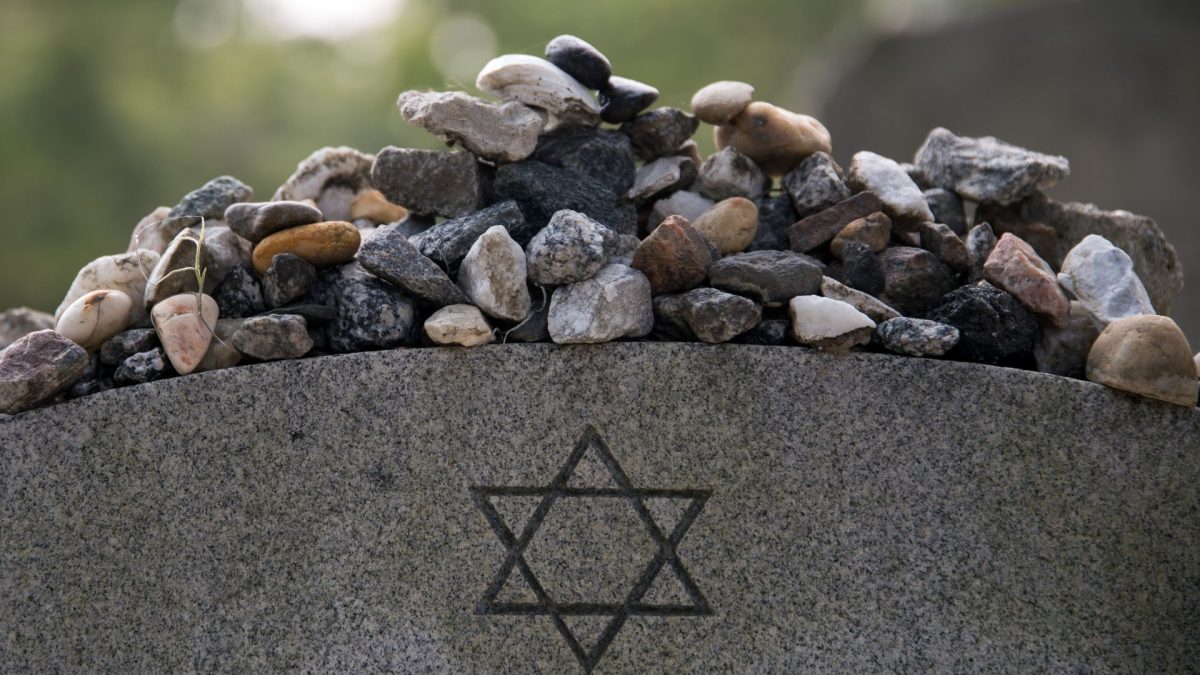
In February 2017, over 150 headstones were overturned at at Chesed Shel Emeth Cemetery in University City, causing more than $30,000 in damage. The event sparked national coverage and prompted then-Gov. Eric Greitens and then-Vice President Mike Pence to visit the cemetery. In 2018 police arrested Alzado Harris for the vandalism. Harris, who said he was drunk and high when he knocked over the headstones, was charged with institutional vandalism. In March 2019, he was sentenced to three years of probation.
Notable deaths
Over the past quarter century, the Jewish community has lost many influential figures. Among them were philanthropists I.E. Millstone and Saul Mirowitz, both of whom died in 2009, and Rabbi Sholom Rivkin, chief rabbi emeritus of the United Orthodox Jewish community, who died in 2011.
In 2024, the community mourned the deaths of St. Louis philanthropists Sam and Marlyn Fox, as well as baseball player and International Jewish Sports Hall of Fame member Ken Holtzman.
Other notable losses include Rabbi Alvan D. Rubin, the rabbi emeritus of Temple Israel, who died in 2006; Rabbi Aaron Winter, longtime leader of Tpheris Israel Chevra Kadisha in Chesterfield, died in 2018.
The three co-founders of the St. Louis Holocaust Museum and Learning Center died within a few years of each other: Bill Kahn, former executive director of the Jewish Community Center and the Jewish Federation of St. Louis, died in 2013; Holocaust survivor Leo Wolf died in 2016; and Thomas R. Green, past president of the Federation died in 2017.
Historic, brief tenure
In 2016, Missouri elected Greitens its first Jewish governor. In January 2018, Greitens admitted to having an extramarital affair with his hairstylist in 2015. Three months later, a bipartisan Missouri House special investigative committee released a report alleging that Greitens had been physically and verbally abusive toward women during that same period. Less than six months into his term, Greitens announced in late May 2018 that he would resign at the end of that month.
Noted Jewish speakers
Over the past 25 years, St. Louis has served as a stage for some of the most influential Jewish voices of the modern era. Elie Wiesel, the Nobel Peace Prize laureate and Holocaust survivor, spoke at St. Louis University in December 2009, drawing more than 1,800 attendees for one of the largest Jewish-related public lectures in the city’s recent history. Wiesel returned to St. Louis in May 2011 and delivered the commencement address at Washington University.
In November 2016, former Israeli Prime Minister Ehud Barak spoke in St. Louis.
Last year, freed Oct. 7 hostage and author Eli Sharabi shared his experiences in captivity.
Beyond individual speakers, the St. Louis Jewish Book Festival become a stop on the national Jewish intellectual circuit in the 2000s and 2010s.
Oct. 7, politics and Israel
Over the past 25 years, St. Louis’ Jewish community has repeatedly mobilized in response to Israel-related events, often finding itself at the center of broader civic debate. In July 2016, the city welcomed the JCC Maccabi Games for the second time, drawing more than 4,500 Jewish teen athletes, families and spectators, after its first turn as host in 2003.
Following the Hamas attacks on Israel on Oct. 7, 2023, St. Louis saw multiple solidarity rallies, with an early gathering drawing more than 1,500 participants.
That same year, local rabbis and Jewish organizations issued an open letter to U.S. Rep. Cori Bush, criticizing her repeated public statements and votes related to Israel, which many in the Jewish community viewed as one-sided or dismissive of Israeli security concerns. The dispute became a flashpoint in local politics, and in 2024 Bush lost the Democratic primary to St. Louis County Prosecuting Attorney Wesley Bell, a race widely seen as influenced in part by organized support for Bell from Jewish voters and allies.
After Oct. 7, protests also spread to area campuses. At Washington University, demonstrations included an attempted encampment in late April 2024, reflecting similar movements nationwide.
Other significant events
In 2003, the Jewish Center for Aged built Cedars as a modern senior care facility; although it faced financial struggles and it was sold to new owners in 2010. By 2016 the facility was sold to Lutheran Senior Services in 2016.
In May 2008, a Torah was stolen from Bais Menachem.
In 2016, Chabad of Greater St. Louis unveiled its newly renovated Morris and Ann Lazaroff Center on Delmar Boulevard after a $1.5 million renovation, marked by a dedication ceremony attended by then-Gov. Jay Nixon.
Sababa, St. Louis’ community-wide Jewish arts and culture festival, debuted in 2018 as a joyful celebration of music, food and creativity, quickly becoming a signature gathering. Plans were halted in 2020 when the pandemic forced its cancellation, but the spirit of Sababa endured. The festival returned in 2022 and again in 2024, bringing the community back together once more.
Chabad also launched a Jewish center in St. Charles in 2019 to offer a geographically convenient source of learning and celebrations for the growing Jewish population in St. Charles County.
When the COVID-19 pandemic closed synagogue doors across St. Louis, the Jewish community quickly adapted with resilience and creativity. Shabbat services, classes and meetings moved to Zoom, keeping people connected even while apart. Life-cycle moments such as b’nai mitzvahs, weddings and shivas were reimagined online or outdoors, often allowing far-flung family and friends to take part. At the same time, congregations and agencies organized wellness check-ins, food distribution and other support for those in need, revealing new, more flexible ways of sustaining community during an unprecedented time.
In 2018, MaTovu opened, creating programming and events rooted in Jewish values and located in the city.
In late 2022 and early 2023, Crown Center demolished the original Tallin Building, replacing it with a five-story, 52-unit residential building and Staenberg Commons, which has 48 new, modern apartments, offering new affordable housing options in University City.
In 2024, Federation released its latest community study, which showed the number of Jews living in the greater St. Louis area had decreased to roughly 46,000 from 60,000 in 2014.
Also in 2024, Missouri school districts began requiring Holocaust education for students in grades 6-12. That same year, a firebombing occurred in Clayton, prompting an ongoing hate crime investigation.
In fall 2024, Jewish Student Union of St. Louis renovated a building at 8037 Delmar Blvd. in University City and opened the JSU Staenberg House.
The J’s Marilyn Fox Building underwent a 15-month renovation, highlighted by the addition of adult day care, expanding services for seniors and adults with special needs in the Chesterfield area. Funded by a $16.2 million capital campaign and completed in 2025, the project also refreshed the community commons, studios, locker rooms and shared spaces.
And in November 2025, a historic ribbon-cutting was held for the first-ever Jewish cemetery in St. Charles County. Local leaders described the opening as a “meaningful milestone” for the region’s growing Jewish population.
If we’ve overlooked any major local Jewish events or milestones, please let us know by emailing Editor-in-Chief Ellen Futterman at [email protected].