
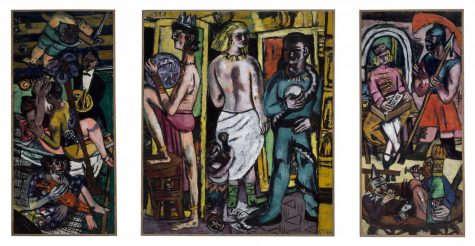
Max Beckmann
1937-39
When I think of art with themes of leisure, I think of Claude Monet and his garden of water lilies in Giverny, Max Beckmann and his characters relaxing and frolicking at the beach, and George Seurat’s “Bathers at Asnieres.”
The art of leisure through history
Spanning virtually all time periods and cultural traditions, depictions of leisure have enjoyed varying degrees of popularity and veneration in art. Several artifacts from ancient Egypt depict royal subjects at leisure, while later the more humanized divine subjects of Greek and Roman mythology were often shown in moments of play or rest, notably on Greek ceramics. Scenes of ordinary people at leisure did not become common in the West until the 17th and 18th centuries, as secular art gained a foothold.
Leisure was a central focus of 18th-century Rococo painters such as Jean-Honoré Fragonard. The 19th century saw leisure presented in countless ways, from Édouard Manet’s “The Luncheon on the Grass” to Seurat’s “A Sunday on La Grande Jette.”
Class, identity, and changing perspectives
Leisure has long been a central theme in art, reflecting societal norms, cultural values and personal aspirations. From the leisurely countryside outings depicted in Impressionist paintings to the grand celebrations of aristocratic life in Rococo works, artists have used leisure as a lens through which to explore class, identity and shifting social dynamics. In historical art, scenes of leisure often reinforced status distinctions — who had the luxury of relaxation and who did not.
Modern depictions challenged these traditional representations, embracing diverse perspectives and questioning accessibility. Whether through the serene contemplation of nature, the bustling energy of social gatherings, or the quiet solitude of a reader lost in a book, artistic portrayals of leisure invite viewers to consider how recreation shapes human experience across time.
Movements that celebrated leisure
Several art movements have prominently featured leisure as a theme, reflecting changing attitudes toward relaxation and recreation. Impressionism, led by artists like Monet and Renoir, captured scenes of leisure in outdoor settings, emphasizing light, movement and everyday enjoyment. Rococo, with its ornate and playful style, depicted aristocratic leisure through lavish gatherings and idyllic pastoral scenes. Post-Impressionism, particularly in Seurat’s work, explored leisure through structure and balance, while genre painters chronicled domestic and social life with intimate precision.
ADVERTISEMENT

Leisure in modern art and beyond
Summer itself evokes leisure — days filled with relaxation, sunlight and the pursuit of joy. Artists like British painter David Hockney, who fell in love with California’s light and private swimming pools, made such images iconic. French Impressionist Frédéric Bazille painted the easy camaraderie of contemporary life, while American realist Edward Hopper found solace and inspiration on the quiet coastlines of Cape Cod.
Themes of leisure extend far beyond painting. Sculpture has captured moments of reflection — Rodin’s “The Thinker” embodies stillness and thought. Photography documents leisure’s rituals, while dance expresses it through movement, and music through rhythm and mood. In literature, theater and film, leisure becomes a universal story of travel, celebration and simple being.
Across forms and centuries, the art of leisure through history remains a powerful mirror of humanity’s search for joy, balance and meaning.
I’m off to “soak in” some culture and relaxation on this beautiful day in our arts-and-culture-laden St. Louis.