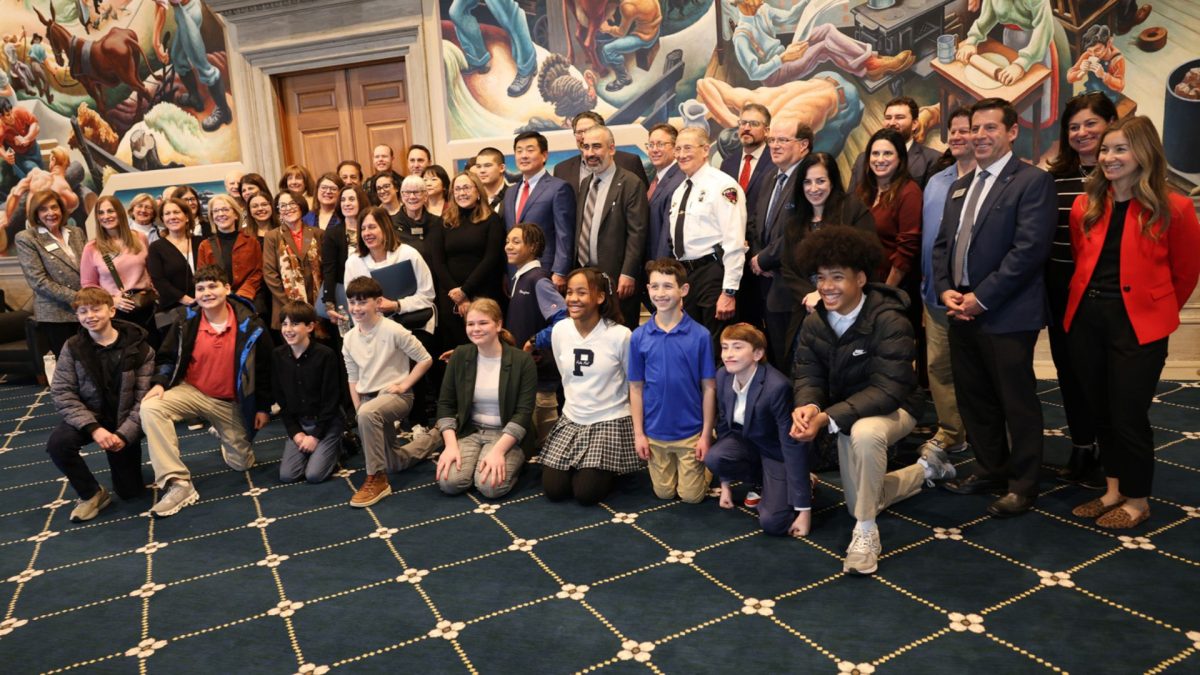

Protection from antisemitic incidents in Missouri schools will officially take effect on August 28. Missouri Governor Mike Kehoe signed House Bill 2061 into law on April 23 at the state capitol. HB 2061 prohibits antisemitic actions against students and faculty in public schools, charter schools and colleges.
The legislation was sponsored by state Rep. George Hruza, R-St. Louis County. Flanked by Hruza and state Senator Curtis Trent, R-Springfield, Kehoe said before signing the bill that antisemitism has no place in Missouri.
“What this bill does is exactly that,” Kehoe said. “And it’s also a fundamental right of every student to be able to learn free from hate.”
The law recognizes that antisemitism is a form of discrimination and requires schools to modify their policies to treat antisemitic conduct in the same category as discrimination on the basis of race, ethnicity, national origin sex, disability, religion or marital status, as well as harassment, intimidation and denial of equal access. Missouri schools and school districts already provide publicly accessible policy statements related to discrimination.
HB 2061 will require those policies to include antisemitism when addressing compliance with Title VI of the of the Civil Rights Act of 1964. Title VI prohibits discrimination on the basis of race, color, or national origin in any program or activity receiving federal financial assistance.
ADVERTISEMENT

Previously, there was precedent on the federal level for interpretation of antisemitic incidents as a form of discrimination. While Title VI has not historically included religion as a protected class, in 2004 the Department of Education’s office of civil rights issued policy statements indicating they would treat antisemitic incidents as a form of discrimination and investigate antisemitic complaints.
How the law will be applied
In addition to addressing antisemitism in the school’s official policy and/or rules of conduct, HB 2061 requires Missouri schools to report antisemitic incidents and complaints to the state Department of Elementary and Secondary Education (DESE), which will investigate the incidents and publicly report them to the legislature. DESE will be required to maintain and publicize a formal reporting process.
Enforcement of HB 2061 will come in the form of public reports. In the event an antisemitic incident in a school is not addressed by the administration, there will be a public accountability remedy. Failure to address Title VI violations could cause a school to risk losing federal funding.
The bill interprets antisemitic acts using the International Holocaust Remembrance Alliance (IHRA) working definition of antisemitism. Schools faced with incidents that may be addressed by the IHRA definition will also need to factor in the intent. That is because HB 2061 gives schools the latitude to consider whether a situation is allowed by First Amendment freedom of speech rights.
For example, if a college student were in a public space such as the student center distributing literature critical of Israel, the action would not violate HB 2061. However, if the same situation took place at the entrance of a gathering of Jewish students, it would constitute intent to create an antisemitic environment.
Missouri joins 17 other states
By establishing the new law, Missouri becomes the 18th state to create protection from antisemitism in schools either via legislation, resolution or executive order. HB 2061 is similar to the legislation passed in other states, according to David Soffer, director of state engagement for the Combat Antisemitism Movement (CAM).
“The key components of it are that it identifies the IHRA definition for antisemitism and identifying antisemitic actions accordingly,” Soffer said. “It puts the antisemitism definition into codes of conduct for students, faculty, and staff. It also will allow the Title VI coordinator to investigate claims, document them, and provide data that shows how many antisemitic incidents there have been.”
CAM supported the legislative path for HB 2061, as did the Jewish Federation of St. Louis and the Missouri Alliance Network. Danny Cohn, president and CEO of the Federation called the passage of HB 2061 a significant milestone.
“But the real work is in how this law is implemented,” he said. “We are committed to partnering with state leaders, educators and community agencies to ensure this law is applied fairly, thoughtfully, and in a way that reflects both its intent and our collective values.”
Stacey Newman, a founding board member of the Missouri Alliance Network, said getting HB 2061 passed and signed by the governor has been the group’s number one priority.
“However, the courageous Jewish students who testified in the Missouri house and senate, telling their painful experiences of harassment and intimidation at school, are the heroes we applaud,” Newman said. “Their stories, repeated in floor debate, were instrumental in legislators taking anti-Jew bullying seriously enough to pass protections long overdue for our Jewish community.”
According to Soffer, each new state providing legal protection from antisemitic acts helps establish an environment where society says no to hate.
“We’re grateful to all the states that have identified this and are working on it and have codified it or adopted it,” he said. “As long as antisemitism continues to rise and continues to be part of society, we need people and we need organizations that are dedicated to creating awareness and educating individuals of all backgrounds on why this is really important.”