
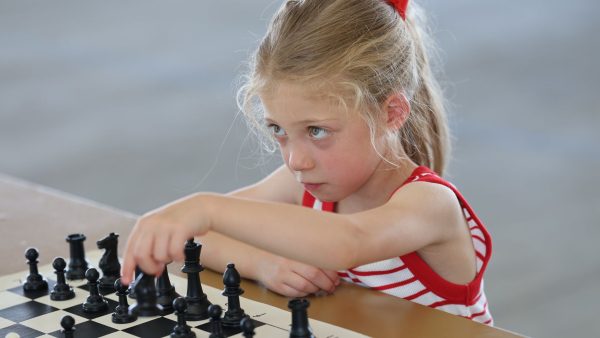
Six-year-old Jillian Yatkeman studied the chessboard, one hand cupped under her chin while the other readied her queen to kick off an enemy pawn.
Asked by her opponent what move he should make next, Jillian quickly shut him down.
“I’m not telling you.”
“You’re not telling me?” he replied, surprised.
“That would give away her strategy,” someone nearby noted.
Seated in the outdoor camp pavilion at the Jewish Community Center, the soon-to-be first grader visiting from Denver was locked into a chess game that was equal parts lesson, competition and family legacy. Oh, and her opponent? None other than Steve Rosenzweig, CEO of the J and an accomplished chess player himself.
ADVERTISEMENT

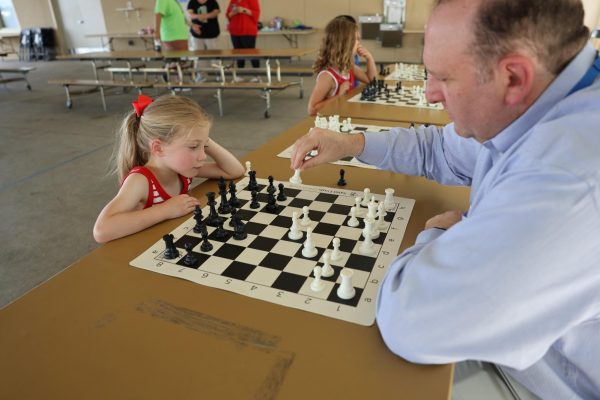
As the great-granddaughter of Sol Plattner, Jillian represents the newest generation connected to a family whose love of chess is now helping introduce the game to children throughout the J.
For Linda Yatkeman, Jillian’s grandma, and Yatkeman’s sister, Jackie Schneider, that legacy began with Plattner, their father.
“Chess was his passion,” Yatkeman said.
Plattner, who owned a shoe business in St. Louis, spent countless hours at the J. He exercised there, socialized there and, whenever he could, played chess.
“We say the J saved his life,” said Yatkeman, who lives in Richmond Heights.
A fund finds new life
In 1995, the family established the Sol Plattner Chess Program Fund, an endowment intended to support youth chess programming at the J and carry forward their father’s love of the game. The goal was simple: get young people interested in chess and, if possible, create opportunities for different generations to play together.
For years, however, the fund never quite found its footing.
“We were funding it and nothing was really happening,” Yatkeman said.
That changed when Julie Gibbs, the J’s chief philanthropy officer, revisited the fund after meeting with Yatkeman and discovered the original vision had largely stalled.
At the same time, Brett Barger, the J’s chief programming officer and a chess enthusiast himself, was looking for ways to weave chess into programs across the organization.
Chess spreads across the J
Today, the game is showing up everywhere from the Early Childhood Center to the J’s summer day camps as well as Camp Sabra.
And the kids are embracing it.
Barger remembers walking into a day camp activity room recently after chess was introduced as one of several optional activities.
“There were kids everywhere playing chess of their own choosing,” he said. “Really without any direction from anyone.”
Even more surprising, some of the children were teaching each other.
“Some of the kids were teaching other kids,” he said, noting that they ran the gamut in age from 6 to 12.
For preschoolers, the approach is less about strategy and more about familiarity. Children learn the names of the pieces, how they move and what a chessboard looks like. The program also includes children’s books featuring chess-themed characters like kings, queens and knights central to the story.
“It just starts their mind going and gets the fundamental tools in place,” Barger said.
More than a game
Deeper lessons come later.
One of the reasons educators continue to champion chess, he said, is that it encourages children to think. He also noted that the game is “sort of a role model for life.”
“You have to think ahead in the decisions that you make, and each decision has a consequence, good or bad,” Barger said. “You have to consider what that will be before you make that decision.”
It’s a lesson that extends well beyond the board.
The Saint Louis Chess Club, which helped guide the J’s efforts, often uses the game to help children understand choices and consequences.
“They make that connection between this game and options and decisions and consequences,” Barger said. “Once kids get into kindergarten and beyond, and really start playing, that’s when strategy comes in.”
The Plattner fund has helped purchase chess sets, create a children’s chess library and train J staff members to teach the game themselves.
“The fund allows us to train our personnel to be able to teach kids,” Barger said.
Unexpected momentum
The renewed focus on chess has already generated unexpected energy. Recently, Barger said, a retired Anheuser-Busch electrical engineer stopped by with an offer.
“I love two things,” the man told him. “I love chess, and I love soccer. I’m available.”
The volunteer, a chess grandmaster, wants to work with children.
“It’s like once the momentum got going, all these organic things are coming,” Barger said.
Passing something on
Back at the chessboard, Jillian was busy plotting her next move.
Asked what else she likes besides chess, she mentioned swimming. Her grandma threw in that she is a hip-hop dancer. But at this minute, Jillian’s focus was on the game at hand.
Like her granddaughter, Yatkeman takes chess lessons. She said watching Jillian play is a reminder of why she and her sister never gave up on the fund.
After all, the goal was never simply to teach children how a knight moves or when to sacrifice a pawn.
It was to pass something on.
“We wanted her to play,” Yatkeman said, “so that we have a legacy.”