
If one person mentions pumpernickel bagels, you move on with your day.
If two people mention them, you figure it’s a coincidence.
But when five unrelated people bring up pumpernickel bagels within a matter of days, you start asking questions.
That’s how this story began.
A few weeks ago, pumpernickel bagels started appearing everywhere. Friends mentioned them. Readers emailed about them.
ADVERTISEMENT

Then my brother sent me a New York magazine story about the possible disappearance of the pumpernickel bagel.
His accompanying text was much shorter.
“Brings back Bagel Factory memories.”
As it turned out, that was exactly what this story was really about.
Are pumpernickel bagels disappearing?
The New York story described pumpernickel as an endangered species, exploring why the dark rye favorite seems to be disappearing from bagel shops across the country.
Some bakers cited declining demand. Others pointed to the extra ingredients and separate production process required to make pumpernickel. Several shops had already removed it from their menus, while others were considering doing the same.
So, I decided to take the pumpernickel bagel pulse of Jewish St. Louis.
I was convinced readers would reject it.
I was wrong.
Very wrong.
When Morning Light readers voted on the question, 76% came down on Team Pumpernickel.
Only 24% voted no.
That raised an obvious question:
If everybody claims to love pumpernickel bagels, why are they so hard to find?
Pumpernickel bagels at Lefty’s
The answer appears to be that while pumpernickel may never be the most popular bagel, its fans are incredibly loyal.
At Lefty’s Bagels in Chesterfield, co-owner Doug Goldenberg said the shop has offered pumpernickel bagels since opening in 2021. Today, Lefty’s makes roughly three to four dozen pumpernickel bagels a day and typically sells out.
“Pumpernickel bagels have a different flavor profile than a typical bagel,” Goldenberg said. “I believe this uniqueness of flavor is why people are drawn to it.”
Goldenberg said pumpernickel requires ingredients many other bagels don’t, including rye flour and caraway seed.
Nationally, those added ingredients and production challenges have led some bagel shops to reconsider whether pumpernickel is worth keeping.
At Lefty’s, that conversation isn’t happening.
Asked whether he had ever considered discontinuing pumpernickel, Goldenberg’s answer was one word.
“NO.”
Pumpernickel bagels at Baked & Boiled
At Baked & Boiled Bagels, in Soulard, pumpernickel bagels nearly disappeared.
Owner Alex Pifer said pumpernickel rye has been part of the lineup since the company’s early pop-up days because it has always been one of her favorite flavor profiles.
But unlike Lefty’s, she nearly pulled it from the menu.
“They were not very popular outside of our loyalists,” Pifer said.
Then she tried something unexpected.
Instead of changing the recipe, she changed the appearance.
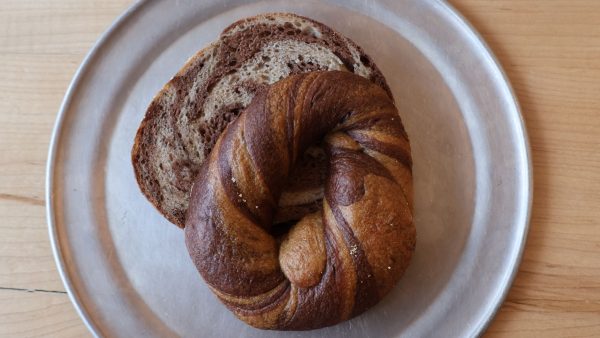
Pifer began marbling the dark pumpernickel dough with lighter dough. The flavor remained the same. Sales improved.
“The eyes eat first so final say goes to the consumer,” she said.
Pifer believes some customers are intimidated by the bagel’s dark appearance before they ever take a bite.
It’s an idea that also surfaced in the New York magazine story, where bakers suggested pumpernickel’s dark color may work against it in an era when food often has to look good before it gets tasted.
The Tzitzelnickel mystery
Then the story got stranger.
While researching local pumpernickel bagel options, I noticed something unusual on Bagel Union‘s menu: a bagel called a Tzitzelnickel.
The name immediately caught my attention. Was it related to pumpernickel? Was it a twist on St. Louis’ longtime tzitzel bagel tradition?
I emailed Bagel Union seeking answers.
Later that same day, longtime friend Cheryl Maayan emailed me about the very same bagel.
“I’ve read your dilemma about pumpernickel bagels…and I’ve read your research on tzitzel rye. I have asked myself – is Jordan Palmer possibly not aware of the Tzitzelnickel bagel at The Station? You haven’t mentioned it, so obviously not.”
Considering I had only discovered the Tzitzelnickel hours earlier, the timing felt oddly perfect.
Bagel Union never responded to my questions, so for now the exact origins of the Tzitzelnickel remain a mystery, which feels appropriate for a story built almost entirely on coincidence.
Why people love pumpernickel bagels
Because after talking to bakers and readers, I’m not convinced this is really a story about ingredients, colors or even bagels.
It’s a story about memory.
Even Pifer sees nostalgia as part of the appeal.
“I believe the loyalty comes from nostalgia and culture within the communities that were raised with it,” she said.
That certainly tracks with what happened here.
For Erin S., who saw our post on Facebook, pumpernickel brought back memories of her grandmother.
“My grandma, who would slice them into five full slices, then toast and butter them for me,” she wrote. “Pure love.”
Gail A. remembered warm pumpernickel bagels from Manhattan’s H&H Bagels after services at B’nai Jeshurun.
Another reader recalled pumpernickel bagels from family visits to New York Bagel & Bialy in Skokie.
The final schmear
Nobody emailed me because pumpernickel was trendy.
They emailed because it reminded them of people, places and moments they hadn’t thought about in years.
Maybe that’s the answer.
The pumpernickel bagel isn’t surviving because it’s the hottest item on the menu. It’s surviving because every pumpernickel fan seems to have a story attached to it.
Where to find pumpernickel bagels
Lefty’s Bagels
13359 Olive Blvd., Chesterfield
Baked & Boiled Bagels
1801 S. Ninth St., St. Louis
Bagel Union / The Station (Tzitzelnickel)
2232 Thurman Ave., St. Louis