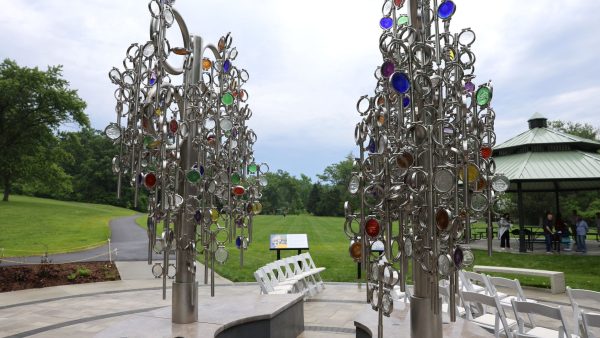
A striking piece of artwork now sits in Dr. H. Phillip Venable Memorial Park that forges a new chapter in the story of the park and honors a prominent Black physician. The art installation, “Home in Sight,” is part of a complete makeover and renovation of the 7.5-acre property, according to Joel Goldberg, a member of the Creve Coeur Parks & Historic Preservation Committee.
“We’ve made several upgrades,” said Goldberg, who belongs to Temple Israel. “We’ve revamped the tennis courts, and we made enhancements to the bridges. It’s wonderful to dedicate this artwork to Dr. Venable and it will really address the history of the park.”
“Home in Sight” had its official unveiling during a May 15 ribbon-cutting at the park. Robert Hoffman, mayor of Creve Coeur and a member of Congregation B’nai Amoona, described the importance of the event.
“It’s making up for a very, very big wrong,” Hoffman said.
An Idea Than Became An Obsession
Hoffman’s sentiments were echoed by Jim Singer, who spoke during the ribbon cutting. When Singer was growing up in Olivette, his parents took him on a picnic in nearby Bierne Park. The park sits between Spoede Road and Lindbergh Boulevard and was originally named for former Creve Coeur mayor John T. Beirne. Singer’s mother explained to him that a ranch house just up the hill had once belonged to a prominent Black physician whose property had been taken from him using eminent domain.
Five years ago, the park was renamed in honor of Dr. Venable. The process to call attention to the injustice and right a wrong began was supported by Singer, a retired attorney and member of Congregation Shaare Emeth. Singer explained what drove him to make the project a reality.
“I never returned to the park until almost nine years ago, when I took my then four-year-old grandson Levi to play at the park,” Singer said. “I looked around and realized that this was the park my mother had told me about so many years ago. What started off as an idea became an obsession to research the park’s history and rekindle the public’s forgotten memory of the park’s racist past.
“With the support of many of the citizens of Creve Coeur and religious organizations, including Shaare Emeth Congregation and Rabbi Andrea Goldstein, by the end of 2019, the city council passed its resolution apologizing for the wrongs which had taken place so long ago and renaming the park in memory of Dr. Phillip and Katie Venable,” Singer said.
On September 18, 2021, Singer and others celebrated the rededication of the park, where members of the Venable family and representatives from the St. Louis Jewish community gathered to celebrate the occasion. Many of the same people were on hand on May 16 for the addition of the new artwork.
Support From HDR Foundation
In 2022, Creve Couer officials created a master plan for Venable Park with the design and engineering company HDR. The plan included playground improvements, clear signage and a new pavilion. A call for artists was released one year later to create commemorative artwork and a Creve Coeur committee raised $50,000 to cover its cost. The HDR Foundation also supported the effort, explained Erin Slayton, a niece of Dr. Venable who knew him as “Uncle Howard.”
“This moment belongs to all of us,” Slayton said. “It honors not only Uncle Howard, but the strength, resilience, and dignity of our entire family. You may be wondering, how did HDR get involved? Well, it so happens that I am an HDR employee.”
The HDR support for Venable Park was made more meaningful through the source of the funding, according to Jeff Fahs, the company’s director of landscape architecture.
“The $400,000 we gave in support of this project did not come from a big corporation,” Fahs said. “It came from thousands of Erin’s colleagues personally donating to support it. We were also involved through a group called ‘Design for the Future,’ a philanthropic initiative within our architecture group in which we lend professional expertise and time at no charge to improve health and well-being around the world.”
Inspired by An Ophthalmic Lens Flipper
The artists selected to create the installation were Oletha DeVane and her son Christopher Kojzar. As they were considering concepts, they settled on an idea central to the Dr. Venable’s specialty, ophthalmology. When you sit for an eye exam, a standard tool used by an ophthalmologist is the lens flipper. It’s a handheld tool that holds two different power lenses. The eye doctor rotates—or flips—the lens in front of the patient’s eyes.
“Home in Sight,” the DeVane and Kojzar’s creation, is modeled after the lens flipper. The work is made of stainless steel and glass pieces. Depending on the angle of the sun, shifting light and angle from which it is viewed, the sculpture offers changing views and perspectives.
With the addition of the artwork, the physical and spiritual transformation of Venable Park is now largely complete. Its impact and opportunity to learn from the past is just beginning. An effort is underway to develop school curriculums to educate students about the concept of eminent domain, the history of the park and the legacy of Dr. Phillip Venable, who died in 1998 at the age of 85.
An educator as well as a physician, Venable would likely be pleased to see the results of his struggles, said Erin Slayton.
“Being here today is so deeply personal because this park is not just a place, it is a significant part of our family’s story,” Slayton said. Uncle Howard was an accomplished physician, a respected leader, and a gifted musician. But despite all he could achieve, he could not overcome the systemic barriers of his time.
“Despite everything he experienced, Uncle Howard once said, ‘This has not made me bitter at all because if it had, that would be a mistake on my part.’ That spirit, that resilience without bitterness, determination without hatred, is part of what makes standing here today so powerful. Today is about more than just reopening this park. It’s about acknowledging the history and learning from it. And most importantly, it’s about continuing to write a better chapter.”