

(JTA) — Tucker Carlson’s recent suggestion that Jews in Israel undergo genetic testing has revived the “Khazar theory,” a long-debunked antisemitic conspiracy that claims Ashkenazi Jews are not descended from the ancient Israelites. Historians, genetic researchers and Jewish organizations have repeatedly rejected the theory, but it continues to surface during periods of heightened political tension involving Israel.
What did Tucker Carlson actually suggest?
During an interview with U.S. Ambassador to Israel Mike Huckabee, Carlson proposed using genetic testing to determine who has a “rightful” claim to the land of Israel.
“Why don’t we do genetic testing on everybody in the land and find out who Abram’s descendants are?” Carlson asked, referring to the biblical patriarch Abraham.
He specifically questioned Israeli Prime Minister Benjamin Netanyahu’s ancestry, noting his Eastern European roots and suggesting that lineage should determine sovereignty.
For many Jewish listeners, the premise was troubling. Judaism has always included converts and has never been defined solely by ancestry. Framing legitimacy around bloodlines carries uncomfortable historical echoes.
ADVERTISEMENT

What is the Khazar theory?
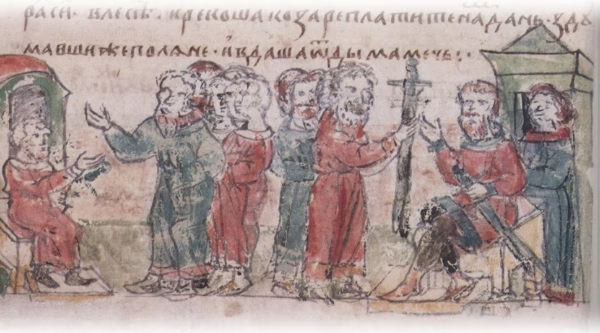
The Khazar theory claims that Ashkenazi Jews are primarily descended from a medieval Turkic kingdom — the Khazars — whose ruling class allegedly converted to Judaism, rather than from the ancient Israelites.
In its modern antisemitic form, the argument goes further: If European Jews are not genetically descended from biblical Israelites, then they have no legitimate historical claim to Israel.
Historians agree the Khazars were a real people. What mainstream scholarship rejects is the claim that they are the primary ancestors of Ashkenazi Jews.
The theory has circulated for centuries and has periodically resurfaced in political debates about Jewish identity and Israel.
What does the genetic research show?
Extensive genetic studies, including large genome-wide analyses published by the National Institutes of Health, have found no evidence supporting a Khazar origin for Ashkenazi Jews.
Research consistently shows that Ashkenazi Jews share ancestry with other Jewish populations and trace substantial genetic roots to the Middle East, along with European admixture developed over centuries in the diaspora.
Linguistic evidence points in the same direction. Yiddish contains strong Hebrew and European elements but almost no Turkic influence, undermining claims of large-scale Khazar ancestry.
Why does this theory resurface during political tension?
The Khazar theory is often used to delegitimize Jewish identity or Jewish sovereignty. The Anti-Defamation League has noted that antisemites promote the theory to argue that Jews are “imposters” or “fake Jews” without a legitimate claim to Israel.
Since the Oct. 7, 2023 Hamas attacks and the war in Gaza, researchers have observed an increase in the theory’s circulation across both far-right and far-left online spaces.
Public figures repeating or referencing the theory, even indirectly, can amplify its reach beyond fringe communities.
Why does genetic framing raise alarms?
Judaism has historically been understood as a blend of religion, ethnicity and community. Converts have always been recognized as fully Jewish under Jewish law.
Using DNA as a test of legitimacy evokes historical attempts to define Jews through racial criteria. Even Carlson himself previously referred to mandatory genetic testing for Jews as sounding like “a Nazi project.”
That tension is part of why many Jewish leaders reacted strongly to his latest remarks.
Why this moment matters
The controversy extends beyond one interview.
It reflects how fringe conspiracies can move into mainstream political discourse, especially when repeated by influential voices.
When discussions of Jewish identity shift toward genetic legitimacy, scholars warn that the implications go beyond academic debate. They touch on how Jewish belonging is defined — and who gets to define it.