
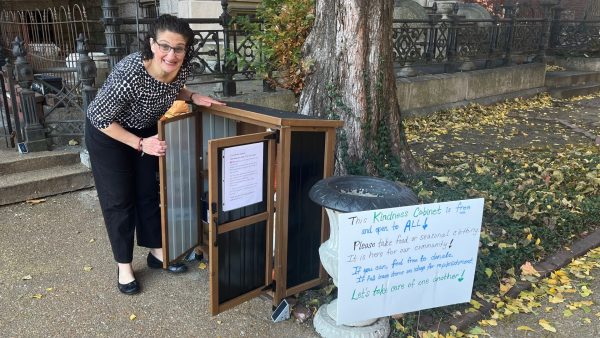
shows the cabinet in front of her Lafayette Square home that she stocks with food, winter clothes or other essentials for St. Louisans in need. (Ellen Futterman)
Raquel Scharf-Anderson and her husband, Eric, have lived in Lafayette Square for several years now, long enough to know that Halloween in the neighborhood is not for amateurs. “We have hundreds and hundreds of kids every year,” said Scharf-Anderson, a Jewish educator. “People come from all over to walk the streets around the park.”
This year, the Scharf-Andersons decided to add a twist. Alongside mountains of candy, they set out baskets of winter hats—babies to adult sizes—and pairs of mittens, all washed and rescued from the Goodwill outlet.
“We had 75 hats and mittens,” Scharf-Anderson said. “They were gone within an hour.” Thirty pounds of candy disappeared, too, but it was the winter wear that seemed to matter most; one little girl told Scharf-Anderson she’d never owned mittens before.
The moment stuck with her. Their neighborhood, perched near drastically different pockets of the city, sees a wide range of visitors—families crossing over from the Peabody Darst Webbe area, people passing through Lafayette Park, sometimes on bikes or carrying their belongings. “Eric and I were like, we just need to do something,” Scharf-Anderson said.
So they built a “kindness cabinet,” inspired by a little “library-style” community pantry they used to pass when they lived in Seattle. Eric Scharf-Anderson assembled the cabinet himself—sturdy, lit and dignified—while his wife stocked it with food, hats, gloves, scarves and whatever else she could scavenge. When she shared the idea in neighborhood social media groups, donations appeared almost instantly. “People started coming immediately to fill the cabinet,” she said.
ADVERTISEMENT

One of the first people drawn in was their new neighbor, Lexi Kroeger.
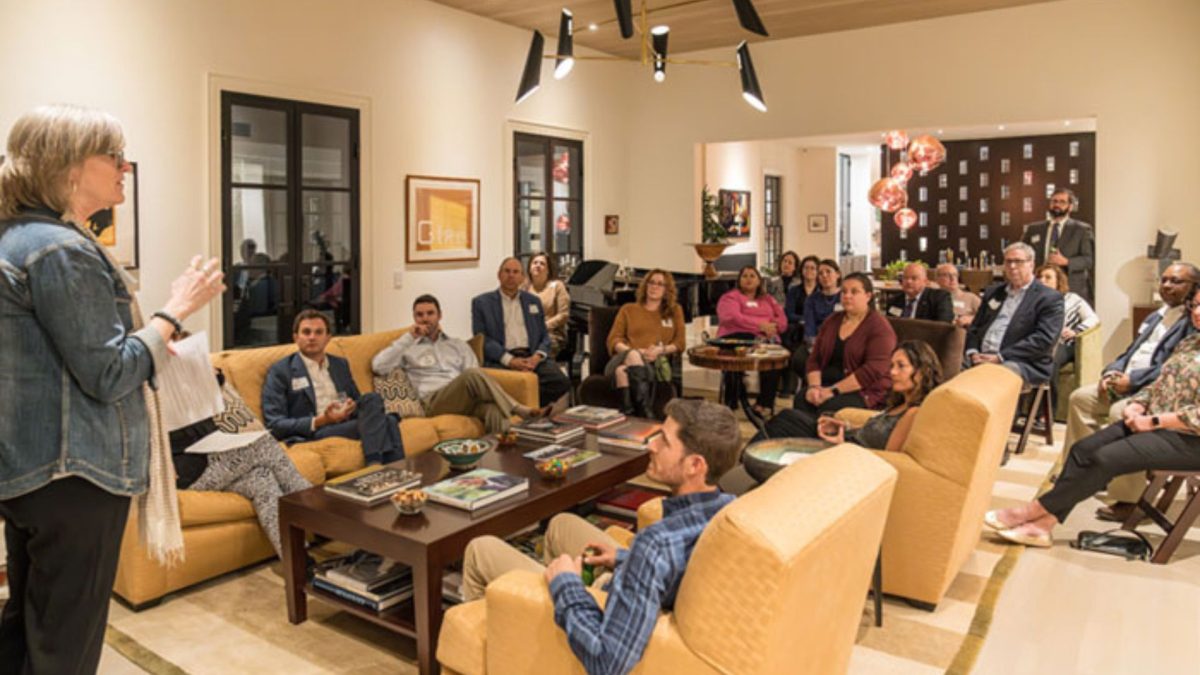
Kroeger and her husband had moved to Lafayette Square in August, searching, as she put it, “for that sense of community.” Within a week, she attended a neighborhood book club—despite never cracking open that month’s book. “I didn’t even read it,” she admitted, laughing. “I just wanted to meet people.”
That night, she met Scharf-Anderson, who hosted the book club at her home. “Her energy is just infectious,” Kroeger said.
The next time the book club met, at another neighbor’s home, Scharf-Anderson unveiled her idea for the kindness cabinet. “We were not remotely surprised,” Kroeger said, “because she is who she is.” She remembered Scharf-Anderson describing her Goodwill treasure hunts, filling a car with hats and jackets. That, Kroeger believes, is what sparked the whole cabinet idea.
Kroeger shared the announcement on Facebook, and soon her own friends and family were dropping off donations. “I have a whole carload of things,” she said—blankets, winter coats, hand warmers, more hats. “It just breaks my heart this time of year. It’s getting so cold.”
As someone who recently moved from a rural area, Kroeger has been struck by what she calls “the whole continuum” of poverty and homelessness in the city—something she didn’t fully see before. “Now that I’m in the Square, I see people sleeping in the park. I see them riding their bikes and carrying all their things,” she said. “What a privilege it was for me to not have to realize that this is a genuine issue.”
For her, the cabinet isn’t about drawing more need into the neighborhood—it’s about acknowledging what already exists. “They’re around whether we help them or not,” she said. “If anything, I think that’s the goal—to show them that we see them and we care.”
The cabinet—just a couple of months old in front of 2012 Lafayette Ave. —has already become a quiet hub of giving and taking. As it empties, Scharf-Anderson restocks it with extra supplies she keeps on hand.
“If somebody takes everything, then they need it,” she said, remembering families on Halloween asking how many hats they could take. “I said, as many as you need.”
Scharf-Anderson can still hear her mother’s voice: “Head and feet warm, and you’ll be fine.”
Kroeger, too, hopes the idea spreads—whether as more cabinets or simply more people paying attention. “Maybe people will feel inspired to start a food drive at work,” she said. “Or pick up hats and gloves at Goodwill and keep them in their car.” She likes the idea of handing out hand warmers or water bottles at highway exits. “I never feel prepared enough,” she said.
Both women see the cabinet as a simple expression of dignity. “We all want to be seen as humans that are worth caring about,” Kroeger said. “Especially people who’ve been overlooked the most. They deserve to feel love and kindness just like everyone else.”
For Scharf-Anderson, the impulse comes from the Jewish values she was raised with: justice, equity, responsibility, the belief that everyone’s fortunes can turn. As she explains, “We just don’t do Jewish on Friday nights.”
“We’re not free to desist from making the world better,” she continued. “We’re not required to complete that work, but we cannot not participate. This community has been wonderful for us, and it’s the least we can do.”
The Scharfs see this as a year-round effort, warm-weather wear in the winter, backpacks at back-to-school time, whatever the season requires. “We’re not going to be able to fix every problem, but we can’t ignore the problems right in front of us,” Scharf-Anderson said.
In the end, the kindness cabinet is more than just a place for food, hats, or mittens—it’s a tangible expression of community care, generosity and the belief that even small acts can make a meaningful difference.