
Oct. 7, 2023, was a day none of us will ever forget. That Shabbat morning, I was supposed to have an aliyah at shul honoring some work I had done. Instead, news of the attack began to trickle in, and services were moved to the shelter. As the hours and ensuing days unfolded, it became clear that our country was facing a catastrophe.
| RELATED: New Jewish Light project sharing voices of St. Louis Jews living in Israel
Many of our friends’ children were called up to the reserves, while for those of us left at home, the question was: how can we help?
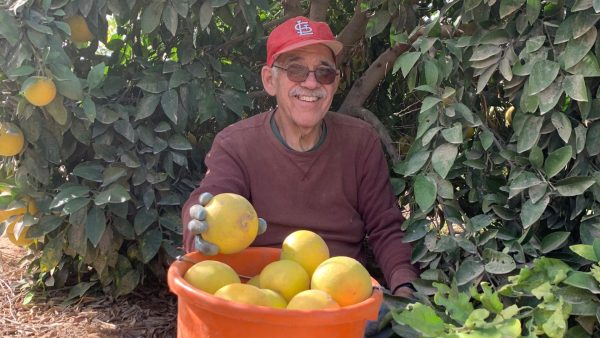
As a semi-retired accountant with a public service career in Israel’s social security, I first volunteered with evacuees now living in hotels, helping them understand their rights and apply for government grants. Eventually, the authorities took over, and I turned to agriculture. Every Thursday, I travel with groups organized by Leket Israel, a food recovery organization that supplies buses, insurance and coordination. Our job is simple: do whatever the farmers need—planting, picking, pruning or packing.
Until October 2023, Israeli agriculture had relied heavily on migrant workers, many of whom were murdered or fled on Oct. 7, and Palestinian laborers, who could no longer enter. Without workers, crops would simply rot in the fields. So, we showed up.
Most of us are seniors, many Anglo immigrants. We are religious and secular, left and right, veteran Israelis and relative newcomers, even tourists. The work is exhausting. I return home sore and drained, but thankful to be able to contribute. Farmers whose livelihoods were shattered greet us with gratitude. Their resilience reminds me that in Israel, survival is not just a necessity—it is a way of life.
ADVERTISEMENT

Each Thursday, on the way to the fields, we pass communities scarred by the attacks. We hear stories of bravery, loss and survival. Some communities defended themselves; others endured unimaginable horrors. Slowly, migrant workers are returning, though Palestinians cannot. We hope each Thursday might be the last time we’re needed—but we’ll continue as long as it takes. For me, this work is my “reserve duty.” My friends’ children have served 200, even 300 days in uniform over the past two years. I cannot do what they do, but I can contribute with my hands and my presence.
This experience in the fields has been a powerful déjà vu. Fifty years ago, on Oct. 6, 1973, as the Yom Kippur War broke out, I was a graduate student at the University of Missouri. By the end of October, with my heart and mind constantly in Israel, I was on one of the first planes to volunteer. I joined a kibbutz in the Jordan Valley, replacing members who had been called up. Then, it was one kibbutz. Now, we move from farm to farm, wherever we are needed.
I have lived in Israel for more than 50 years. I came as a young man after the Yom Kippur War, and now, decades later, I find myself answering the call once again in a time of crisis. Israel is polarized today, perhaps more than ever. And yet, in the fields, people of every background work side by side. It gives me hope that we can find common ground again.
I am proud of the life I have built here—my work, my family and my community, and hope that Israel will be as good to my daughters and granddaughter as it has been to me. The war is not yet over. The hostages are still not home. The recovery will be long. But if history is a guide, Israelis will rise to the occasion. We always do.
And if you visit, look for the old guy in the Cardinals baseball cap. There’s always room for another pair of hands in the fields.
Ron Hendin was born in St. Louis and moved to Israel in 1975. An accountant, husband, father and grandfather, he now spends Thursdays volunteering in the Gaza envelope.