
Mother’s Day has a way of sneaking up on me.
Not the date, I know when it is. The emails and ads make sure of that. And of course, the reminders to order flowers, make brunch reservations and send a card that says something meaningful without trying too hard.
What sneaks up on me is the realization, each year, that I am now firmly on the receiving end of it. Whatever this day is supposed to mean, I am one of the people it’s about.
And also, whether I planned it or not, one of the people who made it necessary in the first place.
Which may explain why certain sentences, words that fly out of my mouth, are ones I swore I would never say. Not because they were wrong, exactly. Just because they were, gulp, my mother’s.
ADVERTISEMENT

For example, not long ago I heard myself say to my adult son who has a job and a calendar and, presumably, access to a phone: “Did you make that dentist appointment yet?”
There was a pause on the other end. Not a long pause. Just long enough.
“I’m going to take care of it,” he said, in the tone that suggested he will absolutely not take care of it, at least not today, and possibly not this year.
I could have left it there. I should have left it there.
“Because it’s been a while,” I added. “And given dad and my crappy dental genes, you don’t want to wait too long.”
Then, as if that wasn’t bad enough, I continued to pile on. “You know women really like it when a guy has a nice bright smile.”
And just like that, there I was. A Jewish Mother’s Day cliché in real time.
This is how it happens, I think. Not in big moments. Not in some sweeping realization that you have become your mother. But in small, persistent ways—one unnecessary reminder, one extra question, one message that reads, “Text me when you get there,” sent to a fully grown person who has already gotten there and forgotten to text.
Weather has become another tell.
I used to wonder why my mother cared so much about it, especially since for all my adult life, she and I lived at least 1,000 miles apart. “How’z ya weatha,” she would say in her Brooklynese, as if she had any control over it. Didn’t matter. She tracked it. Commented on it. Worried about it.
Now, I find myself doing the same thing. Telling my (adult) kids to dress warmly on cold days, as if they wouldn’t have thought of that on their own, or keeping their phones charged when incoming storms threaten. I offer unsolicited updates as if I am personally affiliated with the National Weather Service.
I hear myself and think: When did this happen?
The answer, of course, is slowly. And then all at once.
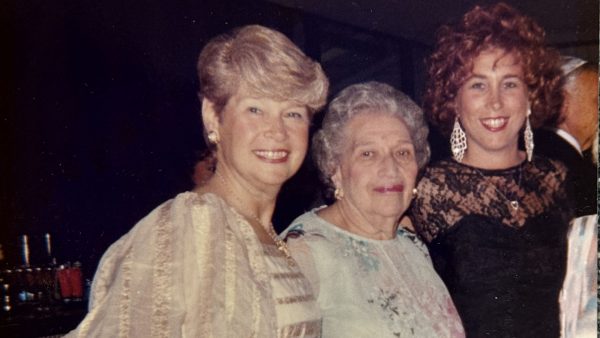
For most of my life, people told me I looked like my father. I accepted that, mostly, though I’ll admit it came with a small, private disappointment. My mother was beautiful—she looked a lot like Doris Day —and I wouldn’t have minded inheriting a little more of that.
But then, something shifted.
It’s not the face I remember from her younger years. It’s the later version, the one she regarded with some dismay, the one that arrived with time and all that time does. And now, looking in the mirror, I see it in me. Not all at once, but in pieces. A familiarity that sneaks up on you.
“Oh,” I think. “There you are.”
This will be the sixth Mother’s Day without my mother.
She died in June 2020, in a hospital alone, at a time when being physically present wasn’t possible. She didn’t have COVID, but the pandemic shaped everything around her final days. My brother and I spoke with her the night before she died—together, on the phone, a conversation that now feels both like a gift and not nearly enough.
She sounded like her old self, not the one who had been so confused and off kilter because of severe gastric issues as well as dehydration and low potassium. I told her I loved her. I’m grateful for that.
Still, there’s a part that lingers. The part that wishes she hadn’t died alone, that my brother and I had been in the room with her, holding her hand. The part that replays what cannot be changed.
Mother’s Day doesn’t fix that. It doesn’t wrap it up neatly with flowers or brunch or a card.
But it does something else, something quieter.
It reminds me that the story doesn’t end where I thought it did, because she is still here, just not in the way I expected.
She’s here when I remind my son, again, to make that dentist appointment.
She’s here when I check the weather with more intensity than necessary.
She’s here in the face looking back at me, in the habits I didn’t mean to keep, in the sentences I didn’t plan to say, and — I hope — in the acts of kindness that were so genuinely hers.
This is the part of Mother’s Day we don’t always talk about—the part where being a mother and having a mother start to blur, where the roles overlap, where what we’ve lost and what we’ve become sit side by side.
We think this day is about cards and calls and maybe a meal together.
But sometimes, it’s just this: Hearing your own voice, saying something you once swore you wouldn’t—and realizing it isn’t just yours. It never was.