
Looking back on Nazi era in newly reissued novels from 1930s
Published July 14, 2021
There is no shortage of fiction set in the Nazi era being written today, and most serious attempts sit atop an enormous amount of historical research. This is in stark contrast to two novels written in the late 1930s and given new life by major U.S. publishers this year.
These are works that did not emerge from excavating the past, but which sprang from the urgency of their moment as history was unfolding.
“The Passenger” was written in the aftermath of Kristallnacht by Berlin native Ulrich Alexander Boschwitz when he was in his early 20s.
The novel follows Otto Silbermann, a successful Jewish Berlin businessman and World War I combat veteran whose commitment to his country has prevented him from leaving, even as his son has found safe harbor in England. However, it is now late 1938, and Silbermann’s world is collapsing quickly. With the forced Aryanization of Jewish businesses, he is now dependent on the goodwill of non-Jewish friends and associates, only to find that they view his bad luck as an opportunity from which to benefit themselves.
 When Nazis come to the door of his apartment, Silbermann has little option but to escape through a back door. Unwanted or unsafe in hotels, he finds himself unexpectedly on the run and living largely on trains. He realizes “the fact is that I have already emigrated … to the Deutsche Reichsbahn. I am no longer in Germany. I am in trains that run through Germany.”
As he travels throughout the country scheming for money and freedom with increasing desperation, the time he spends in passenger compartments offers him the opportunity to take an inventory of attitudes toward Nazism and Jews among his compatriots. Most hold their party membership as a badge of honor.
ADVERTISEMENT

Boschwitz does not idealize Silbermann. While he is admirable in not losing his moral sensibilities as the world around him has abandoned such niceties, he is also a fussy product of his social class. And he is stymied by his own stubborn belief in his country and what should be his rightful standing in it. He comes to understand his status more accurately only after it has evaporated: “I had a wonderful life … I was rooted … No, I wasn’t rooted. I only imagined I was.”
Silbermann is able to travel with relative ease because he does not appear recognizably Jewish. And one of the book’s psychological insights emerges through Silbermann’s growing aversion to encountering fellow Jews, as they now present a risk to him. Running into an old friend, he notes that “I, too, was afraid of his Jewish nose.”
When I saw that Boschwitz died in 1942, I assumed that he had been killed in the Holocaust. His fate was more complicated. He was born to a Protestant mother and a Jewish father who had converted to Christianity, but who died shortly before Ulrich’s birth. Boschwitz, who was still a Jew by Nazi standards, and his mother were able to leave Germany in 1935, eventually settling in England.
He published a version of “The Passenger” there in 1939. However, with the onset of World War II, he, along with many refugees from Nazi Germany, were classified as “unfriendly aliens.” He was shipped off to camps, first on the Isle of Man and then in Australia. Upon being reclassified as “friendly,” he was returned to England on a passenger ship that was torpedoed by the German Navy. He died along with 361 other passengers.
Kathrine Kressmann Taylor’s “Address Unknown” is a book I had heard of but never encountered. The short work was originally published in 1938 in the magazine “Story,” where it was credited simply to Kressmann Taylor — apparently, the magazine’s editor and Taylor’s husband felt that the piece was “too strong to appear under the name of a woman.”
 It was soon published as a book by Simon and Schuster (still under the pseudonym) to great success, but has spent most of the ensuing decades out of print. It has been reissued this summer by Ecco.
Born in Oregon, Taylor (who was not Jewish) wrote the book while living in San Francisco. She did so in response to witnessing good friends of hers in the United States return to their native Germany and transform into committed Nazis.
The 96-page novella consists entirely of letters sent between Martin Schulse and Max Eisenstein, partners in a San Francisco art gallery, after Martin returns to Germany in the early 1930s. Over the course of their correspondence, which begins with great mutual affection, we witness Martin’s emerging adoption of Nazism, along with the corresponding unhappiness voiced by Max, who is Jewish.
Max’s alarm is heightened by concern about the welfare of his Viennese sister (with whom Martin had once engaged in an affair), who is attempting to pursue a career as an actress in Berlin. And I will stop here, as it would be unfair of me to reveal more of the plot of this satisfying, but very short book, other than to say that Taylor used the letter-writing device brilliantly.
Both of these books are timely, given the current rise of antisemitism and an increase in racist violence, particularly directed against Asian Americans. And what I find especially resonant in both books is their focus on relationships as a barometer of societal dysfunction. These portraits of how opportunism, ideological devotion and bigotry can trump friendships and interpersonal loyalties are all too real, and they are warnings to heed.
“The Passenger” by Ulrich Alexander Boschwitz (288 pages, Metropolitan Books)
“Address Unknown” by Kathrine Kressmann Taylor (96 pages, Ecco)
Fatalities from antisemitic attacks in 2025 reach highest toll in 30 years, Israeli analysis finds
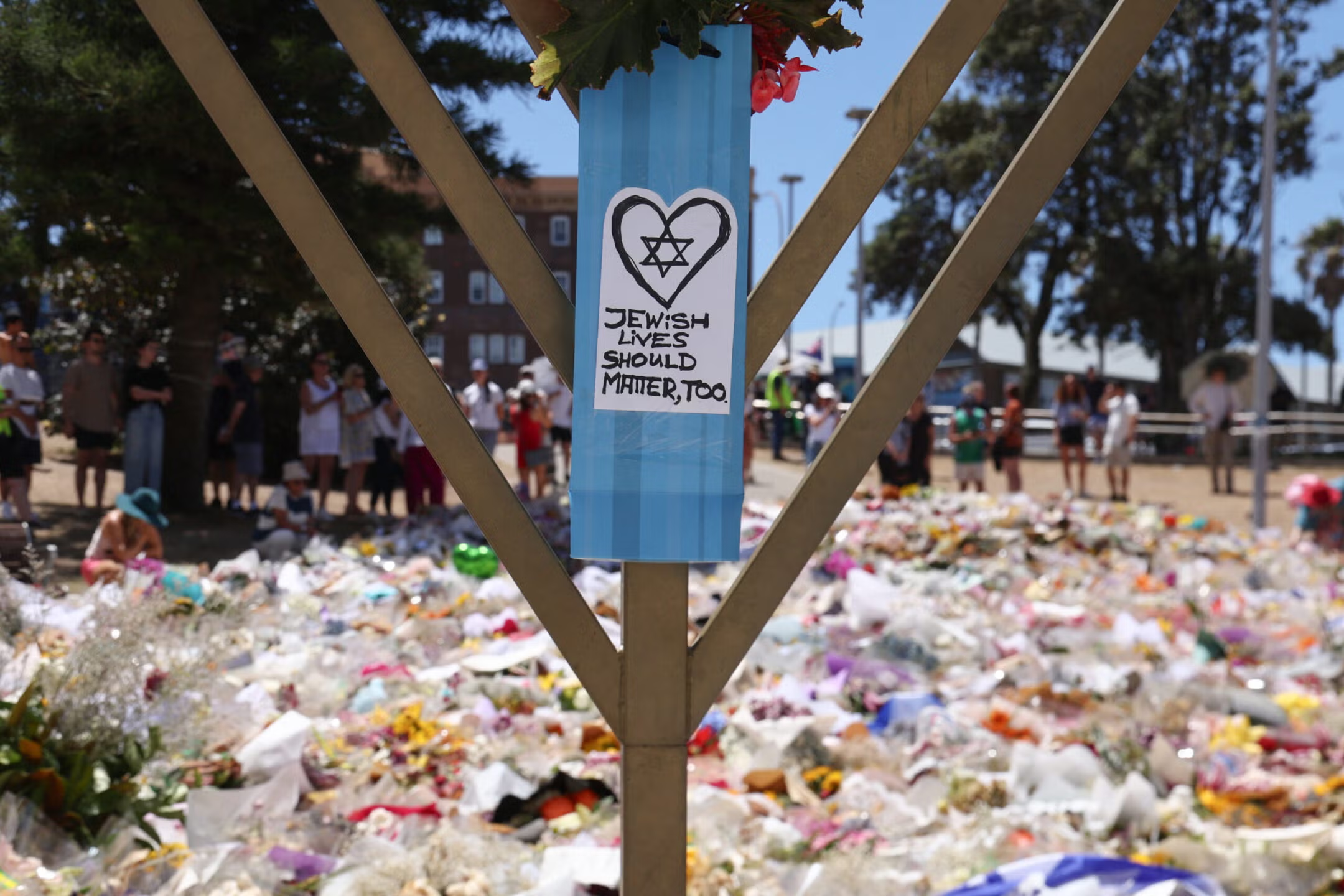
(JTA) — The number of fatalities from antisemitic attacks reached their highest level in 2025 in over three decades, with 20 people killed in four attacks over three continents, according to a new analysis from Tel Aviv University. The fatal attacks included those in Sydney; Washington, D.C.; Boulder, Colorado; and Manchester, England. They marked…

Who gets to understand the universe?
Award-winning physicist Chanda Prescod-Weinstein will visit St. Louis on April 24 to discuss her book, “The Edge of Space-Time,” but the conversation is expected to go far beyond physics. Prescod-Weinstein, who studies dark matter and the early universe, is also part of a much smaller group: Black Jewish scientists working at the highest levels…
The rabbi behind Student to Student is taking on a new role in St. Louis
Rabbi Andrew Terkel will join the clergy team of Congregation Shaare Emeth, bringing experience in Jewish education and community engagement to one of St. Louis’ largest congregations. He will be officially introduced during Shabbat services on Friday, April 24, alongside Rabbi Morgan Tobey. Terkel comes to Shaare Emeth from Be The Narrative, where he has…

Israelis say they are maintaining war readiness as US-Iran talks fail, Trump imposes blockade
(JTA) — U.S.-Iranian peace talks ended without a deal on Saturday and President Donald Trump announced a naval blockade of the Strait of Hormuz, leaving the future of the current ceasefire in doubt. In Israel, which launched the war against Iran jointly with the United States, the ceasefire has brought a return to normal…

Trump administration fires 2 judges who blocked deportations of pro-Palestinian activists
The Trump administration on Friday fired two judges who blocked the deportations of international students involved in pro-Palestinian activism. One of the judges, Roopal Patel, a Boston immigration court judge, oversaw the Trump administration’s immigration case against Rümeysa Öztürk, a Turkish Tufts University doctoral student who was detained by ICE agents on the street in…