(JTA) — Argentine soccer icon Lionel Messi, widely regarded as one of the greatest players in the history of the sport, has built one of football’s most decorated careers.
Throughout his illustrious career, Messi has cultivated a measured public image, rarely commenting on politics or becoming involved in major public controversies. But the 39-year-old has occasionally made headlines for expressing support for Jewish causes and Israeli companies — and at times for being pulled into the tense geopolitical landscape of the Middle East by no doing of his own, including when a grandmother originally from Argentina credited him for saving her life when her Israeli kibbutz was attacked on Oct. 7, 2023.
Messi’s past has roared into public view during this year’s World Cup, in which Argentina plays Switzerland in the quarterfinals on Saturday. Some critics of Israel have surfaced his past activities and affiliations to make the case that opposing Argentina is the anti-Zionist choice. Many Israelis, meanwhile, favor the team.
Ahead of the game, here’s a look back at 10 moments from Messi’s career — presented chronologically — where he and his fame intersected with Jewish and Israeli culture through public appearances, peace initiatives, controversies and more.
ADVERTISEMENT

1. In July 2013, Messi sent a message to the Argentine Maccabiah team, a greeting before the national delegation departed for the “Jewish Olympics” in Israel. It wasn’t the first time he demonstrated support for his country’s Jewish community — in 2011, he participated in a campaign for justice and memory of the victims of the 1994 AMIA Jewish center bombing that killed 85 people in Buenos Aires.
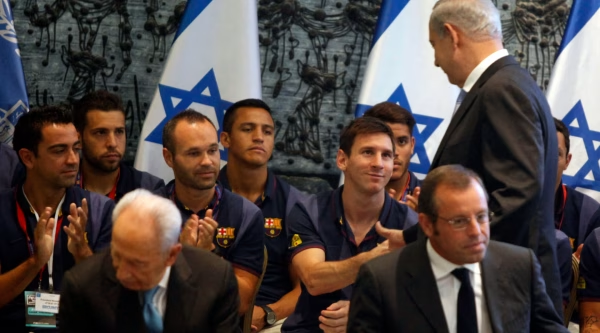
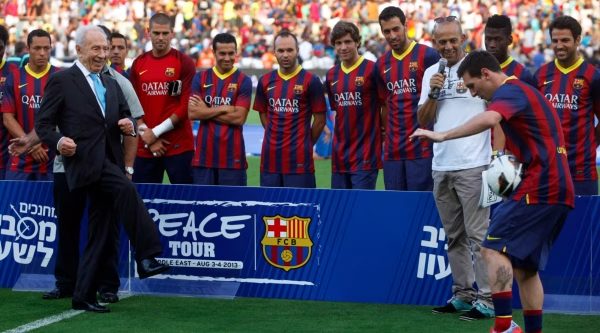
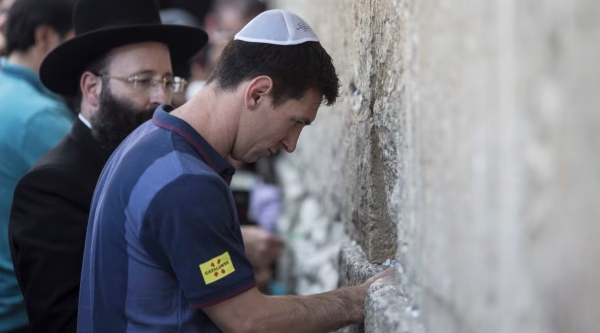
2. One month later, he visited the Western Wall on a “peace tour” with Barcelona F.C., the famed Spanish team with which Messi spent the majority of his career. The club hosted skills clinics for Israeli and Palestinian children and met Jerusalem Mayor Nir Barkat, President Shimon Peres and Prime Minister Benjamin Netanyahu.
3. In September 2014, Messi supported a “match for peace” in Rome organized by Pope Francis to promote peace between Israelis and Palestinians, but he did not play due to an injury. Fellow Argentine great Diego Maradona and Israeli player Yossi Benayoun also participated, alongside stars from Russia, Cameroon, Italy, France and Brazil.
4. In 2016, Messi was slammed as “Jewish” and a “Zionist” by Egyptian officials after donating his soccer cleats to a charity in Egypt. Then-Egyptian Football Federation spokesman Azmi Mogahed phoned in to the show to criticize Messi: “I know he’s Jewish, he donated to Israel and visited the Wailing Wall and whatever. … We don’t need his shoes and Egypt’s poor don’t need help from someone with Jewish or Zionist citizenship.”
5. In June 2018, Argentina’s national team canceled a friendly match with Israel’s national team following pressure from the Boycott, Divestment and Sanctions movement. A boycott campaign sponsored by BDS Argentina was launched using the motto “Argentina don’t go,” or #ArgentinaNoVayas. The Israeli embassy in Buenos Aires tweeted that the match was canceled due to “the threats against Messi that logically generated the solidarity of his teammates.”
6. Two months later, FIFA suspended the head of the Palestinian soccer body for threats against Messi. Jibril Rajoub, who had lobbied for action by FIFA against Israel, was suspended for a year after he urged supporters to burn photos and player jerseys if Messi or the Argentinian national team had shown up for the friendly match that was canceled.
7. In 2019, Argentina’s national soccer team announced it would play a friendly match against Uruguay in Tel Aviv that November, following the cancellation a year prior. The match was again targeted by the BDS movement, with protestors demonstrating outside a training camp in Barcelona and calling on Messi not to participate. Despite the opposition, the game went on as planned, with Messi scoring a goal in front of a sold out crowd of 29,000 fans — including Israeli President and soccer fan Reuven Rivlin — at Bloomfield Stadium. (Messi would return to Israel twice with Paris Saint-Germain in 2022, beating Maccabi Haifa in two Champions League matches.)
8. In 2020, Messi signed a three-year contract to become a brand ambassador for the Israeli company OrCam, which makes devices to help the visually impaired. It wasn’t his first time promoting an Israeli company: in December 2017, the Tel Aviv-based Sirin Labs hired him as its global ambassador.
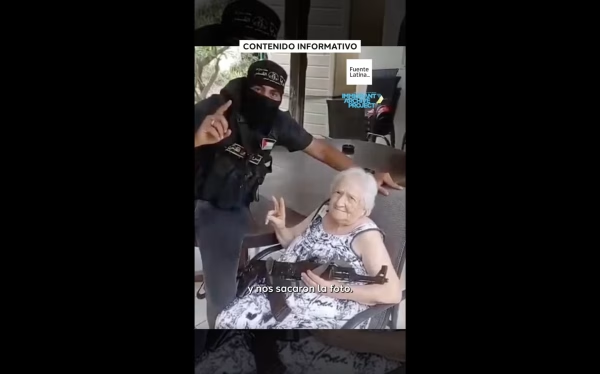
9. On Oct. 7, 90-year-old Kibbutz Nir Oz resident Esther Cunio name-dropped Messi to a Hamas terrorist who had come to kidnap her, likely saving her life. During the attack, Cunio asked the assailant if he liked soccer before telling him, “I’m from where Messi is from.” Cunio then made an appeal to Messi to help rescue her grandson.
10. Last month, after Messi scored a hat trick in a 3-0 Argentina victory over Algeria in the World Cup, an Algerian broadcaster blamed the “Jewish lobby” for a controversial non-call on a potential penalty that could have penalized Messi. “Messi is protected by the Jewish lobby,” analyst Mustafa Mazzouzi said. “This lobby controls the world, they run it however they want as if they were the mafia. [FIFA President] Infantino doesn’t want us to do well.” He added, “We have political stances regarding Western Sahara and the Palestinian issue, and therefore they don’t want us to do well.” Elsewhere, a Palestinian TikTok content creator with over 350,000 followers suggested that Argentina deserved to lose the World Cup because of Messi’s numerous associations with Israel.
Messi wears No. 10 — typically reserved for the best player on a soccer club — but since there are 11 players on the pitch, we’ll add a bonus.
11. The World Zionist Organization used a play on words involving Messi in a 2020 Hebrew educational video, explaining that the Hebrew word “mesibah” means “party,” or “fiesta” in Spanish. In Spanish, it sounds like “Messi va,” or “Messi goes.” In other words, “if Messi goes, it’s a party.”