
Frieda Tsukerman and Linda Carton are both widows who have experienced financial challenges. Both women found a sympathetic and comforting presence when they reached out to the JFS ElderLink assistance helpline. ElderLink is a free information and referral service staffed by master’s level social workers. Their goal is to help older adults solve any number of challenges, from food assistance to transportation to housing options.
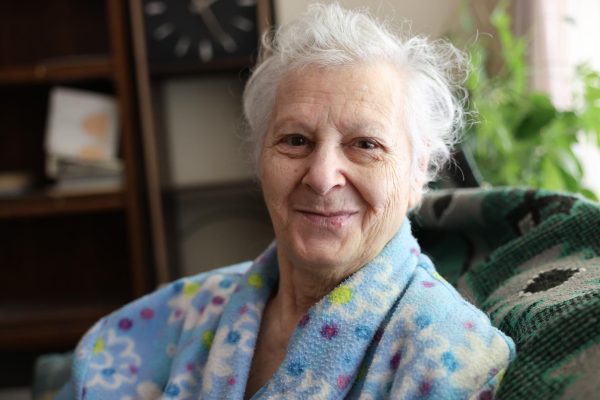
Tsukerman, 86, is originally from Kiev. She and her family lost their home and belongings during World War II. Through the Claims Conference, she is entitled to nominal benefits, which helps her pay for essentials.
“JFS helped me,” said Tsukerman, who is a member of Agudas Israel of St. Louis. “They have a social worker who works with people who survived the war. Every year, I get a payment. It’s not big money, but it’s more than nothing. I really appreciate it.”
Recently, Tsukerman’s microwave oven quit working. She contacted JFS (Jewish Family Services) and a staffer helped her acquire a new one through access to the Blue Card, which provides emergency grant assistance to help improve the living conditions of Holocaust survivors.
Carton, 78, has relied on JFS ElderLink on several occasions. Most recently, the ElderLink specialists helped identify grant funding to pay her rent for two months while she was struggling to make ends meet. While she was a caregiver for her late husband Gene, she attended a JFS caregiving seminar.
“They’ve been very helpful,” said Carton, who is a member of Kol Rinah. “JFS has been wonderful.”
ADVERTISEMENT

Quiet help for growing challenges
ElderLink staffers are trained and prepared to find a solution for nearly any situation, according to Christine Thurber, older adult services director.
“We get a lot of calls from people who either need some financial support or are aging and just don’t know what resources they need,” said Christine Thurber, older adult services director. “They may be struggling to pay their bills. Sometimes it’s just trying to figure out how to stay safe in their home.”
The JFS staff often brainstorms to find the best solution available for their clients, Thurber said.
“We do a full assessment of need,” she said. “Sometimes things creep up on you, and you don’t realize that you’re not doing them so well anymore until someone comes in and really analyzes it for you. We have a host of resources that either we can provide ourselves or we can connect people to and make their life better.”
More than financial support
One area of special focus for older adults is poor nutrition or food insecurity, Thurber said.
“A lot of people may have the means to pay for food, but they can’t get to the grocery store, or they just don’t have the energy to cook the food,” she said. “We can connect people to home care services that will come in and assist with that and make sure they get their groceries. We have access to funding for other things, as well. We recently had somebody who was sleeping on a horrendous mattress, so we got them a new mattress.”
When the JFS social workers assesses a client, there are certain red flags they look for to identify areas of potential concern.
“One man called recently and our case manager went to the home to do the assessment and noticed that he had no furniture,” Thurber said. “Not even a bed or a couch. We got him support and connected to a food resource to make sure he had some food available, too. We were able to provide a whole lot of things when he only called for one thing.”
Building connection
Another popular service offered through JFS is the chaplaincy program. It provides spiritual care for the Jewish community, Thurber explained.
“We have a variety of services available depending on what people need,” she said. “We recently had one woman who had moved to St. Louis and hadn’t connected with anyone. She moved here for her work and Leora Balinsky (chaplaincy program coordinator) was able to connect her to a synagogue that would be a really good fit.”
The JFS ElderLink phone line (314-812-9300) receives about 30 calls per month, Thurber said. Depending on the caller’s needs or concerns, they may be referred to a case manager, the chaplaincy program or the St. Louis NORC (Naturally Occurring Retirement Community).
“Maybe they are just looking for some socialization and our NORC program would be of benefit,” she said. “We pride ourselves on being able to meet so many of the needs in-house.”
Volunteers helping behind the scenes
NORC is a non-sectarian service that supports healthy aging for St. Louisans age 60 and older who live in their own home. Residents must live within the NORC designated service area. One benefit NORC members receive is access to a free volunteer service, according to Joan Hirst, volunteer coordinator.
“NORC’s volunteer program provides in-home minor repairs and technology troubleshooting and support,” Hirst said. “I have about 22 volunteers currently, and we’re always looking for kind-hearted folks who enjoy sharing their time and talents with older adults.”
The technology and troubleshooting can be anything from retrieving lost emails to changing a printer cartridge. Replacing light bulbs, furnace filters and organizing closets are just a few jobs volunteers can help members with inside the home.
JFS volunteers are background checked and screened. They receive volunteer training and orientation before they are allowed to go into homes and support older adults. Volunteers come from all age groups and include some college students. Volunteer assistance for minor home repairs can also take the form of replacing smoke detector batteries, organizing closets and simple furniture assembly, Hirst said.
“I just got a call today from a NORC member who said she hadn’t been on her computer in a while and discovered she had over 500 emails and couldn’t get to any of them,” she said. “Typically, our volunteers can remedy these types of situations in a day or two.”