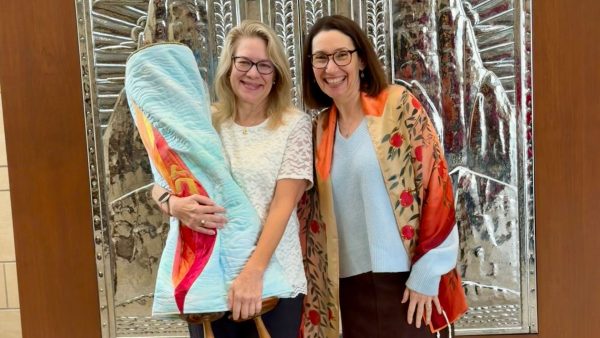
Mary Murawski was 10 days old when she was adopted in Ann Arbor, Mich., by a couple she describes as “very liberal, musical, intelligent people.” Her parents, Sarah and Wes Measel, told her from the beginning that she was adopted, and she grew up knowing she was chosen and deeply loved.
“I adored my parents,” she says.
They raised her alongside a younger adopted brother, though the two were never especially close.
“We had very different DNA,” Mary says, a phrase that would come to feel increasingly literal as her life unfolded.
Like many adopted children of her era, Mary, 64, grew up with only a single page of non-identifying information about her biological parents. The adoption agency had provided a brief profile: her biological mother was 5-foot-9, dark-haired, of English-Scottish descent from New England, and studying linguistics at the University of Michigan. Her father was listed as 6-foot-4, blond, a champion sailor and hockey player.
ADVERTISEMENT
“So I’m picturing this golden Nordic Gaia,” Mary recalls with a laugh, “and this WASP-y woman.”
For years, she didn’t think much about it.
But in her early 20s, curiosity became persistence. With no internet to help her, Mary and her adoptive father drove to the University of Michigan and did what she calls “old-fashioned research — knocking on doors and looking at registers and rosters.” She narrowed the search to a short list of women from New England who had studied linguistics there and eventually found her biological mother.
The response was not what she had imagined.
“The first thing out of her mouth on the phone was, ‘What is this, the Oprah show?’ ” Mary remembers.
Her biological mother had never told anyone about Mary’s existence and made it clear she had hoped the past would remain buried (years later, she softened). When Mary asked about her biological father, the answers were vague. The only detail she eventually offered was that he had attended Dartmouth College. Mary even traveled there, flipping through yearbooks in search of a tall hockey player who looked like her. She found no one. Eventually, she let the question go.
All her life, Mary had felt like she didn’t quite fit. Her family moved frequently for her father’s work in education, leaving her without roots. She skipped grades and was younger and smaller than her classmates. A social worker once told her, gently, that what she felt might be “the original injury of being relinquished by your birth mother.” Mary understood that explanation but she also knew it wasn’t the whole story.
She searched for belonging everywhere. She spent her junior high and early high school years in St. Paul, Minn., where she joined a Lutheran youth group, played piano, praised Jesus and went on backpacking trips.
As a senior in high school, she returned to Michigan and lived for the first time in a strongly Jewish community. She even fell in love with a Jewish boy.
In college, she moved between Christian environments — Hope College, study abroad in Paris, Michigan State, born-again churches — always seeking something that felt real.
“I was trying to find Jesus, but it never connected,” she says. “I felt like a fraud.”
After graduating from college, she moved to St. Louis for her fiancé’s work, before marrying and divorcing after a decade together. She had never planned to stay in St. Louis, but “it was too comfortable and cheap here,” she jokes.
At age 33, she became pregnant unexpectedly and decided to become a single mother.
“I didn’t know if I’d ever get married or be able to have a child,” she says. “So I went for it.”
Her daughter, Elena, became the center of her world.
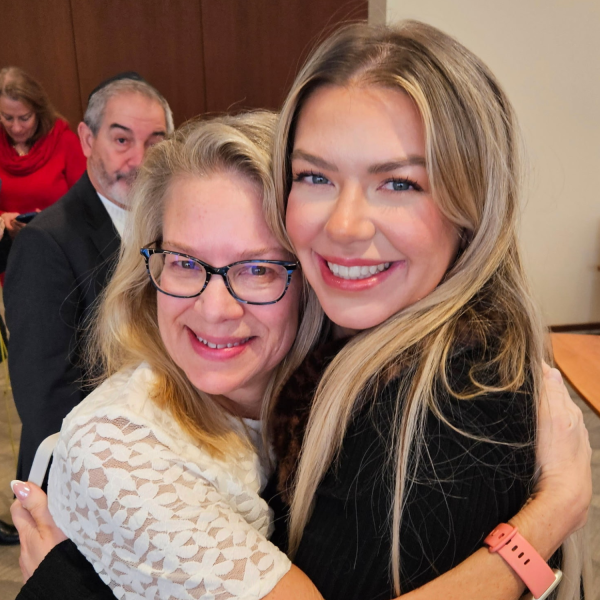
Church remained part of their lives until the pandemic, but even then, something was missing. After both her adoptive parents died — her mother in 2013, her father suddenly in 2022 — Mary found herself, as she puts it, “all of a sudden … an orphan.” Around the same time, she learned her biological mother had also passed away, still without ever naming Mary’s father.
That was when Mary joined Ancestry.com.
One early morning, her phone buzzed with her DNA results. Half of the pie chart matched what she expected: English, Scottish, Irish. The other half was Ashkenazi Jewish. Her biological father was 100% Eastern European Jewish.
“What an ah-ha moment,” Mary says. “It was like an epiphany. I felt radically validated. Like, ‘That’s why I’m this and this and this.’ It explained a lot, and it felt great.”
With the help of newly discovered relatives, old journals and meticulous detective work, Mary finally learned her father’s name: Abram Joseph Landau. He had died, but his extended family welcomed her.
“Instantly, I felt at home with these people,” she says. “I discovered my Jewish soul.”
The feeling deepened over time, through Passover seders, a family Haggadah, tears, laughter and making gefilte fish from scratch in her great-grandmother’s wooden bowl.
“I just knew,” Mary says. “This is it. I’m done looking for Jesus.”
In St. Louis, her Jewish connections blossomed. A friend, Laurie Goldberg, invited Mary to join her at the 2024 Nishmah women’s retreat at Camp Sabra, which became another turning point. Although Laurie got sick and couldn’t go, Mary went anyway, alone, knowing just one other person.
“I came back with my tribe,” she says, adding she had 30 new contacts in her phone. “Candid, intelligent, socially responsible women.”
She immersed herself in Jewish life: Shabbat dinners, studying Judaism and Torah, attending Friday night services.
She was invited by some of her new Jewish friends to attend High Holiday services that year at Congregation Shaare Emeth. One of those friends, Sheryl Lyss, had met Mary at the Nishmah retreat during a speed-dating-style icebreaker to introduce everyone.
“I really connected with her energy in those few minutes,” Sheryl says. “I don’t remember if she told me she wasn’t Jewish or was thinking about converting right away, but I do remember saying to her, ‘You have such a Jewish soul.’ ”
That sense of recognition followed Mary into her growing relationships at Shaare Emeth, including with Rabbi Andrea Goldstein. During an “awe walk” with Goldstein, Mary looked up at the sky and felt a clarity she says she had been searching for all her life.
“God said, ‘You’re a Jewish woman,’ ” she recalls. “I’m home.”
Today, Mary is Jewish, having completed her conversion through study, lived practice and immersion in the mikvah. When it came to choosing a Hebrew name, she selected Liora Shulamit, meaning light and wholeness — a name that reflects both how she sees herself and how others have come to experience her.
“What’s unique about Mary is that her desire to learn about Judaism and to connect in the Jewish community really overpowered any of those internal concerns that people often have,” Rabbi Goldstein says. “She’s someone who just puts herself out there, and it’s inspiring, because when we show up as our genuine selves, we are most often met with a beautiful reception. That’s what I’ve gotten to witness with Mary.”
Mary says she believes her purpose now is “to be a light — a positive, approachable example of a Jewish person — to help combat antisemitism and to be a warm and welcoming place for all.”
Asked what comes next, Mary laughs. Her answer is learning. She is enrolled in a 17-month Anshei Mitzvah class and plans to become a bat mitzvah in February 2027.
“I’m actually learning Hebrew — I can read, write and pronounce,” she says, still sounding amazed.
What drew her most to Judaism, she says, is the value placed on questioning.
“I always got criticized for asking too many questions,” she says. “And that’s such a Jewish value.”
She has also embraced tikkun olam, volunteering regularly and participating in Jewish leadership and learning spaces throughout the community.
“I’ve realized that volunteering is the way,” she says.
For a woman who spent decades searching for belonging, the journey did not end with a DNA result or a ritual immersion. It ended —as it began — with recognition.
“Once I start talking,” she says with a smile, “you know I’m Jewish.”
| RELATED: Tracing Jewish roots: How St. Louisans can explore their heritage through genealogy
ADVERTISEMENT