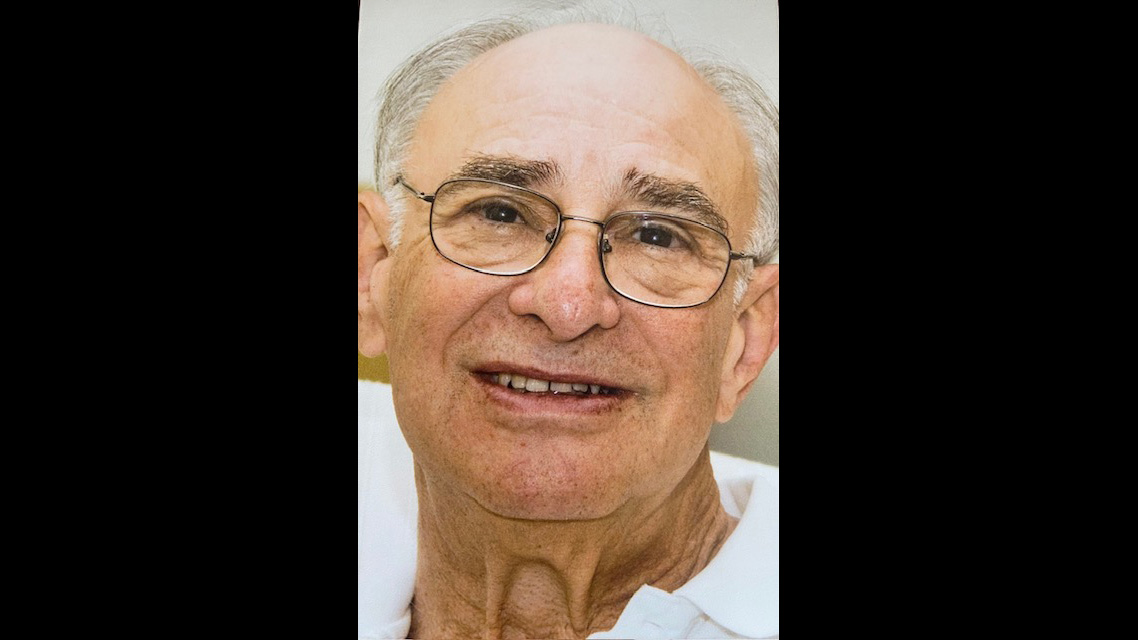


Donald I. Makovsky, a pioneering historian of the St. Louis Jewish community and a devoted educator whose career spanned more than half a century, died February 28 at Hadassah Hospital in Jerusalem. He was 92 and died of natural causes.
Mr. Makovsky was born in St. Louis on March 5, 1933, and lived there or in nearby University City for almost his entire life before moving to Beit Shemesh, Israel, in 2022.
Over 53 years in education, he pursued three distinct but related callings: historian, teacher, and administrator.
ADVERTISEMENT

As a historian, he was as a pathbreaker who uncovered the origins of the St. Louis Jewish community and its early institutions.
His scholarship included a two-volume M.A. thesis in history at Washington University, completed in 1958, and a publication based on that research, The Philipsons: The First Jewish Settlers in St. Louis, 1807–1858. He also wrote a history of the early years (1841-1859) of United Hebrew Congregation, St. Louis’ first organized Jewish house of worship, and authored the entry on St. Louis for Encyclopedia Judaica, the authoritative reference work on Jewish history and culture. His research was frequently cited by other historians and remains essential to understanding development of the city’s Jewish community in the 19th century. He was a co-founder and first president of the Jewish Historical Association of Greater St. Louis in 1964. Mr. Makovsky was also a widely respected American history teacher for almost two full decades at Pattonville High School and later Webster Groves High School. At different points in his life, he also taught in the adult education division of Washington University and at the community colleges of Forest Park, Lindenwood and St. Charles. He also taught in summers at Ladue and Parkway Central high schools.
Students remembered him as both inspirational and rigorous. Doug Phillips, a former student at Webster Groves High School who later studied at Princeton University, described Mr. Makovsky’s American history class as the equivalent of a demanding college course that taught him methods of historical interpretation and analysis that benefited him throughout his life.
During the years he taught high school, Mr. Makovsky personally supported many liberal causes — civil rights, opposition to the Vietnam War, and teachers’ right to unionize. Yet former students said he never projected his own political views in the classroom.
In all of his educational work, Jewish and secular alike, he emphasized substance and analytical thinking over form and style.
He was known for his extraordinary devotion to students. He especially relished teaching Advanced Placement American history and encouraged his students to aim for the country’s leading universities. In addition to writing recommendations, he did everything possible to advocate for students he deemed especially worthy.
Mr. Makovsky’s longest and perhaps most visible educational contributions came in the Jewish field.
He served as principal of the Shaare Zedek Congregation Sunday School from 1958 to 1975. He often had 350 students in his school. He also served as principal of an afternoon and evening high school program under the auspices of the Central Agency for Jewish Education of St. Louis, expanding its enrollment from about 25 to over 150 students.
From 1978 to 1980 he served as citywide director of the Jewish Education Council in Kansas City. He later returned to St. Louis to become executive director of the Louis and Sarah Block Yeshiva High School, a Jewish day school, where he served until his retirement in 2007.
His approach shaped generations of students. When asked about his view of education, Don said, ‘My educational philosophy is treating every individual as if he or she is your own child, then the chances are you will be successful. I love the term in the Talmud that says, “if you save one person, you save the world.” My goal has been excellence, whether it is Jewish or secular subjects.’
In his administrative roles he emphasized both academic excellence and strong extracurricular activities He recruited talented teachers and coaches and worked tirelessly to attract students from throughout the Midwest. He would personally travel hundreds of miles in the Midwest to recruit a single student.
Sports played an important role in his vision of a well-rounded education. Mr. Makovsky himself had lettered in track and cross-country at Washington University, where he received his B.A., after graduating from University City High School in 1950.
At Block Yeshiva High School, he helped build a competitive sports program that became an unexpected recruiting tool. Among the prominent coaching hires he brought to the school were: Harry Keough, who had coached St. Louis University to five national soccer championships; Vergil Fletcher, a legendary high-school basketball coach from Collinsville, Illinois; and Ken Reitz plus Curt Ford, former major league players of the St. Louis Cardinals.
One memorable moment came when the Block team, representing the school’s tiny population of 70 students, defeated 700-student Soldan High School in basketball — an upset that made the front page of the St. Louis Post-Dispatch sports section and remained a point of pride for Mr. Makovsky for years afterward.
Beyond the classroom and administration, Mr. Makovsky remained deeply committed to strengthening Jewish communal life. For 14 years he led High Holiday services in Cape Girardeau, Missouri, where the Jewish community lacked a regular rabbi. He also established a monthly Orthodox Sabbath service at St. Louis Jewish Hospital for 15 years; a committed Orthodox Jew himself, Mr. Makovsky would walk six miles from his home to conduct the service, in accordance with Jewish law prohibiting driving on the Sabbath. In retirement, he also arranged for Talmud scholars to teach classes for retirees.
He was revered within the St. Louis Jewish community — often called ‘Mr. St. Louis’ for his lifetime commitment to the city — not only for his accomplishments but also for his personal qualities: honesty, modesty, sincerity, kindness, unflagging cheerfulness and an unwavering sense of communal responsibility. Following his passing, former students filled his memorial guest book with tributes describing the lasting influence he had on their lives.
Mr. Makovsky was also an intensely knowledgeable sports fan, especially of baseball, and a lifelong devotee of the St. Louis Cardinals. His love of Judaism came from the traditional household in which he was raised by his parents, Jack and Minnie Makovsky. His passion for baseball came from his father, a respected amateur baseball authority who followed the Cardinals from 1920 until his death in 1991.
Like his father, he admired players who maximized their effort and ability — his favorite was Enos Slaughter — though he also cherished Cardinals legends such as Stan Musial, Bob Gibson, Lou Brock and Albert Pujols.
Mr. Makovsky was a devoted father, grandfather, and great-grandfather. He loved being surrounded by family on a regular basis. He is survived by his devoted wife of forty years, Judy Makovsky; his sons David (Varda) and Michael (Nataly) of Washington, D.C.; his daughter Lori Goldfarb (Brian) of Beit Shemesh, Israel; and his stepdaughter Rachayl (Eli) Duker of Beit Shemesh, whom he helped raise from the age of twelve; thirteen grandchildren and step-grandchildren; thirteen great-grandchildren; and three brothers, Kenneth, Stanley, and Alan, along with nieces, nephews, and cousins.
His first wife, Nancy Elbaum Makovsky, the mother of his children, died in 1980 after twenty-four years of marriage.
Mr. Makovsky’s funeral was held March 1 at Shamgar Funeral Home in Jerusalem, Israel. He was buried the same day in an Orthodox ceremony at the historic Jewish cemetery on the Mount of Olives, beside the grave of his first wife.
Donations in memory of Donald Makovsky can be made to: 1)National Library of Israel’s teacher training program for American educators. https://nliusa.org/donate 2) Jewish Institute for National Security of America: https://jinsa.org/donate 3) Hillel Foundation at Washington University in St. Louis, directed to support programs for the Jewish Learning Initiative on Campus (JLIC). https://www.washuhillel.org/donate