
Sixty years after Nostra Aetate changed everything between Catholics and Jews, St. Louis is taking stock of what that relationship looks like now — not just the friendships built, but whether those bonds can hold at a moment when antisemitism is rising, alliances are being tested and showing up for one another carries real weight.
St. Louis Jews and Catholics will mark the anniversary and their community partnership with a special public program on Feb. 5, 2026, at Washington University’s Danforth Center on Religion and Politics. The work leading up to it began this fall at a meeting between the Jewish-Catholic Dialogue Group — which includes ADL, American Jewish Committee (AJC) and the Jewish Community Relations Council — and Archbishop Mitchell Rozanski, part of an ongoing effort to strengthen a relationship that has grown steadily for generations.
Understanding Nostra Aetate
Issued on Oct. 28, 1965, during the Second Vatican Council, Nostra Aetate redefined how the Catholic Church relates to Judaism and other faiths. The declaration rejected the idea of collective Jewish guilt for the death of Jesus, condemned antisemitism and encouraged Catholics and Jews to meet one another with respect and honesty.
“After centuries of myths and stereotypes about Jews being normalized in Catholic communities around the globe, there was a recognition of the harm that had done and a commitment to a new way for the two communities to relate,” said David Cohen, executive director of the Jewish Community Relations Council.
It did not solve every issue, but it opened the door to a different kind of relationship, one rooted in dignity instead of distance. That shift remains the foundation for the partnerships shaping Jewish Catholic friendship St. Louis today.
ADVERTISEMENT

‘A relationship that has stood the test of time’
For Cohen, the anniversary arrives at a moment when that kind of relationship feels especially needed.
“At a time when international events are straining relationships between the Jewish community and many longstanding friends, it is a perfect time to celebrate an interfaith relationship that turned a new page in 1965 and has stood the test of time since then,” he said.
Cohen said the history behind Nostra Aetate resonates precisely because the stakes feel higher today. When trust breaks down between communities, he said, it doesn’t happen quietly — it shows up in moments of silence, delayed responses and fractured public support when antisemitism surfaces.
Locally, he said the Jewish-Catholic Dialogue Group has strengthened ties by being proactive and assuming goodwill even when issues get tough. “We won’t always agree on every point,” he said, “but by keeping the relationship intact, we will always be able to come out stronger in the end.”
Goals from the September gathering
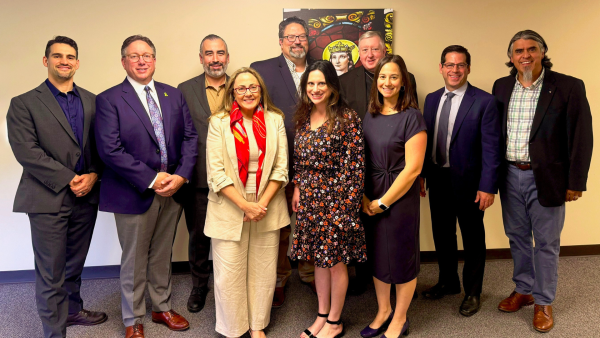
Dr. Javier Orozco, the Archdiocese’s executive director of human dignity and intercultural affairs, said the September meeting with the Jewish-Catholic Dialogue Group reaffirmed several priorities. The meeting came at a time when interfaith relationships in many cities are under strain, and when public solidarity can no longer be taken for granted. The gathering brought together ADL, AJC and JCRC as part of their long-running collaboration with the Archdiocese, a partnership that has met quarterly for years to support dialogue and shared understanding.
The group committed to regular meetings with the archbishop, continued collaboration on education and a shared responsibility to confront antisemitism and religious bigotry. “These conversations help us see one another more clearly and remind us of the work we hold in common,” Orozco said.
He pointed to AJC and the U.S. Conference of Catholic Bishops’ joint publication Translate Hate: Catholic Edition as one of the tools partners affirmed together. He also highlighted the Archdiocese’s “Meeting Our Neighbors” program, which has brought more than 1,000 Catholics into houses of worship across the region, including Shabbat experiences at local synagogues.
“The declaration’s exhortation to engage religious differences in dialogue, mutual learning, appreciation and trust is a relevant lesson,” Orozco said. “In our times when it is easy to create silos, to affirm the truth and holiness found in other religions is extremely important.”
A national lens on a changing world
AJC’s involvement in Catholic-Jewish relations long predates Nostra Aetate. For decades leading up to the Second Vatican Council, the organization partnered with Catholic scholars and institutions, including scholarship collaborations with Saint Louis University’s Divinity School, to identify harmful stereotypes in Catholic education and advocate for reforms that ultimately helped shape the declaration’s emphasis on dignity and mutual respect.
Rabbi Noam Marans, AJC’s national interreligious affairs director, said the world looks very different than it did ten years ago when communities gathered for the 50th anniversary of Nostra Aetate.
“There has been a dramatic rise in antisemitism, October 7 and its aftermath, and a greater necessity for Catholic-Jewish relations as a bulwark against these threats,” Marans said. He noted disagreements in the wake of some Catholic responses to Israel’s defensive war, but also pointed to strong statements from Catholic leadership, including Pope Leo, condemning antisemitism during Nostra Aetate at 60 commemorations.
National engagement, Marans said, often addresses policy and diplomacy. Local engagement depends on something simpler. “There is no substitute to visiting each others’ institutions and building relationships with local leaders,” he said.
Looking ahead to February
Archbishop Rozanski said the anniversary is both a historical marker and a reminder that interfaith work must be sustained with intention. Honest dialogue takes time, trust and the willingness to confront difficult moments in both communities’ histories, he said, especially as global crises ripple into local conversations.
“I hope people of faith and good will can appreciate the vision and message of Nostra Aetate calling us to the work of dialogue and cooperation,” Rozanski said. “Our coming together can renew our commitment to building bridges of appreciation and friendship.”
In the past year, moments that once would have drawn immediate, unified responses from interfaith partners have instead required careful negotiation, private conversations and time. Leaders say that doesn’t signal failure — but it does underscore why relationships built over decades matter most when they are hardest to maintain.
The Feb. 5 program at Washington University, sponsored by the Archdiocese, ADL, AJC, and JCRC’s Newmark Institute for Human Relations, aims to do exactly that, offering St. Louis a chance to reflect on the progress of the last 60 years and the work still ahead. The event will begin at 6:30 p.m. in Knight Hall’s Emerson Auditorium on the Danforth Campus of Washington University in St. Louis. A light reception will follow. Registration is required.
| RELATED: JCRC focuses on Catholic-Jewish relations since Nostra Aetate