“Life is full of miracles — you just have to look for them.”
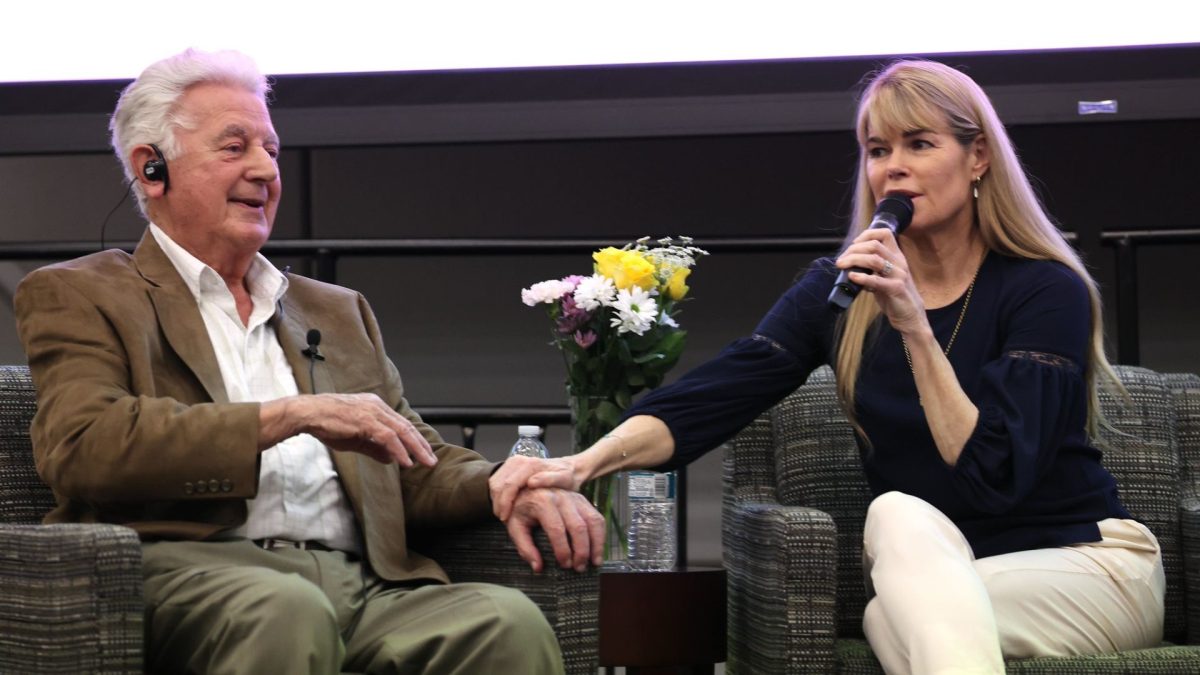
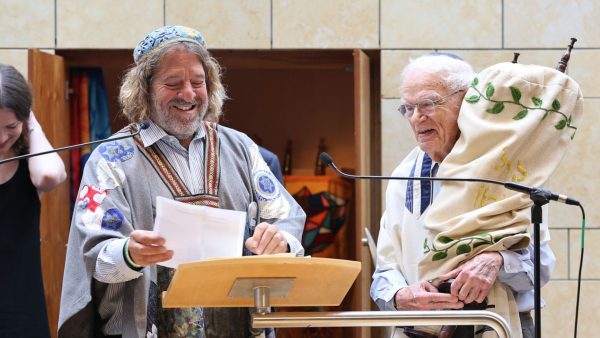
That simple but poignant concept was the theme of a recent bar mitzvah ceremony at Central Reform Congregation. The words came from Dr. Ray Slavin, who celebrated his third bar mitzvah June 27.
At age 96, Slavin is something of a miracle himself. With the youthful exuberance of a teenager, he carried the Torah around the sanctuary before approaching the bimah.
Rabbi Randy Fleisher offered his own assessment of Slavin as the ceremony began.
“In 96 years, you have become the embodiment of the best in Torah,” Fleisher told the roughly 250 congregants in attendance. “You’re a mensch. You’re a professional. You’re an incredible family member. You’re an amazing friend. You’re a congregant who any congregation would dream of having. You’re a scholar. You’re curious.”
ADVERTISEMENT

Slavin had his first bar mitzvah at age 13 in 1943. He had his second in 2013 at CRC. The significance of his second ceremony can be traced to Psalm 90:10, which considers a full lifespan to be 70 years. Each year lived beyond that represents the beginning of a new life.
Slavin was then 83 (or 70 years plus 13) when he had his second bar mitzvah. It wasn’t long before he began considering a trifecta. He consulted with Fleisher and arranged for an encore, 13 years following the second bar mitzvah.
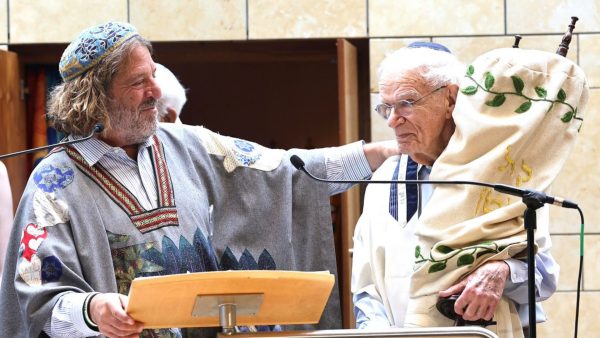
“If it was 70 years after the second one, we can forget about it,” Slavin said, recalling his thought process. “But if it’s 13 after the second, I’ve got a shot. I had a tryout at age 93, and people were very kind and thought that I did well. So now, here we are 13 years after my second. I’m doing it to convince my family, particularly my grandchildren and my great-grandchildren, that life offers wonderful opportunities and, even at 96, you can learn and you can grow.”
Even with two bar mitzvahs under his belt, Slavin admitted reading from the Torah is challenging, because it has no vowels, so Fleisher provided him with study aids as he does for teenage b’nai mizvot. One aspect was easier than it would be for a typical 13-year-old: public speaking before a large gathering. Slavin said he gave hundreds of talks during his career as director of allergy and immunology at St. Louis University School of Medicine.
Slavin said he hoped to set an example that people can accomplish anything they set out to do, regardless of their age. People who know him well were likely not surprised at his diligent preparation routine, which included brushing up on his Hebrew and creating a compelling narrative during his remarks to the congregation.
“They know me well enough that they’re not surprised by the offbeat things that I do,” Slavin said. “But I know people are in sort of wonderment that two days before my 96th birthday, I’m doing this. It’s a bit of a curiosity.”
A curiosity, or maybe an example of a miracle. The latter was fitting for Slavin’s Torah portion, about King Balak of Moab, who hired Balaam, a pagan prophet, to curse the Israelites. Balaam’s donkey refused to move, and it speaks, warning of a messenger angel with a drawn sword blocking their path. G-d opens the prophet’s eyes to see the danger. Instead of cursing the Israelites, Balaam blesses them.
A talking donkey and his newly enlightened master proved to be the ideal subject for the proceedings. Fleisher addressed the parsha during the ceremony.
“Something happened when Balaam looked out at the community, just like Ray and I are doing right now,” Fleisher said. “He saw something sacred and holy and beautiful and generous and loving, and the words of curse couldn’t leave his mouth. Instead, he blessed them. So, Ray Slavin, this community that’s here right now, we would not be here in this congregation if not for you and your courageous, brilliant, stunning decision.”
While preparing for his address to the congregation, Slavin got some sage advice from Rabbi Susan Talve, CRC founder and rabbi emerita. She suggested he try and come up with one key message the congregation, friends and family could carry away from the ceremony.
Slavin said: “I found a quote by Albert Einstein about how some people live their life as if there are no miracles, and another group lives their lives in terms of life is full of miracles. You just have to look and not take things for granted.
“My major thesis revolves around the fact that miracles occur all the time, but we’re either not aware of it because we aren’t looking, or we take them for granted. And I’ve got a couple of examples of how important it is to look for them.”
A life fully lived offered Slavin a wealth of material. Some years ago, during a photo shoot, Slavin was walking with his longtime patient Peter Raven, then the director Missouri Botanical Garden.
“We were walking and chatting, and he suddenly said, ‘Look at that!’ ” Slavin said. “Between two concrete slabs, a lovely, colorful little flower had emerged. Peter looked at me and said, ‘Isn’t that something?’ I would have just passed right by. That is an example of things that we don’t look for carefully enough.
“Another is taking things for granted. One example is the heart, which beats a hundred thousand times a day and it propels 5 liters of fluid. And yet, we just had to take it for granted unless we have an arrhythmia or a myocardial infarction. Ordinarily, the heart just simply goes along doing its job. We don’t really think about it.”