
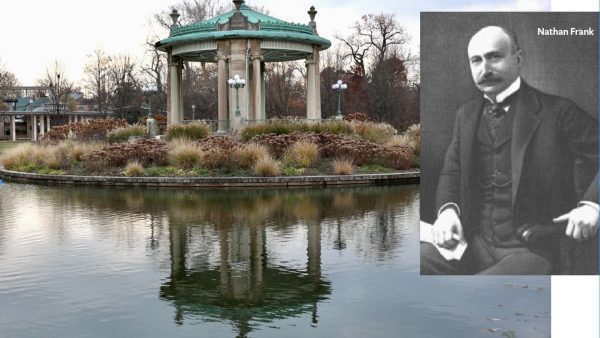
Forest Park contains a wide variety of iconic places and buildings, from the Jewel Box to the Grand Basin to the Art Museum. One of the most striking and unusual sites is a bandstand directly across from the Muny Opera. Most St. Louisans who see a photo of its distinctive shape can easily recognize it, if not name it or recite its provenance.
The circular marble structure is the Nathan Frank Memorial Bandstand, named for a Jewish mover and shaker of the early 1900s. Frank was a successful lawyer and newspaper publisher. He was also the first and only Jewish member of Congress from Missouri.
The bandstand cuts a striking image and is often used as a background for wedding party photos. It is notable because it is surrounded by a moat. Park maintenance crew can reach the bandstand, but there’s no access for park visitors — unless they take a very short boat ride.
Who was Nathan Frank?
Frank was born Feb. 23, 1852, in Peoria, Ill. His father, Abraham, had a wholesale and retail dry goods store. Abraham Frank was president of the Peoria Hebrew Society, the predecessor to the city’s first congregation, Anshai Emeth, which opened in 1859.
ADVERTISEMENT

The Franks moved to St. Louis in 1867 when Abraham went into business with his brother-in-law, Max Weil. Frank led the business, which was renamed A. Frank & Sons. He was active in the Jewish community in St. Louis and was one of the founding members of Congregation Shaare Emeth.
Nathan Frank attended Central High School and graduated at the top of his class. After one year at Washington University, he transferred to Harvard University and received a bachelor of law degree in 1871. After graduating, he moved back to St. Louis and started a practice specializing in commercial and bankruptcy law.
Frank became active in the Republican Party and, in 1886, ran unsuccessfully for the 9th Congressional District seat in the House of Representatives. His platform supported the working man. He also supported a uniform bankruptcy law. His lack of experience in public affairs drew derision from both the Post-Dispatch and Globe-Democrat newspapers, and Frank lost the election.
Two years later, Frank ran for Congress again and won, riding a wave of Republican victories. He was appointed to two committees, one of which dealt with the World’s Fair. He pushed for St. Louis to host the event in 1892, but Chicago was the eventual winner. As a congressman, Frank was successful in creating a bankruptcy law.
After one term, he retired from Congress and returned to his law practice. He later entered the publishing business and founded the St. Louis Star, which eventually became the St. Louis Star-Times. Frank was an avid baseball fan. He sat in the president’s box at Sportsman’s Park with President William Howard Taft on May 4, 1910, and watched the Cardinals beat the Cincinnati Reds 12-3. He was a member of the Missouri Athletic Club and Westwood Country Club.
Like his father, Frank was an active member of the Jewish community. He was a donor supporting construction of St. Louis Jewish Hospital and, from 1885 to 1889, he served as the first president of the hospital. He was campaign chair for the Jewish Orphans Home in 1926. His philanthropy extended to the Orthodox Old Folks Home, the Federation of Jewish Charities and the Jewish War Relief Committee.
Frank worked diligently to plan the 1904 Louisiana Purchase Exposition, also known as the St. Louis World’s Fair, and was named a commissioner for the fair.
The Nathan Frank Bandstand
Forest Park boasts a few remnants from that era, including the World’s Fair Pavilion. That structure was renovated in 1998, thanks to the efforts of another Jewish philanthropist, Sunny Glassberg.
The bandstand named for Frank was not the first on that site. The original bandstand was erected in 1876 for the grand opening of Forest Park. It was meant to mimic an “Arabian Nights” theme and was made of wood. It was one of the most photographed structures at the World’s Fair, just as the Nathan Frank Bandstand is today. After the fair, concerts were held there. It closed for repairs in 1911 and then was destroyed by a storm and a fire.
The site was empty until 1924, when Frank donated $50,000 to erect a new bandstand. It was the first private gift to any local park. The structure is an example of classic Renaissance architecture designed by the firm Heffensteller, Hirsch and Watson. It is made of white marble and concrete with bronze rails and a copper roof. It was named for Frank after his death in 1931.
Since the dedication of the Frank bandstand 100 years ago, it has undergone two major renovations. Time and the elements had taken a toll on the bandstand and, in 1981, the Central West End Charitable Trust paid for roof repairs and electrical work. Two years later, funds from Forest Park Forever completed the restoration.
Mary Goldstein Stolar, another member of the Jewish community, helped with fundraising for that effort. In 2012, Bob Cohn, editor-in-chief emeritus of the Jewish Light, wrote this report on Stolar’s contributions to the restoration.
The most recent restoration was completed in 2000. Care of the bandstand is overseen by the city and Forest Park Forever. The Flora Conservancy of Forest Park maintains the landscaping and plants.
There is one postscript to Nathan Frank’s legacy in Forest Park. The Nathan Frank Society, a planned giving program, also bears his name. Dominik Jansky, director of communications and marketing at Forest Park Forever, said:
“The society was named for Nathan Frank because he was really the first private donor to give money for a specific project in need in the park.”