
On Christmas Eve in 1994, Holly Bernstein and some of her friends from Washington University Hillel headed to the St. Peter and Paul homeless shelter in Soulard to serve dinner. The experience was meaningful in a couple of ways. It was a way for her to give back to the community, and she gave a ride to another volunteer who later become her husband.
“We gave them dinner, which was certainly helpful in that moment,” Bernstein said. “Anyone who’s having a hard time like that, it’s tremendously helpful to have someone sit down and talk with them, just as one human being to another.”
The concept of giving back to the community in tangible ways was a value Bernstein learned growing up.
“My family has been very philanthropic,” she said. “They also volunteered, but I think more of the influence I had from them was the importance of philanthropy. They taught me that we had a responsibility to give back, which is something I’ve always taken very much to heart.”
Bernstein grew up in St. Louis and graduated from Williams College in Massachusetts with a degree in mathematics, followed by a PhD from Washington University, where she did research on differential geometry. She has done some part-time teaching but primarily was a stay-at-home mom prior to her now-busy volunteer schedule. That began in earnest after consulting with Rabbi Mark Shook about ways to be more thoughtful about charitable giving.
ADVERTISEMENT

“I told him we wanted to give money that would help hunger and homelessness and human needs, and we wanted to do it Jewishly, but we didn’t want to have it only impact the Jewish community and he directed us to the Jewish Fund for Human Needs (JFHN),” she said. “I started off donating to them through JCRC (Jewish Community Relations Council). The JFHN gives grants to small nonprofits that serve basic human needs.
“I eventually got to serve on the JFHN committee and then became its chair. I learned so much from that. Yes, we were helping people, which felt great. But also, it was such an education for me. We would go to these different organizations that were serving basic human needs and had applied for a grant. We visited them to meet the people involved and see the work that they did. I’ve never done anything that’s made me feel both so lucky for what I have and so amazed at what other people do to help the world.”
Bernstein learned that making new friends was a side benefit of volunteering.
“All my friends from graduate school had moved away, so I was looking to meet people and build relationships,” she said. “My grandmother clipped an announcement that said National Council of Jewish Women-St. Louis was holding an event to get young women involved. I went, looking to make connections with people. And the nice thing about making connections with people through volunteering is they tend to be very like-minded.
“It opens up a new social sphere for you from that perspective,” she continued. “Often they are tremendously interesting people, tremendously driven people, but they also help you expand your own horizons.”
Currently, Bernstein serves on several committees at Congregation Shaare Emeth, where she is a member. Those include two co-chair positions for the REDI (racial equity, diversity and inclusion) committee and the voting rights committee. She is active in the Missouri Voter Protection Coalition (MOVPC), and a board member of Access MO. She was also a recipient of the Shaare Emeth Tzedek Award in May 2025.
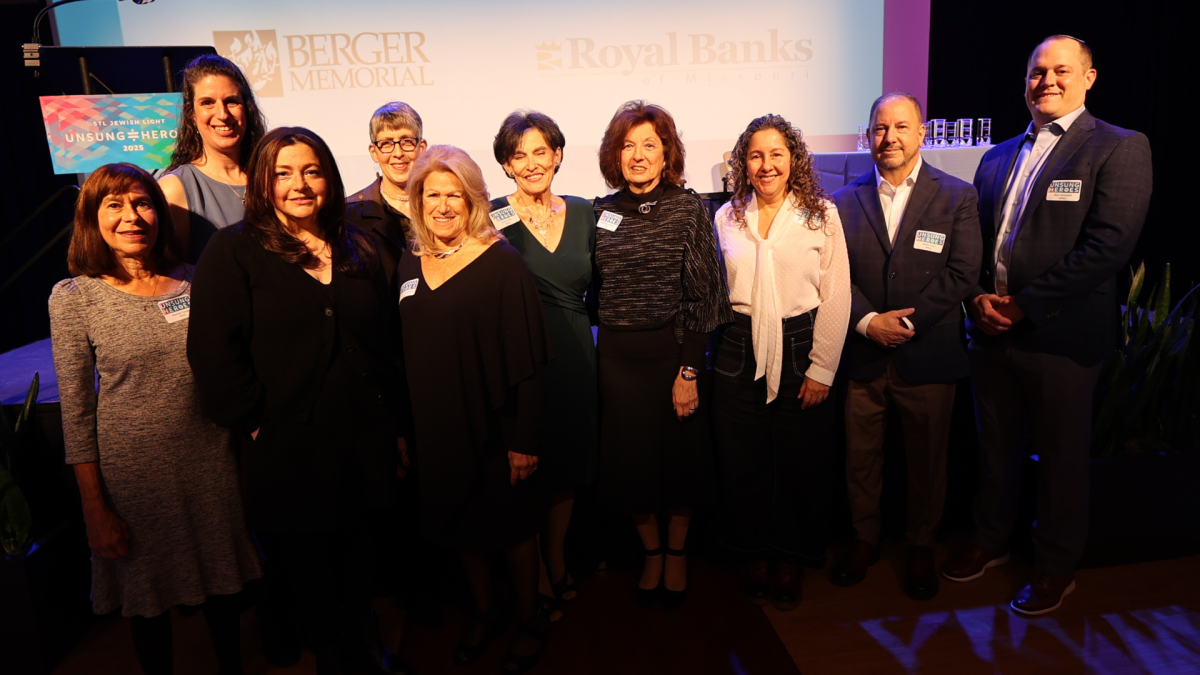
While she’s happy to do the work of governing and planning on committees, Bernstein especially enjoys working in the trenches, especially when it comes to voter rights. During elections, she often works alongside her friend, volunteer (and 2025 Jewish Light Unsung Hero) Michele Steinberg.
They co-lead the St. Louis Metro Field Program, coordinating field volunteers for the city of St. Louis and St. Louis County. These volunteers either stand outside a polling place or travel between polling places to help voters and identify and document systemic problems. Steinberg said Bernstein is a tireless, selfless worker.
“Holly always does what needs to be done, regardless of the cost to her,” Steinberg said. “She puts in the effort, and she puts in the time. The mission is more important to her than the accolades or making sure that she gets credit for it.”
Jen Bernstein, director of advocacy for NCJW-St. Louis, also lauded Holly Bernstein’s commitment to voter rights.
“She’s been a tireless advocate,” said Jen Bernstein, who is not related to Holly. “She goes to the polling places. She does the door knocking. And being an unsung hero is kind of fitting for her because she really is not someone who seeks attention or credit or anything like that. She quietly goes about doing what she does.”
The MOVPC field program prioritizes placing volunteers at polling places where voters have historically encountered more challenges.
“The goal is to have every person who is eligible to cast their vote be able to cast their vote,” Holly Bernstein said. “Much of the work that Michele Steinberg and I do is voter education. For example, something that lots of people don’t know, is if you cannot physically get inside the polling place, you can vote curbside. You can vote in your car.
“I was at the polling place at Ritenour High School, where you sometimes have a far walk from where you park to get to the polling place, and there was a poor woman who had a broken leg, and she was on crutches. She was really struggling to reach the polling place. And I said, ‘Go back, pull your car up, and we’ll go get the poll workers so you can vote curbside.’”
Bernstein said she is passionate about voter rights because it speaks directly to fixing problems.
“There are so many organizations doing so much valuable work,” she said. “But how do we fix the systemic causes? We have to vote, and we have to elect people who are going to do what we want them to do. In recent years, that’s really where my volunteer work has centered, protecting the right to vote, helping people vote and trying to elect people who are going to actually uphold our values.”