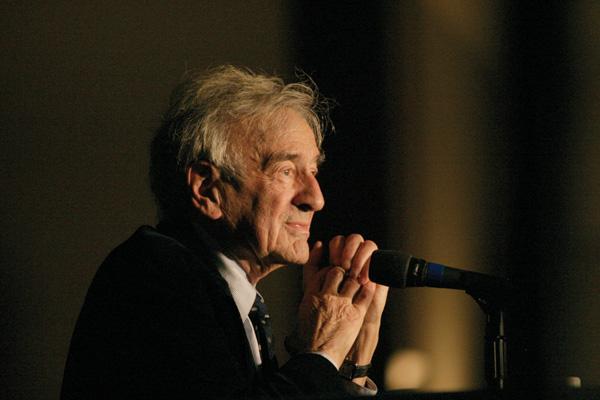
For decades, author, educator and humanitarian Elie Wiesel used his voice to confront injustice and remind the world of its moral responsibilities. Best known for his searing memoir “Night,” drawn from his own experiences as a Holocaust survivor, Wiesel chronicled both the depths of human cruelty and the enduring power of memory. “American Masters – Elie Wiesel: Soul on Fire,” airing at 8 p.m. Jan. 27 — Holocaust Remembrance Day — on Nine PBS (and the PBS app), offers an intimate portrait of his life and legacy, narrated in his own words and shaped by the experiences that fueled a lifetime of writing, teaching and activism.
The film will also be featured as part of the St. Louis Jewish Film Festival at 3 p.m. March 17 (details to come).
Born in 1928, Wiesel was raised in a close-knit Jewish family in Sighet, Romania until his world was shattered by the Nazi occupation in 1944. Deportation to Auschwitz claimed the lives of his mother and younger sister almost immediately; Wiesel and his father were later forced on a death march to Buchenwald, where his father died. Rescued by American soldiers in April 1945, Wiesel was sent to France with other orphaned survivors known as the Buchenwald Boys. There, a photograph in a newspaper led to an emotional reunion with his sisters Hilda and Beatrice, marking the beginning of a new life forged from unimaginable loss.
The film traces Wiesel’s journey from postwar Europe to New York, where he emerged as a writer, journalist and teacher. Early on, he reported on international affairs, studied at the Sorbonne, led a children’s choir and slowly began to shape the body of work that would define his career. Though initially reluctant to write about the Holocaust, Wiesel ultimately found his voice in “Night,” first written in Yiddish as “And the World Remained Silent” before evolving into its French and English editions. The book became a cornerstone of Holocaust literature and is still taught in classrooms around the world.
“Soul on Fire” combines Wiesel’s first-person narration with interviews, family footage, archival material and hand-painted animation, along with scenes from his Boston University classroom—where he taught for more than three decades—and a contemporary middle school class in Newark. The documentary also features reflections from family members, scholars and colleagues, underscoring Wiesel’s impact as both a moral witness and an educator. Central to the film is his lifelong fight against what he called “the perils of indifference,” a theme that echoed through his public speeches, including his televised plea to President Ronald Reagan in 1985 before his trip to a German cemetery at Bitburg and his Nobel Peace Prize acceptance speech the following year. Wiesel died in 2016 at the age of 87.
Filmmaker Oren Rudavsky brings a deeply personal lens to the project, noting that Wiesel’s teachings and stories were part of his own family life – his mother studied with Wiesel in Boston. In a fractured world, Rudavsky sees Wiesel as a model of moral clarity and compassion—“a healer, which we need today more than ever.”
ADVERTISEMENT