
A shameless plug for one of New York’s best bargains: a walking tour of the Lower East Side.
I’ve logged plenty of miles on food and history tours in New York through Greenwich Village, Chelsea Market/High Line and Chinatown, and I’m convinced they’re one of the smartest ways to get to know a city. You leave with a full notebook, a fuller stomach and enough trivia to annoy your friends and family for days.
In town for the annual American Jewish Press Association conference, on Friday, we took part in an optional conference outing. Jordan Palmer, Angie Rosenberg and I joined several other attendees for a two-hour exploration of the Lower East Side.
Our guide, Bradley Shaw of the Lower East Side Jewish Conservancy, was worth the price of admission alone. Shaw’s signature tour is called “Kosher Nostra,” a deep dive into the neighborhood’s Jewish gangsters and mobsters—an itinerary that immediately landed on my list for a return visit. Instead, we got a fascinating crash course in immigrant life, stunning synagogue architecture and the generations of dreamers, strivers and survivors who helped shape this iconic New York neighborhood.
ADVERTISEMENT

Our tour began at the legendary Katz’s Delicatessen, which, for reasons that still baffle me, was serving as the backdrop for a three-day Prada Mode (yes, that Prada) cultural extravaganza. The event featured private parties, immersive art installations and a parade of fashion influencers who traded caviar blinis (and whatever else fashion influencers eat) for pastrami sandwiches the size of their faces and other deli classics.
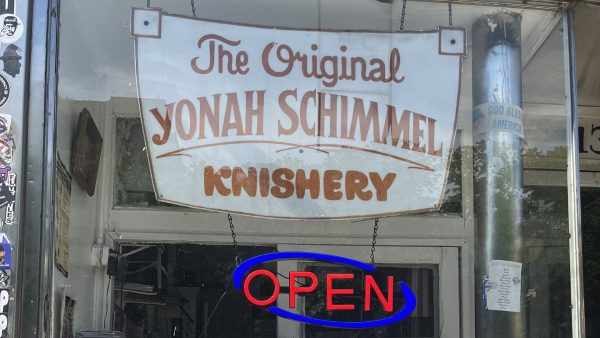
Sadly, two Lower East Side institutions had not yet opened when we arrived: Yonah Schimmel’s Knish Bakery and Economy Candy, the city’s oldest candy store, packed floor-to-ceiling with retro treats, hard-to-find sweets and penny candy sold by the scoop. But our disappointment quickly dissolved when we stumbled upon Pickle Guys, a temple to all things brined, offering 47 varieties of pickles and pickled products, from traditional kosher dills to more adventurous options like pickled mango, pineapple and Brussels sprouts.
Beyond the quirky inventory lies a remarkable piece of New York history. At the turn of the 20th century, pickle vendors were as common on the Lower East Side as food carts are today, feeding waves of Jewish and Eastern European immigrants. Pickle Guys keeps that tradition alive, still making its pickles according to old-world recipes that rely on salt brine, garlic and spices—not preservatives. One bite and you’re tasting more than a pickle; you’re tasting a century of neighborhood history.
As we wandered the Lower East Side’s iconic streets, it was fun to imagine our immigrant ancestors encountering this neighborhood for the very first time.
We stopped at the Stanton Street Shul, one of the last surviving tenement synagogues, and admired the Angel Orensanz Center on Norfolk Street, where Sarah Jessica Parker and Matthew Broderick married in 1997. Built in 1849, it is also the oldest surviving building in New York City constructed specifically as a synagogue.
Then came one of the day’s most memorable lessons: the “Tonsil Riots of 1906.” Yes, tonsil riots. Apparently, thousands of Eastern European Jewish immigrant mothers stormed the neighborhood’s public schools after city physicians began performing free tonsillectomies and adenoidectomies on students. Health officials believed enlarged tonsils contributed to poor school performance and developmental delays. The mothers, understandably skeptical of government officials wielding surgical instruments around their children, responded with outrage. It’s one of those wonderfully odd chapters of New York history that sounds too bizarre to be true—except that it is.
As always, the AJPA conference was focused on the future of Jewish journalism. Yet my favorite takeaway was walking through this neighborhood steeped in Jewish history. The Lower East Side reminded us of where so many of our communal stories began—and why telling them remains as important as ever.