
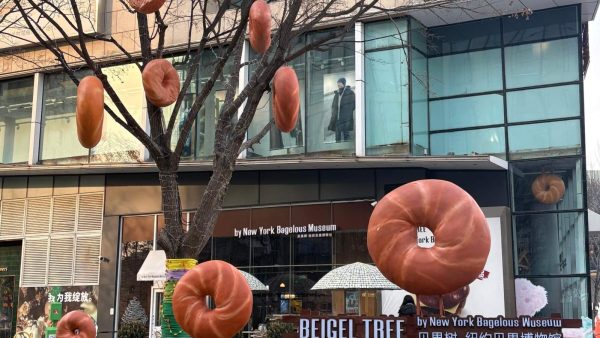
I was strolling through a gleaming new mall complex in Beijing beside a couple walking their robot dog when I stumbled upon the bagel tree. Its branches, though bare of leaves, bore giant bagel sculptures, hanging from its boughs on translucent string. In front was a sign proclaiming, “Beigel Tree by New York Bagelous Museum.”
Beigel Tree by New York Bagelous Museum, it turned out, was a new offshoot of the viral New York Bagelous Museum, a growing bagel chain with five shops across three Chinese cities.
The New York Bagelous Museum would seem, at least in name, to be a nod to New York Jewish culture. These days, China isn’t so hot on either of those things. The Chinese government sees America as a country in decline and often points towards visible poverty in major American cities, like New York, as a sign of this. While China used to be nearly free of Jew-hatred, there has seen a rise of antisemitic posts and rhetoric on Chinese social media platforms. The government tightly controls what is posted on these platforms, but there has seemingly not been censorship of antisemitic posts.
In this environment, the proliferation of New York Bagelous Museums was surprising. I’d been living in China for nearly a year pursuing a Masters in Global Affairs, and I couldn’t help but wonder what this new development in Beijing-New York relations was all about. I went to see for myself.
Inside, the shop was decorated less like a New York bagel shop and more like a New England bed and breakfast. Instead of sturdy linoleum, it has hardwood floors. Customers sat on benches with green velvet pillows, noshing on bagels and sipping coffee. The shop’s exposed brick walls are hung with oil paintings, photos of New York City, and one tapestry depicting a famous 1963 photo of John and Jackie Kennedy’s family at Hyannisport. I found myself thinking, wouldn’t a portrait of Ruth Bader Ginsburg be more appropriate?
ADVERTISEMENT

Well, yes, but the shop isn’t exactly meant to be a faithful duplicate of a New York bagel shop. The likely inspiration for the store comes not from New York but from Seoul. In 2021, Seoul experienced its own bagel craze when a store called London Bagel Museum opened up, drawing two-hour-plus lines.
The Bagel Museum is, in no way, a museum. Besides the bagel part, the rest of the name is arbitrary. According to a Korea Times article, the store’s name simply “combines the founder’s favorite words.”
Two years later, in 2023, New York Bagelous Museum opened its first location in Shanghai. Like many Chinese companies, it was welcomed into this world with copycat allegations. The two shops are nearly identical, even including the font on the marquee, the interior design and the artwork on the packaging. The main difference is that one features a Union Jack while the other features the Statue of Liberty.
The mission statement on the shop’s page on WeChat, the popular Chinese social media application, says that the founders started the company because they wanted “to create a unique American museum-style bagel shop” and for their customers “to enjoy and feel the atmosphere from the American 50s and 60s.”
Though the menu did feature a lox and cream cheese bagel, the rest of the options were unrecognizable to this New Yorker. The signs were written in both English and Chinese. Some bagels were pre-made sandwiches. One featured sweet red bean paste and a slab of butter. Another was stuffed with cream cheese and topped with sticky syrup and rose petals. The sandwiches were artfully put together, unlike the slapdash constructions you find in New York. Other bagels had fillings rolled into the dough, like the Mexican pepper bagel, stuffed with asiago and salami. My friends and I got these, as well as a blueberry sandwich and chocolate bagel, to try.
Notwithstanding the unorthodox flavors, upon taking a bite, I realized that these were bagels in name only. While they did have some of the chewiness of a bagel, they didn’t have the density or the hard exterior. This is likely because, in making the bagels, New York Bagelous Museum doesn’t boil them, something I learned while watching bakers make them through a window into the kitchen. Besides the shape, there wasn’t much separating the bagels from a bread roll.
At the New York Bagelous Museum, I found few traces of New York, bagels, or museums. But the average Chinese customer probably wouldn’t realize the difference between this shop and the real deal, just like the average American eating Chinese takeout wouldn’t realize the gulf between the Chinese food in America and that in China.
It doesn’t seem like those who visit New York Bagelous museums are all that attracted by New York, much less New York Jewish culture. Instead, judging by the myriad posts from Chinese social media about the shop, it’s merely because the shop is viral. Many reviews mention the bagels, but a lot mention another fact: the shop, with its approximated Americana and absurdly stuffed sandwiches, is a great place in which to take photos.
This story was originally published in the Forward. Click here to get the Forward’s free email newsletters delivered to your inbox.