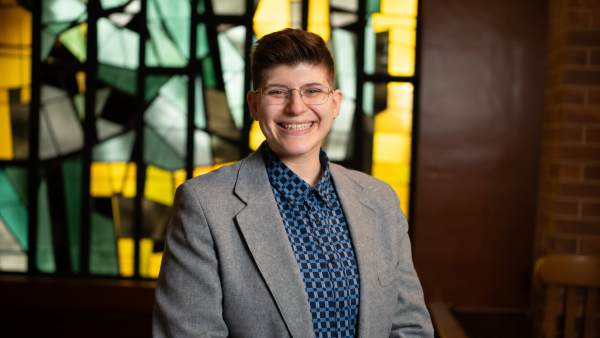
Standing at the bimah, Cantor Kalix Jacobson gives a special sermon to attendees of Congregation Shaare Emeth’s Pride Shabbat, which took place June 26.
Jacobson, who currently lives in Pittsburgh, returned to their hometown of St. Louis this month while on sabbatical both to visit family and participate in events like Pride Shabbat.
Jacobson grew up intertwined with Jewish life in St. Louis, attending Shirlee Green Preschool at Shaare Emeth and Saul Mirowitz Jewish Community School. Though they didn’t come from a traditionally observant family, Jacobson loved attending and leading services, chanting Torah and learning about Judaism from a young age.
“[Rabbi Andrea Goldstein] told my mother that, without a doubt, I would be a rabbi or cantor by the time I was 2 or 3 years old,” Jacobson said. “So it’s been in the stars for me for a long time.”
Resisting a calling that felt inevitable
However, the decision to become a cantor was not one that they made lightly. Because of their experiences growing up transgender and queer in Missouri, doing what people told them to do wasn’t usually a positive thing.
ADVERTISEMENT

“I didn’t really want to be a cantor, it was something that people wanted for me,” Jacobson said. “All my life, the things that people wanted from me, in my idea, felt wrong, and so I assumed that if people wanted this for me, it must be wrong, too.”
Jacobson began to seriously consider cantorial school after helping a friend navigate the loss of family members through pastoral care, offering support for their physical, emotional and spiritual needs. Although Jacobson hadn’t set out to do this work, the experience made it clear that this was what they were meant to do.
“That was the first time I understood what they were saying, because it’s not just that I can sing, it was because of everything else, the pastoral care, the teaching, all of that stuff,” Jacobson said.
By that point, Jacobson had already gotten a bachelor’s degree in business from Maryville University and studied at Meramec Community College, so they were able to begin cantorial school at Hebrew Union College, which offers a five-year master’s and ordination program.
The cantorial program began with a year in Israel learning about its history and significance, then four years in New York City. Jacobson also earned a master’s of Jewish nonprofit management to connect their business knowledge with the cantorate.
Making history as a cantor
Cantorial school was a natural fit for Jacobson’s skills, but it came with its own challenges. While attending classes full time, they balanced responsibilities with multiple congregations and a small business, all while navigating conflicts with some peers and faculty over their nonbinary identity.
“It was very hard, and also I’m very grateful I went, because had I known how difficult it would have been, I would have never gone,” Jacobson said. “And thank God I didn’t know, because it’s the best decision I ever made.”
Jacobson was ordained in 2023 alongside two other nonbinary cantors, Ze’evi Tovlev and Jordan Goldstein. The three were the first transgender/nonbinary cantors to ever be ordained, and though there are now many more trans rabbis and cantors, Jacobson and their peers have been in the spotlight.
“I didn’t want to be famous, it found me anyway,” Jacobson said. “And it ended up being the right thing.”
Jacobson uses their prominence for good by being a mentor figure for young Jewish people, especially those who are part of the LGBTQ+ community.
“I’m really grateful that I get to be this for people,” Jacobson said. “It’s a huge honor, and also a lot of responsibility.”
Looking toward the future
They note that it has become both easier and more difficult to be transgender in today’s social and political climate. There has been a huge leap forward in LGBTQ+ rights in America in recent years, but people in the community continue to be endangered every day, many facing mental health struggles and prejudice from those around them.
“I think it’s actually harder for trans people now than it was when I was a kid, because I think with knowledge, people are more poised to say stuff that is horrible,” Jacobson said.
But Jacobson continues to be optimistic about the future of America, as well as both the Jewish and queer communities within it.
“We’re in an environment where we’re kind of hearing the death rattle of this oppressiveness, and I think we’re going to move forward,” Jacobson said. “How you make change is from the inside.”
Jacobson has just taken up a new position as senior solo cantor at Temple David in Pittsburgh, which is the highest position a cantor can have. They are also the youngest cantor to reach this point and the only nonbinary one, so this move is history in the making.
“I’m ready to flex that creative muscle,” Jacobson said. “I’m not getting further than this, so as long as I’m having a good time, I can see myself there for a long time.”
One thing we’ve learned from working on hundreds of Jewish Light stories: three H3s is usually the sweet spot for a story of this length. These break naturally at the major shifts in the narrative, improve readability and satisfy Yoast without making the page feel over-structured.