
This story was originally published in the Forward. Click here to get the Forward’s free email newsletters delivered to your inbox.
As more people explore Yiddish, a thick 1950 book I discovered on a beloved friend’s shelf can help anyone find the exact right word for any situation.
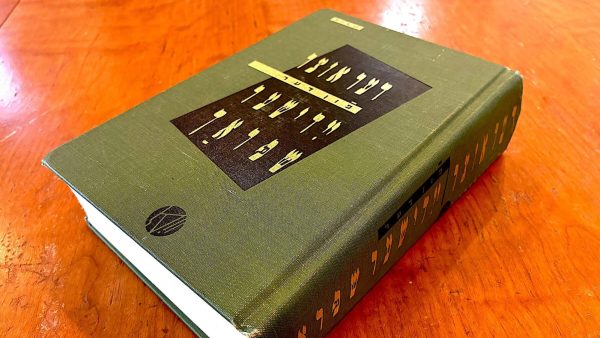
Der Oytser fun der Yidisher Shprakh (The Treasure of the Yiddish language) published by the YIVO Institute in New York and available digitally through the Yiddish Book Center, is a 1,000-page Yiddish thesaurus, modeled on Roget’s Thesaurus of the English Language.
Like Roget’s, a standard source for writers and students of English, Der Oytser is not arranged alphabetically, but according to concepts. If you’re looking for a word related to evil, you look up the concept “evil,” and there you find many words related to it, for example, “untoward, black, sinister, wicked, wrong, vicious, sinful and criminal.”
The book was born of a project by author Nahum Stutchkoff to create a new kind of lexicon for the Yiddish language. He launched the project under the editorial oversight of Max Weinreich, the great Yiddish philologist and then director of YIVO. Yiddish had had many dictionaries over the course of its existence, but never a thesaurus of this kind. The result is a magnificent work of lexicography, 15 years in the making, a storehouse of over 175,000 Yiddish words, phrases, folk sayings, and idioms.
ADVERTISEMENT

The book is out of print but Yiddish students and enthusiasts can download it from the Yiddish Book Center’s digital library. There’s also a free digitized version of the book printed in the English alphabet for people who don’t read Yiddish. Instead of an index, readers use the search box.
In 1950, a mere five years after the Holocaust, the Oytser was finally published. It included a preface by Weinreich, with the following words:
The very fact that, despite the years of the huge catastrophe that befell our people, a great man with vision has appeared to gather the scattered treasures of our language, can surely serve as a symbol of our unbroken collective will to survive. In Nahum Stutchkoff we see a love of mame-loshn, a keen understanding of both broad concepts and the smallest of details, tireless perseverance and pragmatism in carrying out the designated plan for Der Oytser fun der Yidisher Shprakh.
It is without a doubt, the greatest complete achievement of Yiddish lexicography since Jehoshua Mordechai Lifschitz‘s dictionary, compiled during the last third of the nineteenth century.
For the first time we see the full inventory of the Yiddish language, in accordance with the knowledge that the field of Yiddish research has accumulated under the authority of the YIVO Institute.
Weinreich goes on to speak about the problems of standardizing Yiddish, Yiddish dialectology, the Germanisms, Americanisms, Slavicisms in Yiddish and how Stutchkoff addresses these issues.
In his own introduction, Stutchkoff states he had two purposes in mind: (1) to gather as many Yiddish words, phrases and proverbs as he could, and (2) to provide a helpful tool for the Yiddish speaker and writer.
When you use a dictionary, says Stutchkoff, you have a word in mind and want to find or clarify its meaning. The words in a dictionary, therefore, are arranged alphabetically. His thesaurus, on the other hand, like Roget’s, is for a user who has an idea but can’t recall the right word. It is therefore arranged according to ideas. He created 620 categories, such as onheyb, or beginning (category No. 41); glaykhayt, equality (153), and libe, love (500)
Let’s say you’re looking for a Yiddish word related to thieves. You may know the word ganef, thief, but need a different word. So you turn to the index at the back of the Oytser where there are thousands of words arranged alphabetically and find the word ganef, which has the number 483 next to it That means all the words related to ganef are listed under number 483 of the 620 idea categories. You would then turn to the section for number 483 and find no less than seven pages of terms and expressions related to ganef, including, for example, the word marvikher — a dealer in stolen items, as well as the proverb dos ken nor a ganef (Only a thief would think of that). Those seven pages demonstrate the incredible richness of the Yiddish language.
The Oytser also contains the colorful slang of various occupations and groups such as klezmers, thieves, cobblers, actors, tailors and butchers.
Nahum Stutchkoff wasn’t an academic. He was an actor, a playwright, and a popular radio personality before he became a masterful lexicographer.
Stutchkoff was born in 1893 in a town called Brok in Czarist Poland. When he was 7, his family moved to Warsaw, where he was sent to cheder and yeshiva. At the age of 16, he was drawn to the theatre. He began translating and reworking plays for a Yiddish theatrical company from the standard European repertoire, such as, for example, Moliere’s The Miser. Eventually he became an actor too, touring with the company throughout Poland and Russia.
In 1912 he served a stint in the Czarist army. Upon his release in 1917, he again joined a theatrical troupe, eventually becoming director of the Yiddish State Theatre in Vitebsk. In 1923, he emigrated to the United States.
In New York, where he settled, he performed in various Yiddish theatres and authored plays, musical comedies and operettas for the Yiddish theatre. In 1926, he became secretary of The Yiddish Playwrights League of America.
He then took up a radio career. Every Sunday, starting in 1932, on the Forward radio station WEVD (the call letters are the initials of Eugene Victor Debs, the leader of the American Socialist Party), he performed a children’s radio show called The Uncle Nahum Hour, as well as other radio programs.
In 1931, he turned to lexicography, publishing another creative work: a 330-page Yiddish rhyming dictionary.
Stutchkoff died in 1965, but he left us a great legacy: a wealthy storehouse of the Yiddish language that continues to inform and entertain Yiddish enthusiasts everywhere.
This story was originally published on the Forward.