
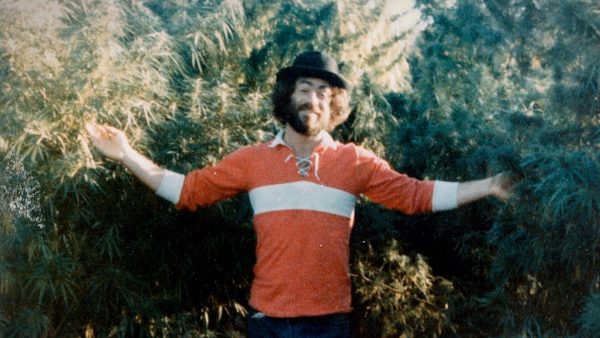
Many Jewish St. Louisans may have never heard of Ron Shapiro. And yet, pieces of his story have been hiding in plain sight for decades, including in the pages of the Jewish Light. Ads for A-1 Tuxedo. Mentions tied to his family’s business. A familiar name that appeared, then quietly slipped away, until a film brought it back into view.
Until learning of a new documentary by filmmaker Jon Brick, I had never heard of Ron “Ronzo” Shapiro. Now, I wish I had. Brick’s film doesn’t claim St. Louis lost something when Ronzo left town. But after learning more about the man known as “Ronzo,” I’m not so sure.
That tension sits at the heart of “Ronzo,” Brick’s documentary. The film screened to a sold-out audience in St. Louis on Jan. 17 at the Gaslight Theater and while it is not yet available for wide distribution, I still wanted to tell the story of a guy I wish I’d known.
Who was “Ronzo”?
Before he became known as “Ronzo,” the cultural force behind Oxford, Mississippi’s legendary Hoka Theater, Ron Shapiro grew up in Jewish St. Louis surrounded by family, music and community. People noticed him early. Not because he tried to stand out, but because he didn’t seem interested in blending in.
“He had a natural optimism and an ease that made him well liked,” said Brick. “You see it later during his time at Washington University in St. Louis.”
Shapiro was fraternity brothers with Harold Ramis during his time at WashU. Over the years, some who knew Shapiro have quietly wondered whether his outsized personality may have helped inspire characters Ramis later created in the film “Animal House.” It’s an Oxford urban legend, less about proof than about the impression Shapiro left on people.
ADVERTISEMENT


Music was part of Shapiro’s life long before Oxford. His father, Melvin Shapiro, owned The Barrel jazz club in the Delmar Loop, where Miles Davis recorded “Miles Davis, Live at the Barrel.” Brick believes that growing up in this environment mattered.
“That love of music, paired with Shapiro’s entrepreneurial spirit, later helped inspire the founding of the Hoka Theater,” he said.
After returning from Vietnam, Shapiro worked at the family business, A-1 Tuxedo. When his father died suddenly, Shapiro stepped into a larger role as the company expanded across the region. The Jewish Light archive captures that period clearly. Shapiro appears by name in ads beginning in 1970, visible and woven into Jewish St. Louis life.

The business succeeded. But according to Brick, success and fulfillment weren’t the same thing for Shapiro.
“Despite its success, he felt confined by the family business and wanted to forge his own path,” Brick said. “That period marked a turning point. He realized that to live the life he wanted, he needed to step outside convention and pursue his own direction.”
In the early 1970s, Shapiro left St. Louis.
Westward, then south
Shapiro headed west to Jackson Hole, Wyo., where he operated four movie theaters. Brick describes that chapter as formative.
“Running those theaters showed him that if he wanted a different kind of life, he was going to have to create it himself,” Brick said.
It was a realization that would follow Shapiro south, shaping not just where he lived next, but how he lived.
From there, Shapiro moved to Oxford, Miss. What began as another relocation became something more enduring when he opened the Hoka Theater, a space that quickly grew into far more than a cinema.
With the Hoka at its cultural center, Oxford changed. Students mingled with longtime locals. Writers, musicians and wanderers passed through. Shapiro wasn’t trying to build a scene. He was simply where things were happening and people followed.
“It’s impossible to name one moment,” Brick said. “Ron helped turn Oxford from a conservative college town into an unlikely cultural mecca. The Hoka became the meeting ground.”

In Oxford, Shapiro didn’t just open a theater. He created a place where people lingered. Brick describes him less as a programmer than a host.
“He wasn’t trying to curate a scene,” Brick said. “He just made space for people and things happened.”
That spirit turned the Hoka into more than a venue. It became a room you wanted to be in, whether you knew what was scheduled or not. A place where conversation mattered as much as performance and where showing up was often the point.
Oxford already had talent. Shapiro gave it gravity.
A kind of person many of us recognize
What the documentary “Ronzo” captures most clearly isn’t a résumé, but a type of person — someone a little out there; someone playful, restless, impossible to ignore. The kind of person who walks into a room and changes its temperature.
Some people like that eventually level out and conform. Ron Shapiro didn’t.
I think Shapiro’s story resonates not because it’s exceptional, but because it’s aspirational. He lived the way many people wish they had the courage to live. Fully himself. Unapologetic. Magnetically so.
Why this story comes home now
Shapiro died in 2019 and his death was noted in the Jewish Light. His influence, however, continues to ripple through Oxford, which now honors him each year with Hoka Days, an annual celebration that ends in a parade. Brick said the film was made to preserve that legacy, not to smooth it over.
“The film offers an intimate look at the challenges, growth and choices that shaped his life,” Brick said. “It shows how Ron inspired artists, sparked dialogue and changed lives.”
For St. Louis, this isn’t about catching up on a life lived elsewhere. It’s about recognizing a force of nature who came from here and celebrating a zest for life that never quite fit into tidy boxes.
The world got to enjoy Ron Shapiro. St. Louis, it turns out, helped make him.